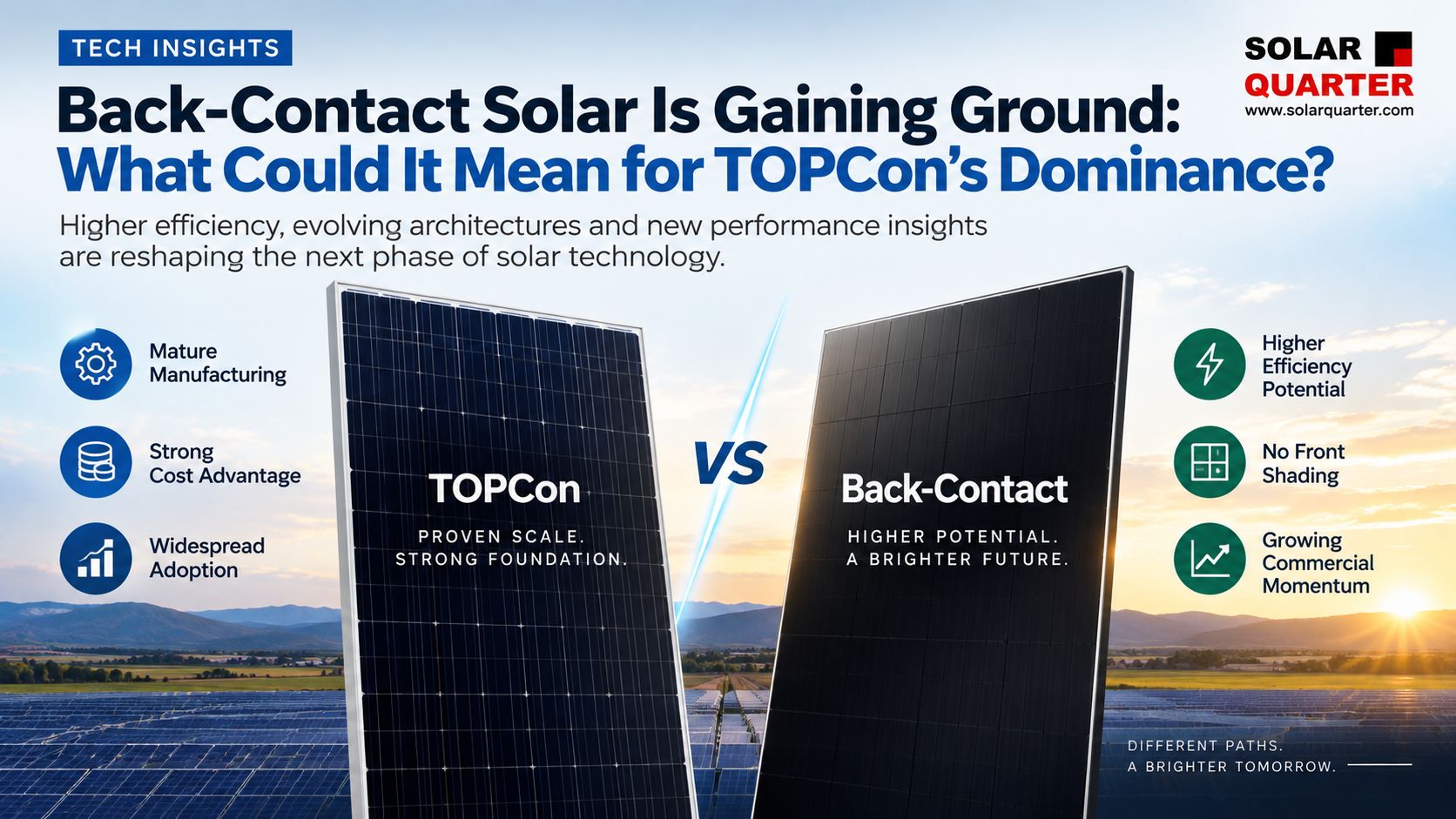
The solar industry’s technology transition has moved quickly from PERC toward n-type architectures, with TOPCon emerging as the dominant route for high-volume manufacturing. But the efficiency race is continuing, and back-contact (BC) technology is increasingly moving from a premium niche toward larger-scale commercialization.
The key question is not simply whether BC will replace TOPCon. Recent developments suggest a more complex possibility: back-contact architecture could increasingly be combined with TOPCon itself, creating another pathway for higher-efficiency crystalline silicon solar cells.
The principle behind BC is straightforward. Conventional solar cells have metal contacts on their front surface, which inevitably shade part of the active area. Back-contact cells move both positive and negative electrical contacts to the rear, leaving the front surface available for light absorption.
The resulting efficiency potential is becoming visible in commercial products. TaiyangNews’ June 2026 module analysis reported that commercially available BC modules had crossed the 25% efficiency threshold, while the highest-efficiency TOPCon module in its ranking had reached 24.1%.
At the cell level, the gap is being pushed further. In April 2026, LONGi announced a 28.13% hybrid interdigitated-back-contact silicon cell, independently confirmed by Germany’s Institute for Solar Energy Research Hamelin (ISFH). The company also reported certification of a 26.4% HIBC module.
These figures matter because incremental efficiency gains can translate into more watts from the same module area. At project level, higher power density can potentially reduce the area and balance-of-system infrastructure required for a given capacity.
BC’s progress should not be interpreted as evidence that TOPCon has reached the end of its development.
TOPCon combines excellent surface passivation with carrier-selective contacts and has already established a large manufacturing base. Research continues to push its efficiency higher. An Australian Renewable Energy Agency-supported program involving the Australian National University and JinkoSolar, for example, targets at least 26.5% prototype TOPCon cell efficiency and 26% average efficiency in pilot production.
That existing industrial scale remains a major advantage. A new architecture must compete not only on laboratory efficiency but also on manufacturing yield, equipment requirements, cost, reliability and ultimately energy economics.
Perhaps the strongest indication of where silicon technology is heading is that TOPCon and BC do not have to be competing pathways.
In August 2026, ARENA-backed research involving ANU, UNSW, the University of Melbourne, PV Lab Australia and JinkoSolar began work on TOPCon back-contact cells targeting efficiencies above 28%. The project will investigate cell fabrication, passivation, photon management, lower-cost metallisation, durability and readiness for pilot manufacturing.
This convergence could be important. Instead of abandoning the passivated-contact technologies developed for TOPCon, manufacturers may be able to combine them with a back-contact architecture to pursue another step in efficiency.
The BC discussion is also expanding beyond conversion efficiency.
A peer-reviewed 2026 study published in Solar Energy compared BC and TOPCon modules under partial shading. Under the study’s single-cell full-shading condition, the BC module experienced 12.9% power loss compared with 33.9% for the TOPCon module. Under more severe shading, however, their performance converged, highlighting why application conditions matter when evaluating technology claims.
Reliability remains equally important. Another ARENA-supported program is developing TOPCon-back-contact modules alongside outdoor testing and AI-based tools for degradation forecasting and long-term performance assessment.
For now, TOPCon retains the advantages of manufacturing maturity and established scale, while BC is increasingly demonstrating higher efficiency potential.
The emerging technology story, however, may be less about BC versus TOPCon and more about BC plus TOPCon.
If manufacturers can combine back-contact architecture with mature passivated-contact processes while controlling manufacturing complexity and cost, the next phase of crystalline silicon PV could be defined by convergence. In that scenario, TOPCon’s evolution may not end with BC gaining ground—it could continue through back-contact technology itself.
Subscribe to get the latest posts sent to your email.