Sourcing in the semiconductor industry is complex, involving specialty suppliers that can provide complex or rare gases, chemicals, and equipment.
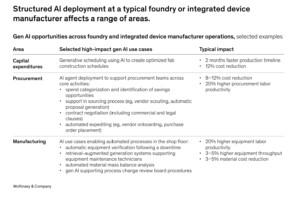
New McKinsey & Company research points to how sourcing agents are streamlining this process by using AI to scout and discover suppliers, automatically generating request proposals, and optimising award allocation for suppliers of critical chemicals and specialty gases.
“Owners and operators can save up to 50% of the time they’d typically spend on these activities by using sourcing agents, making sourcing one of the biggest areas of opportunity for AI applications to pay off,” it notes, in a new paper entitled Revolutionising semiconductor fab operations with AI.
AI agents are also actively being developed for contracts and purchasing too. Across the board, AI could generate a staggering $134bn in savings for the semiconductor industry, McKinsey found.
Contract negotiation agents can help automate the drafting, review, and comparison of contracts, which not only reduces errors and ensures compliance but also can save up to 30% of the time these associated procurement activities typically take, the research adds.
“With AI-enabled solutions, semiconductor companies can run hundreds of models at once within a category to determine which individual products or suppliers drive the highest costs,” it states.
“Moreover, aggregated category-wide insights show savings for high-value representative components as well as high-volume, low-value purchases from suppliers, enabling cost savings between 5% and 9%.”

©McKinsey & Co.
Purchase agents can help place orders, track inventory levels, and manage supplier relationships.
These tools can automate purchase order handling, supplier qualification and onboarding, exception management, and vendor statement reconciliation, allowing semiconductor owners and operators to save up to 15% and improve purchasing efficiency by about 30%.
Beyond the $60bn savings potential AI has on improving operations, capital deployment, and procurement, a further $74bn could be gained by using AI to enhance productivity and efficiency across research and development, material discovery, chip design, and sales and pricing, McKinsey concludes.
“By combining disciplined strategy-setting, careful use-case selection, robust pilots, and strong governance, semiconductor companies can move beyond experiments and realise sustainable benefits from AI,” it states.