According to EDF, the completion of the five month-long tunnelling project under the Bristol Channel means that, in total, more than eight kilometres of marine tunnels have been dug as part of the new nuclear power plant project.
The boring machine has now been picked up by a floating crane, and is being taken away for cleaning before being used on another site.
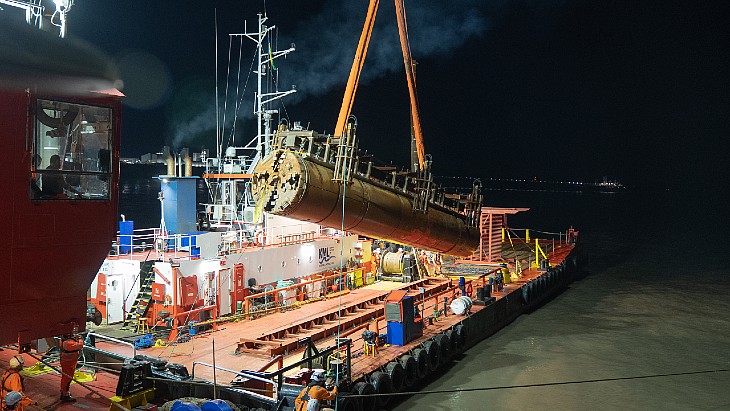
(Image: EDF)
Fish protection
Power stations on the coast use seawater in their cooling water systems and Hinkley Point C, in southwest England, is using “specially designed intake heads to slow the speed of water entering the cooling tunnels, allowing fish to escape from as close 2 metres in the 20-kilometre-wide channel”. The intake tunnels are each 3.4 kilometres long with a diameter of six metres. There is also one outfall tunnel, 1.8 kilometres long with an internal diameter of seven metres.
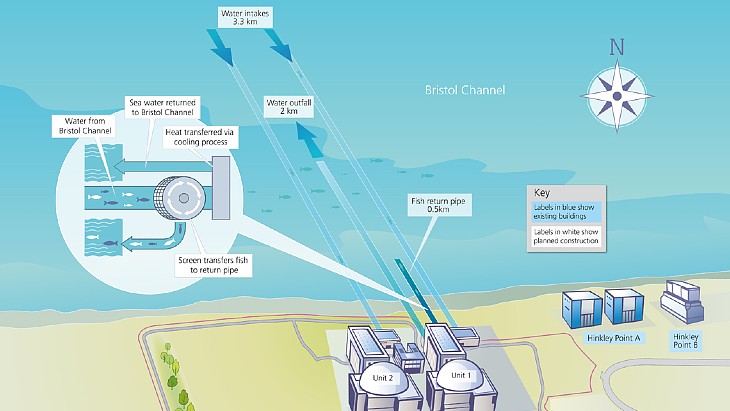
An EDF graphic showing how the fish return system will work (Image: EDF)
In addition, there is also an innovative ‘fish disco’ system of underwater acoustics being planned to keep fish away from the water intake areas. Finally, there is the fish return system to transfer fish that do enter the system back to the sea. Taken together, EDF says that the GBP700 million (USD955 million) fish protection systems mean the new plant will have more fish protection measures than any other power plant in the world.
Background
Construction of Hinkley Point C – composed of two EPR pressurised water reactors of 1,630 MWe each – began in December 2018, with unit 1 of the plant originally scheduled to start up by the end of 2025, before that was revised to 2027 in May 2022. In 2024, EDF announced that the “base case” was now for unit 1 being operational in 2030, with the cost revised from GBP26 billion to between GBP31-34 billion, in 2015 prices.
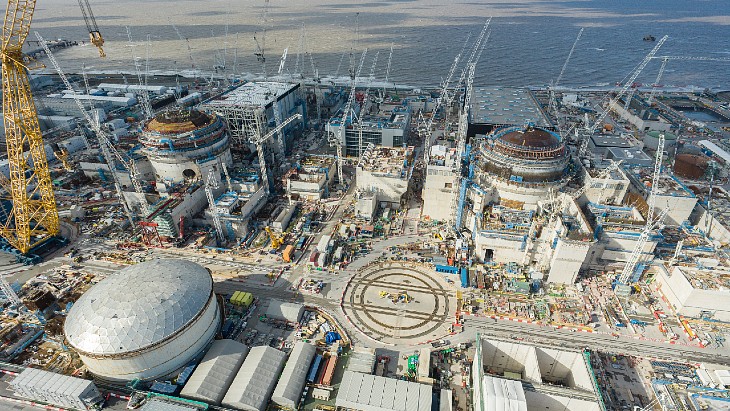
An aerial view of the construction site (Image: EDF)
When complete, the two EPR reactors will meet around 10% of the UK’s current electricity demand, and are expected to operate for as long as 80 years.