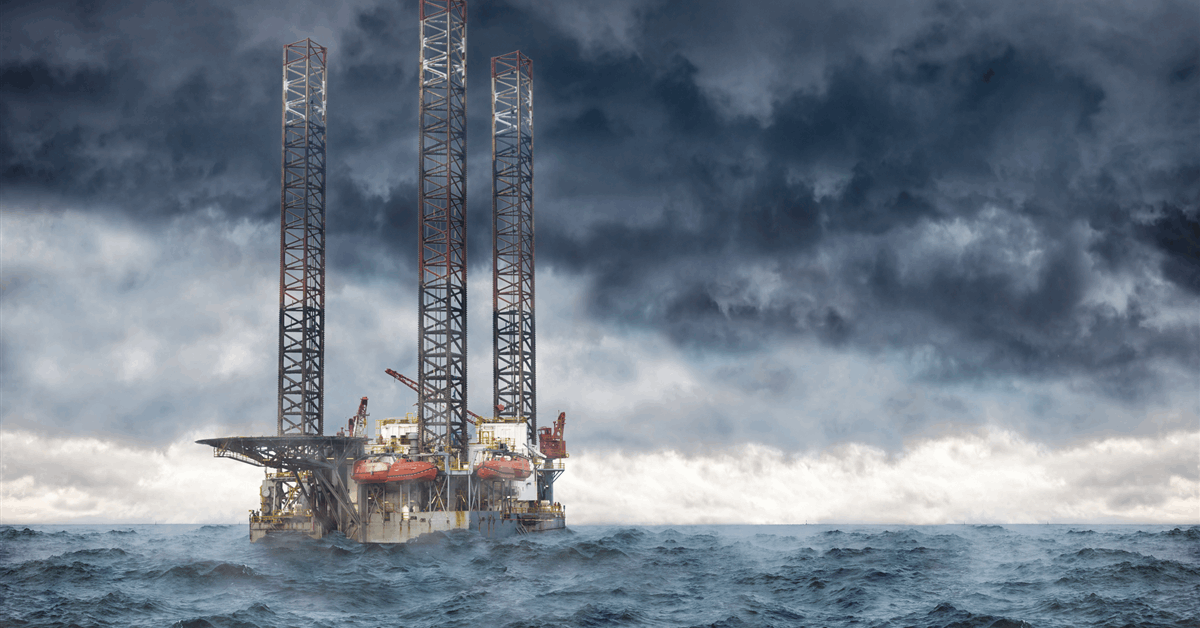
In a statement sent to Rigzone late Thursday, the Marine Minerals Administration (MMA) revealed that personnel had been evacuated from a total of 121 production platforms in the Gulf, based on data from offshore operator reports submitted as of 11am CDT yesterday.
That represents 32.61 percent of the 371 manned platforms in the Gulf of America, the MMA highlighted, noting that production platforms are the offshore structures from which oil and natural gas are produced and transported to shore. The MMA pointed out in the statement that, unlike drilling rigs, which typically move from location to location, production facilities remain in the same location throughout a project’s duration.
The statement also revealed that personnel had been evacuated from five non-dynamically positioned rigs, which it noted was equivalent to 45.45 percent of the 11 rigs of this type currently operating in the Gulf. Rigs can include several types of offshore drilling facilities including jack up rigs, platform rigs, all submersibles, and moored semisubmersibles, the statement highlighted.
Four of the 17 dynamically positioned rigs in the Gulf have moved off location out of the storm’s path as a precaution, according to the MMA, which noted that dynamically positioned rigs maintain their location while conducting well operations by using thrusters and propellers. These rigs are not moored to the seafloor, so they can move out of harm’s way in a relatively short time frame, the MMA stated, adding that personnel remain on board and return to the original location once the storm has passed.
Production Shut In
In its statement, the MMA outlined that, from operator reports, it estimates that approximately 62.89 percent of the current daily oil production and 57.35 percent of the current daily natural gas production in the Gulf of America has been shut in.
The production percentages are calculated using information submitted by offshore operators in daily reports, the MMA noted. Shut-in production information included in these reports is based on the amount of oil and gas the operator expected to produce that day, the MMA said, adding that the shut-in production figures are estimates that the MMA compares to historical production reports to ensure the estimates follow a logical pattern.
“The Marine Minerals Administration is monitoring offshore oil and gas operators in the Gulf of America as they evacuate platforms and rigs in response to the storm,” the MMA said in the statement.
“The Marine Minerals Administration team will work with offshore operators and other state and federal agencies until operations return to normal, and the storm is no longer a threat to Gulf of America oil and gas activities,” it added.
“As part of the evacuation process, personnel activate the applicable shut-in procedure, which can frequently be accomplished from a remote location,” it continued.
“This involves closing safety valves located below the surface of the ocean floor to prevent the release of oil or gas, effectively shutting in production from wells in the Gulf and protecting the marine and coastal environments,” it noted.
“Shutting in oil and gas production is a standard procedure conducted by industry for safety and environmental reasons,” it went on to state.
The MMA highlighted that, after the storm has passed, facilities will be inspected.
“Once all standard checks have been completed, production from undamaged facilities will be brought back online immediately,” it said, warning that “facilities sustaining damage may take longer to bring back online”.
The MMA’s statement highlighted that, as of July 10, the Department of the Interior reunified the Bureau of Ocean Energy Management (BOEM) and the Bureau of Safety and Environmental Enforcement (BSEE) into the MMA. The MMA “will oversee the responsible development of the nation’s offshore energy and marine mineral resources with an integrated focus on safety, environmental protection, and efficient oversight”, the statement noted.
ESA Sees Less Production Going Offline
At the time of writing, Earth Science Associates’ (ESA) GOMsmart platform projected mean production losses of 6.67 million barrels of oil and 8.04 billion cubic feet of gas as a result of Isaias.
ESA’s latest projections are lower than those the company made on Thursday, when it expected mean production losses of 9.55 million barrels of oil and 10.03 billion cubic feet of gas as a result of Isaias, and Wednesday, when it projected mean production losses of 11.17 million barrels of oil and 13.25 billion cubic feet of gas in the wake of the hurricane.
The company projected mean production losses of 7.12 million barrels of oil and 9.85 billion cubic feet of gas as a result of Storm Bertha, mean output losses of 10,001 barrels of oil and 80.00 million cubic feet of gas as a result of Edouard, and mean production losses of 10,000 barrels of oil and 60.00 million cubic feet of gas as a result of Arthur.
ESA’s website highlights that its GOMsmart platform forecasts production lost based on the path, strength, and speed of a storm impacting platforms in the Gulf. Back in July, an ESA spokesperson told Rigzone that ESA is a “leading provider of data and analytic tools to the companies that produce oil and gas in the Gulf”, adding that its clients are responsible for over 85 percent of the basin’s hydrocarbons.
Shell, Chevron, BP
In a statement posted on its website on October 8, Shell said it was continuing to monitor Hurricane Isaias for potential impacts to its assets and operations in the Gulf of America.
“Evacuations are complete for Appomattox, Mars, Ursa Olympus and Vito. Production is shut-in at Mars, Ursa, Olympus and Vito,” the company revealed in the statement.
“In addition, we previously removed non-essential personnel from our Stones asset. As always, Shell’s top priority is the safety of our people, the environment, and our assets,” it added.
Chevron announced in a statement posted on its website yesterday that, in preparation for Hurricane Isaias, the company had shut-in production at five of its Chevron-operated Gulf of America facilities.
“While the majority of our offshore personnel have been transported onshore, production continues at our other four Gulf of America platforms,” the company said in the statement.
“At our onshore facilities, we continue to follow our established storm preparedness procedures and are closely monitoring the projected path of the hurricane,” it added.
“Chevron will continue to closely monitor the system and remains focused on the safety of our workforce, the integrity of our facilities and the protection of the environment,” Chevron continued.
In a statement posted on its website on Thursday, BP said it was closely monitoring Hurricane Isaias to protect its people and operations in the deepwater Gulf of America.
“BP removed all personnel from our Na Kika and Thunder Horse platforms and shut in production at both,” the company said.
“Out of an abundance of caution, we also removed non-essential personnel from our Argos, Atlantis, and Mad Dog platforms,” it added.
“Our top priority is the safety of our people and operations in the Gulf of America,” it went on to state.
Hurricane Isaias
The National Oceanic and Atmospheric Association’s (NOAA) National Hurricane Center (NHC) website showed that, as of 4am CDT on October 9, Isaias had maximum sustained winds of 110 miles per hour, a minimal central pressure of 963 mb, and a 15 mile per hour north-north easterly movement.
As of 4am CDT on October 8, Isaias had maximum sustained winds of 80 miles per hour, a minimal central pressure of 979 mb, and a nine mile per hour east-north easterly movement, the site showed. As of 4am CDT on October 7, Isaias had maximum sustained winds of 40 miles per hour, a minimal central pressure of 1004 mb, and an eight mile per hour east-north easterly movement, the site highlighted.
“A life-threatening storm surge is expected from the Mouth of the Mississippi River to Suwannee, Florida,” a ‘key message’ for Hurricane Isaias, as of 4am CDT on October 9, posted on the NHC site stated.
“Residents in the warning area should follow advice given by local officials and evacuate immediately if told to do so,” the statement added.
“Damaging hurricane force-winds are expected over portions of the Florida Panhandle, southern Alabama, and southern Mississippi where a Hurricane Warning is in effect. Residents in these areas should prepare for the possibility of long-duration power outages,” it continued.
“Damaging wind gusts are possible over much of central and northern Alabama, extreme eastern Mississippi, and portions of western and northern Georgia, especially in areas of higher terrain,” it noted.
“Additional Tropical Storm and High Wind Watches and Warnings may be required for portions of that area later today. Residents should secure loose outdoor items, avoid driving high-profile vehicles, and prepare for power outages,” it went on to state.
“Isaias will bring areas of heavy rainfall to the central U.S. Gulf coast and much of the Southeast through the weekend. Considerable flash and urban flooding, along with significant river flooding, will be possible,” it warned.
Atlantic Hurricane Forecast
In a statement posted on its site recently, NOAA announced that it was maintaining its prediction for a “below-normal” Atlantic hurricane season.
“With the climatological peak of hurricane season approaching in early September, NOAA’s prediction for below-normal activity in the Atlantic basin remains,” NOAA said in that statement.
NOAA revealed in the statement that its forecasters were predicting a 75 percent chance for “below-normal” activity, a 20 percent chance of a “near-normal” season, and a five percent chance of “above-normal” activity. It highlighted that this updated prediction was similar to its initial outlook issued in May.
In that outlook, NOAA predicted a 55 percent chance of a below-normal season, a 35 percent chance of a near-normal season, and a 10 percent chance of an above normal season.
NOAA highlighted in its latest Atlantic hurricane projection that forecasters from its National Weather Service had updated the number of expected named storms to 7-13. Of these, two to six could become hurricanes, including zero to two major hurricanes, that statement noted.
Gulf Oil, Gas Production
According to the U.S. Energy Information Administration’s (EIA) October short term energy outlook (STEO), in 2025, total crude oil output in the federal Gulf of America averaged 1.94 million barrels per day and total marketed natural gas production in the federal Gulf of America averaged 1.9 billion cubic feet per day.
The EIA’s latest STEO projected that, in 2026, total crude oil output in the federal Gulf of America will average 2.03 million barrels per day and total marketed natural gas production in the federal Gulf of America will come in at 2.0 billion cubic feet per day.
Atlantic weather systems have severely affected oil and gas operations in the Gulf in the past. For example, at its peak, on August 29, 2021, and 94.47 percent of gas production on August 31, 2021, U.S. Bureau of Safety and Environmental Enforcement (BSEE) figures revealed.
To contact the author, email