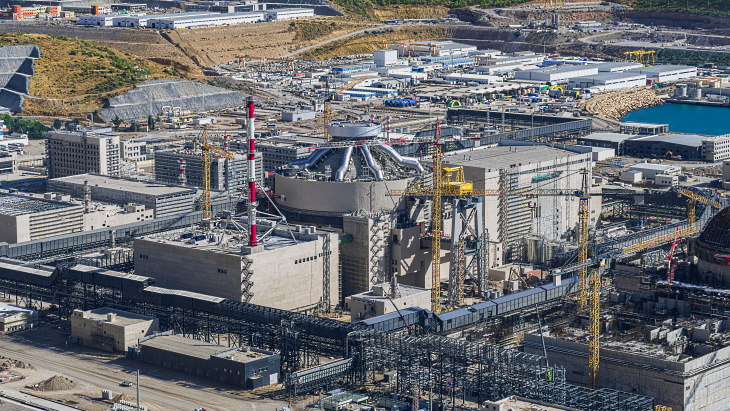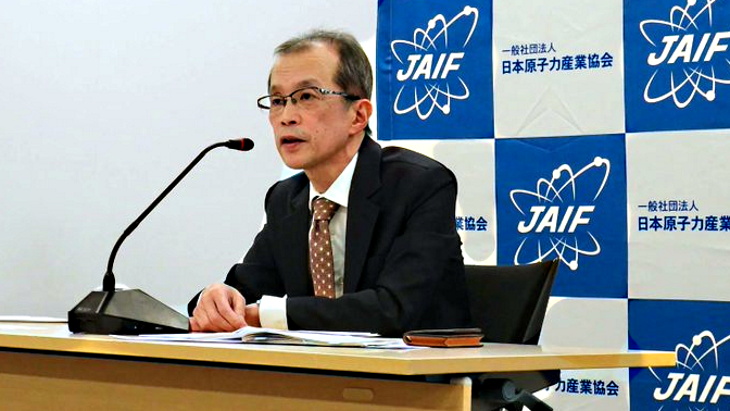
JAIF president and CEO Hideki Masui presented the trade organisation’s report at a press conference on 2 October, outlining the various benefits of a single nuclear power plant from the perspective of the 3Es (energy security, economic efficiency and environmental sustainability).
For its economic impact analysis, JAIF used data from the government’s 2025 Working Group on Verification of Power Generation Costs and Japan’s 2020 Input-Output Tables compiled by the Ministry of Internal Affairs and Communications. The estimate covers direct and primary ripple effects.
JAIF estimates that replacing a single nuclear power plant would generate a total economic impact of approximately JPY4.3 trillion across the Japanese economy over the plant’s entire lifecycle. During construction, the project would also induce employment of about 14,000 people per year.
From an energy security perspective, JAIF highlighted a domestic procurement rate of more than 90% for nuclear plant equipment and a fuel stockpiling effect equivalent to 2.9 years, referring to the period for which electricity generation could be maintained using nuclear fuel already held in Japan. From an environmental perspective, it noted that nuclear power produces no emissions of carbon dioxide during electricity generation.
“The advantages of nuclear power are not simply its economic ripple effects,” Masui said. “In addition to providing a stable energy supply and strong environmental performance, nuclear power also generates significant economic benefits.”
When asked about estimating the economic impact of newly-built reactors, Masui said JAIF could potentially conduct a new assessment if the government’s Working Group on Verification of Power Generation Costs evaluates advanced light-water reactors in the future. He noted, however, that such reactors have yet to be built in Japan, making it difficult to verify an estimate at present.
Replacement reactors
JAIF’s analysis follows the presentation in June by Japan’s Ministry of Economy, Trade and Industry of a draft target of replacing up to five of the country’s nuclear power reactors that are due to be decommissioned by the 2040s and 11-14 reactors by the 2050s.
Kansai Electric Power Company said in July last year that it plans to conduct surveys of the Mihama nuclear power plant site in Fukui Prefecture to determine if a new reactor could be build there as a replacement for unit 1, which was declared permanently shut down in 2015. According to a Reuters report, Kansai was considering deploying the SRZ-1200 advanced light water reactor being developed by Mitsubishi Heavy Industries. Launched in September 2022, the 1,200 MWe reactor is designed to meet the country’s enhanced regulatory safety standards.
Prior to the March 2011 accident at the Fukushima Daiichi plant, Japan’s 54 reactors provided about 30% of the country’s electricity. However, within 14 months of the accident, the country’s nuclear generation had been brought to a standstill pending regulatory change. Of the 33 units that remain operable, 15 have so far been restarted.
In February 2023, Japan’s Cabinet approved a policy to allow new nuclear power reactors to be constructed and the operation of existing reactors to be extended from 40 to 60 years.
The government’s 7th Basic Energy Plan, adopted in February 2025, calls for nuclear electricity generation to increase from 8.5% in fiscal 2023 to about 20% in fiscal 2040. Renewable energy’s share of total electricity production, meanwhile, is expected to increase from 22.9% to 40%-50%, with fossil fuels’ share dropping from almost 69% to 30%-40%.