Westinghouse Electric Company says it aims to begin operations in 2030.
LEU+ fuel has a higher level of uranium enrichment than the low-enriched uranium (LEU) fuel currently used in most commercial nuclear plants. Last year saw its first deployment in a commercial US reactor, when lead assemblies containing EnCore ATF Lead Test Assemblies with greater-than-5% LEU+ ADOPT fuel, manufactured at the Columbia Fuel Fabrication Facility, were loaded into Unit 2 of the Vogtle nuclear power plant.
This sort of fuel is expected to unlock advanced operating plant uprates that would provide near-term expansion of nuclear power output nationwide to meet the growing demand for baseload nuclear power, Westinghouse said. It aligns with the UPRISE (Utility Power Reactor Incremental Scaling Effort) programme launched earlier this year by the US Department of Energy, which is targeting a 5 GW increase in US nuclear capacity from the existing nuclear fleet by 2029. LEU+ fuel also offers the flexibility to extend operating cycles, helping to lower operating costs and deliver greater value to customers.

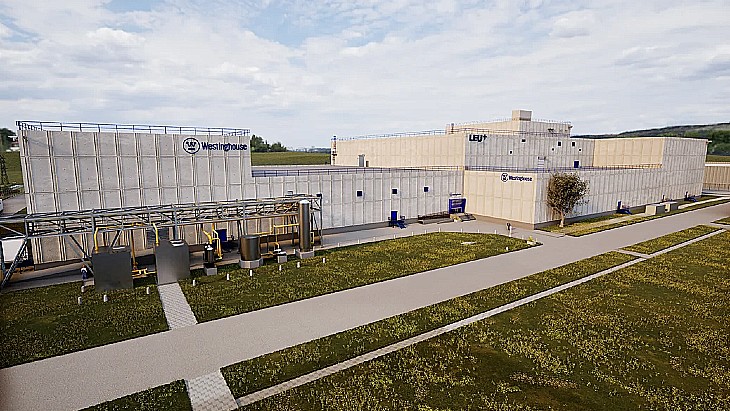
A rendering of the new facility (Image: Westinghouse)
The existing Columbia Fuel Fabrication Facility, built in 1968, is one of the largest nuclear fuel plants in the world, producing fuel pellets, fuel rods, fuel assemblies and fuel components for a global base of customers, but its plant configuration and current process technology are not suitable for producing LEU+ fuel. The new facility is purpose-designed to produce nuclear fuel with a higher enrichment level using more advanced technology, and will be housed in a new building adjacent to the existing plant. It will feature modern standards with higher levels of automation and advanced technologies, worker ergonomics and production quality, while maintaining high levels of safety, Westinghouse explained. It will use an innovative “dry” process, similar to the one currently used at the company’s facility in the UK.
“Westinghouse has been a leader in the nuclear industry for 90 years and continues innovating the next frontier in nuclear technology,” said Westinghouse President and CEO Dan Sumner. “As we advance the next generation of fuel, we are positioned to create more value for our customers and unlock new nuclear generation to support the growing demand for baseload power. The Columbia LEU+ Fuel factory is our largest single manufacturing investment to support the operating fleet and marks a transformative milestone for our company and the industry.”
Sumner also expressed gratitude to the Department of Energy’s tax credit programme, and to the governments of the state and Richland County for their support.
The Columbia Fuel Fabrication Facility already employs more than 1,200 people, and the USD1 billion investment is projected to contribute USD4.9 billion in positive economic impact across South Carolina over the next 10 years, including some USD3.8 billion in Richland County through construction, new equipment and the creation of additional jobs, workforce development and career growth opportunities, according to an economic impact study commissioned by Westinghouse in partnership with researchers at the University of South Carolina’s Darla Moore School of Business. At its peak, the new project is expected to host several hundred contractors in addition to an in-house team of 30-50 people, creating potential benefits for local businesses.
Background
Uranium-235 is the fissile isotope of uranium that is useful for energy production in a nuclear reactor – but this isotope only makes up about 0.7% of natural uranium. So for use in nuclear fuel, uranium can be “enriched” to increase the ratio of fissile uranium-235 to non-fissile uranium-238.
Most commercial reactors currently in operation use LEU fuel that is typically enriched to 3-5% uranium-235.