Somewhere in the nuclear industry today is the engineer who will bring a country’s first reactor online, the regulator who will license it, and the financier who will make it bankable. Most of them don’t know it yet.
Thirty-nine countries have now backed the Declaration to Triple Nuclear Energy, and the IAEA estimates that four million nuclear professionals will be needed by 2050. That growth won’t come from one place or follow one model. Some countries are running fleets into their sixth decade, some are building again after a long gap, and others are setting up a regulator for the first time. A single project can now combine a vendor from one country, finance from another and a supply chain spread across several more. Reactors approved in the next decade could still be running at the end of this century, and many of the people who will decide how they are built, financed, regulated and run are mid-career today. What they learn now will shape the energy system their grandchildren grow up with.
Most workforce planning, quite reasonably, starts with numbers. But programmes are rarely delayed because they are one welder short. They are delayed when decisions are made late or badly, when government, regulator, operator and suppliers stop pulling in the same direction, or when a project loses its grip on schedule and cost. Those are leadership problems, and in an industry this international, the people solving them need to understand systems and markets well beyond their own.
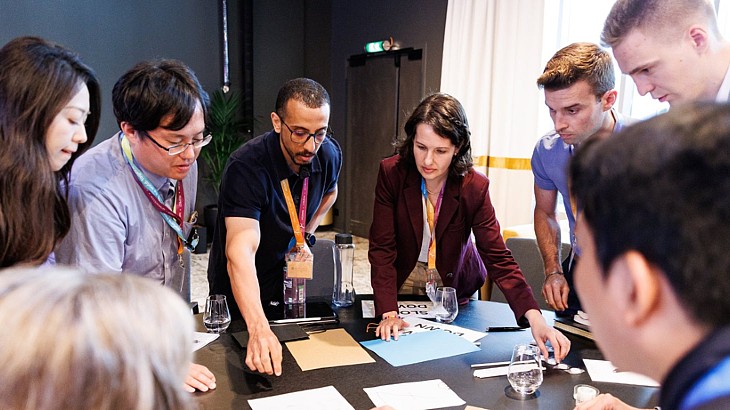
Summer Institute Fellows work on real industry projects (Image: World Nuclear University)
What the leadership challenge looks like
The challenge runs across the whole industry – not just plant operations or new-build, but the supply chain and the long-term operation of existing fleets.
Countries starting a nuclear power programme are building institutions, not just plants. The IAEA’s Milestones approach expects them to establish a government body to coordinate the programme, an independent regulator and an owner-operator – each needing senior leaders who understand the others’ roles well enough to work together without compromising the regulator’s independence.
Safety depends on leadership everywhere. IAEA safety requirements place responsibility for safety culture with senior management, who set what gets reported, what gets questioned, and what gets prioritised when time and money are tight.
New-build and long-term operation both test leaders. Recent megaprojects have shown that project management and decision-making matter as much to schedule and cost as the reactor technology itself. Keeping existing reactors running for 60 years or more demands its own leadership: major refurbishment and licence renewal programmes, ageing equipment and obsolete components, and skills that must be kept in place across decades.
The supply chain needs leaders too. Many suppliers left nuclear during the long lull in construction, and those that remain must scale up, maintain nuclear-grade quality and meet different regulatory requirements in each market they serve.
The experienced generation is leaving. A quarter of the nuclear workforce is over 55, according to the 2022 Global Energy Talent Index, and many of the people who led the last major wave of construction have retired or are close to it, and their knowledge has to reach a new generation of leaders while they are still around to pass it on.
On top of all this, leaders have to manage public and political support and new technologies such as AI and small modular reactors – often all at once.
What globally connected leaders need
Leading in that environment takes three things that are hard to build from inside one single organisation or one country: an international network of peers and expertise to call on, the systems thinking to see how policy, regulation, finance, construction and operations depend on one another, and the ability to work across markets and institutions that do things differently.
The World Nuclear University (WNU) Summer Institute is designed around those needs. This leadership development programme brings together a global cohort of high-potential mid-career professionals, at the point where people move from being expert in one area to leading across several, from every part of the industry: operators, regulators, vendors, research organisations and government. Over five weeks they hear from senior figures across the sector, work in mentored international teams on real industry projects, and visit nuclear facilities in the programme’s host country. At least half the programme is applied group work, and in 2027 the mentors include a former IAEA Deputy Director General and a former President of the Canadian Nuclear Safety Commission. The aim is not to turn a regulator into an engineer or an engineer into a financier, but to give each a holistic understanding of the whole system and practice in leading people who think differently from them.
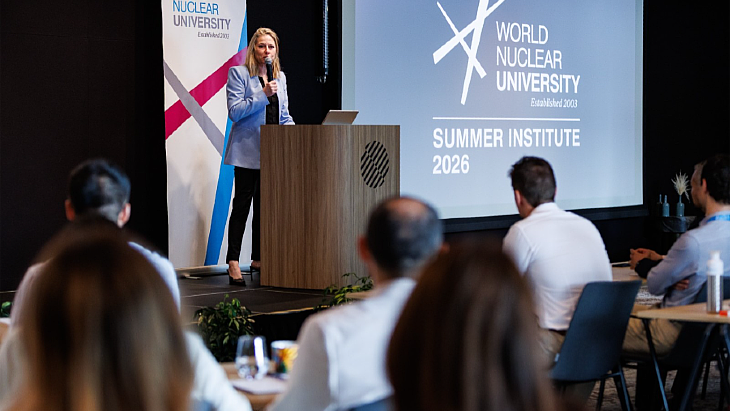
Sama Bilbao y León, World Nuclear Association Director General, at the 2026 Summer Institute (Image: WNU)
For the organisations that send them, the return is a colleague who comes back with a wider view of the industry, a network to draw on, and experience of leading across disciplines and cultures. They bring back first-hand knowledge of how other countries regulate, finance and deliver projects, and contacts across the sector to call on when problems arise. Putting someone forward also signals to high-potential staff that the organisation is investing in their future.
For Fellows themselves, the programme is a rare chance to step back from day-to-day work, learn from senior leaders and mentors, and test their leadership in an international team – while building a network of peers who will be leading the industry worldwide in the years ahead. As Emanuele Campelo, a 2025 Fellow now working as a Nuclear Safeguards Inspector at the IAEA, puts it, the Summer Institute “broadened my perspective through the experience of collaborating with and leading people from diverse cultural backgrounds”.
Why place still matters
Some of this can be taught in a lecture hall. Much of it is learned by being somewhere unfamiliar, seeing how another country’s institutions actually work, and comparing it with home. That is why the Summer Institute has always moved around the world, and why it is never just the Fellows who travel: our speakers and mentors come too.
In 2027 the programme runs in Cape Town from 30 May to 3 July, its first time in Africa, and the setting is a particularly rich one. South Africa’s Koeberg 1 and 2, just up the coast from the city, have operated since 1984 and 1985 and have received a licence extension allowing operation into the mid-2040s. The country’s 2025 Integrated Resource Plan calls for 5200 MWe of new nuclear capacity by 2039. So Fellows will see a sector managing a mature fleet while working out how to restart new build – a challenge many established nuclear countries also face.
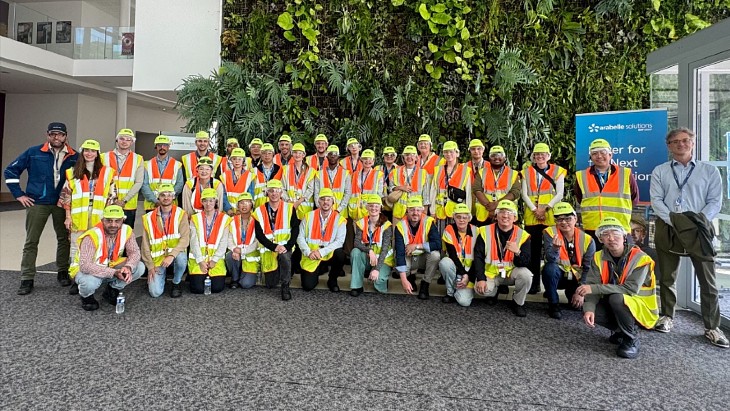
Arabelle Solutions Technical Tour during the 2026 Summer Institute (Image: WNU)
The learning runs in every direction. Fellows from established programmes gain as much from these different contexts as anyone else, and moving the programme around also brings it within reach of professionals for whom distance, visas and travel costs would otherwise rule it out.
Leadership that stays connected
Our host in South Africa is Loyiso Tyabashe, Group CEO of the South African Nuclear Energy Corporation – Necsa – and a 2009 Summer Institute Fellow, who championed bringing the programme to Africa. That is a common pattern: Fellows go home, take on bigger roles, and many later return as hosts, speakers and mentors for new cohorts.
More than 1,700 Fellows from over 90 countries have now been through the programme, and many stay in touch long after the five weeks end, with specific activities both online and in person for our Alumni community. For a leader in a newcomer country, that means a direct line to peers who have already worked through the same regulatory, construction or operational questions elsewhere. Marily Jaska, a 2023 Fellow who now heads Radiation and Nuclear Safety at Estonia’s Ministry of Climate, says the knowledge and network she gained “are still useful in my daily work, especially as Estonia is developing its nuclear energy programme”. For the industry, it means lessons travel faster than they otherwise would.
The Summer Institute is one part of a wider effort. World Nuclear Association’s Workforce and Talent Development Working Group brings together experts from member companies to identify strategies and best practices for attracting, developing and retaining people and leadership across the sector – from closing skills gaps to strengthening the leadership pipeline that programmes like the Summer Institute feed.
Putting someone forward
Applications for the 2027 Summer Institute close on 27 November 2026. For anyone who leads a team or an organisation, the useful question is who among your people is at the point of moving from specialist to leader. The programme is designed for high-potential mid-career professionals from any part of the nuclear energy industry; past cohorts have included engineers, regulators, researchers, lawyers and finance specialists. Organisations in developing countries can put candidates forward for IAEA sponsorship through its technical cooperation programme. Full details, including eligibility and the application process, are on the . Questions about putting someone forward can go to the WNU team at wnu@world-nuclear.org.
The reactors of the tripling will be built and run by people who are mid-career today. The question for every organisation is whether they will be ready to lead.