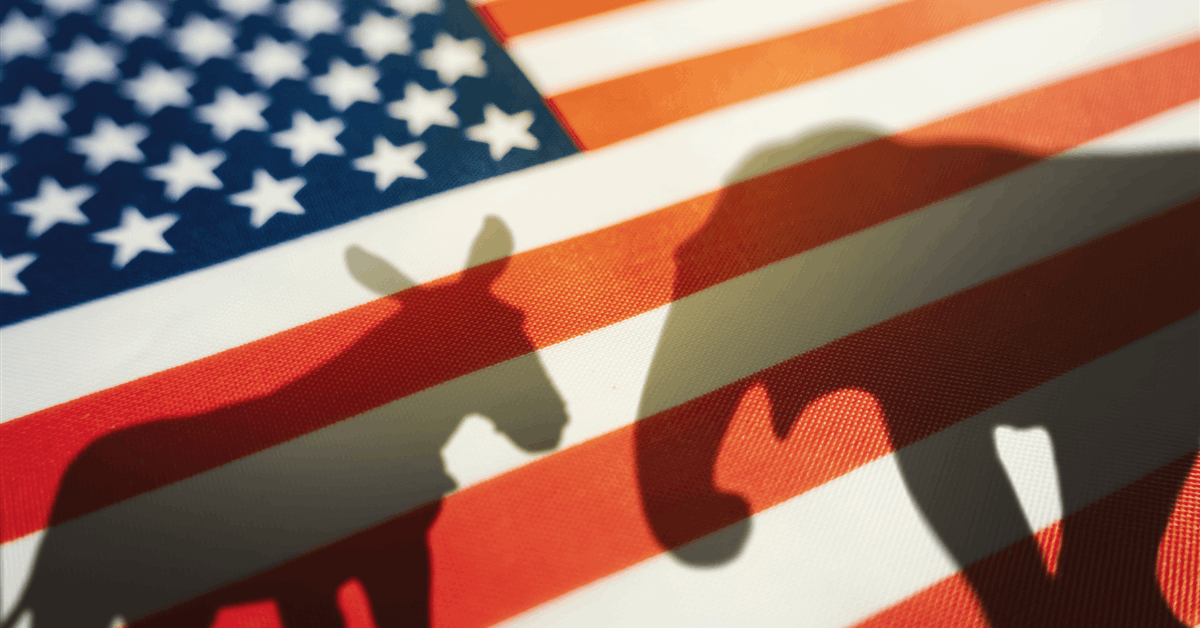
There’s a 66 percent chance that Democrats “sweep” the midterms, according to Polymarket’s website.
The site shows that Democrats have a 91 percent chance of controlling the House of Representatives and a 66 percent chance of controlling the Senate, in addition to a 78 percent chance of holding the most governorships.
With the above in mind, what would a blue sweep in the upcoming midterm election mean for the U.S. oil and gas market?
Well, according to Kristian Coates Ulrichsen, a fellow for the Middle East at Rice University’s Baker Institute for Public Policy, and co-director of the Middle East Energy Roundtable, a Democrat sweep of both houses of Congress, “should it happen”, may have “mixed consequences for oil and gas prices”.
“In the longer-term, the prospect of greater constraint on the Trump administration, particularly in relation to the Iran War, could establish greater predictability in U.S. decision-making which could help bring prices down,” Ulrichsen told Rigzone.
He added, however, that in the short-term, “there may be an elevated risk of renewed conflict in the two-month period between November 3 and January 3 if the White House perceives that it has one final chance to act without constraint before the new Congress begins”.
Ole Hansen, Head of Commodity Strategy at Saxo Bank, told Rigzone that he would not interpret a Democratic sweep as an automatically bearish development for U.S. oil and gas production or bullish for prices.
“The immediate focus will undoubtedly be on the war in Iran and the supply disruption and high prices it has caused,” Hansen said.
“Therefore, the global oil market may respond if a Democratic Congress increases pressure for a diplomatic resolution of the Iran conflict,” he added.
“The resulting reduction in geopolitical risk could have a much larger impact on crude and refined-product prices than any changes to U.S. drilling policy,” he continued.
Standard Chartered Bank Energy Research Head Emily Ashford told Rigzone that, while a Democratic sweep of the House and Senate “might materially change the political environment for the Trump administration”, it “would not automatically reverse any of its oil and gas policies or translate to an immediate change in production volumes”.
“For the U.S. oil and gas market, and in particular producers, the immediate implications may be less about changes to drilling regulations, for example, and more about policy uncertainty, congressional oversight, and the difficulty of passing new energy legislation,” Ashford said.
The Standard Chartered Bank Energy Research Head outlined to Rigzone that, if a Democrat sweep occurred, “further legislative de-regulation might become more difficult”.
Ashford added that the implications “may be more pronounced for natural gas and LNG infrastructure, where permitting reform and investment remain important”.
“The broader risk is therefore a more uncertain policy environment, rather than immediate reversal of the administration’s energy agenda,” Ashford highlighted.
In an oil and gas report sent to Rigzone this week by the Macquarie team, Macquarie strategists, including Macquarie Energy Strategist Walt Chancellor, said energy markets “remain on edge ahead of the U.S. midterm elections, beholden to concerns of [Iran conflict] escalation before or after the November 3 event horizon”.
Rystad Energy highlighted, in a market update sent to Rigzone last week, that, “with U.S. midterm elections less than three weeks away, elevated energy prices have become a central economic and political variable”.
“The picture heading into the midterms is an economy growing at a resilient pace overall but facing mounting pressure on consumers, particularly through gasoline and diesel prices,” Rystad outlined in that update.
The U.S. Congress is the legislative branch of the U.S. government and is composed of two chambers, the U.S. House of Representatives and the U.S. Senate, the USA.gov website highlights, noting that midterm congressional elections are the elections that take place halfway between presidential elections.
All 435 House seats are up for election every midterm and presidential election year, the site states. It points out that there are 100 U.S. senators, two from each state, and that senators serve six-year terms.
“They will not all be up for election at the same time, their terms are staggered,” the site highlights.
“Every two years, during each midterm and presidential election year, a different third of the Senate is elected,” it adds.
To contact the author, email andreas.exarheas@rigzone.com