The Department of Energy (DOE) has closed a $5.1 billion federally guaranteed loan package for Alliant Energy’s two regulated utilities, providing access to lower-cost financing for new natural gas-fired generation, battery energy storage, liquefied natural gas (LNG) storage, and upgrades to existing power plants in Iowa and Wisconsin. The financing arrives as Alliant prepares for an increase in electricity demand of approximately 60% by 2031, driven largely by new data center customers.
DOE’s Office of Energy Dominance Financing (EDF) on Oct. 28, saying the investments would support more than 2.6 GW of new or upgraded power capacity. Its project summary identifies approximately 1,500 MW of new natural gas generation, 240 MW of additional capacity at existing generating units, and 1,000 MW of battery energy storage, alongside 2 billion cubic feet (Bcf) of LNG storage. Alliant’s announcement, however, lists 1.6 GW of new gas generation. Neither source identifies the specific facilities to be financed or specifies whether the electrical capacity figures represent nameplate or accredited capacity.
The package comprises two loans provided by the Federal Financing Bank (FFB) and guaranteed by DOE under Title XVII of the Energy Policy Act of 2005. According to Alliant’s , Interstate Power and Light (IPL), its Iowa utility, can borrow up to $3.5 billion, while Wisconsin Power and Light (WPL) can borrow up to $1.626 billion. Both utilities executed their respective loan agreements on Oct. 26. Each utility is solely responsible for its borrowings, and Alliant Energy, the parent company, has no direct obligations under either agreement, the filing notes.
The close follows DOE’s Oct. 27 conditional commitment of up to $5 billion for . However, unlike that financing offer, Alliant’s loan agreements have been executed, although individual advances remain subject to project-specific conditions.
“These investments will drive down energy costs for families and businesses in Iowa and Wisconsin, strengthen our nation’s electric grid, and fuel American prosperity for decades to come,” said Energy Secretary Chris Wright.
Alliant President and CEO Lisa Barton said the federal financing could lower borrowing costs as the company expands its generation portfolio. “This federally backed financing helps lower the cost of building the generation and critical energy infrastructure our customers depend on, while strengthening the grid and supporting long-term savings.”
Loan Terms Link Financing to Regulatory Approvals
Alliant projects up to $1.2 billion in cumulative customer savings over the 30-year life of the loans. EDF estimates that the financing could reduce annual interest expense by more than $46 million, subject to project qualification and financing terms. The agency also estimates the investments will support 1,630 construction jobs and 46 permanent positions.
Each advance will carry an interest rate based on the applicable U.S. Treasury rate plus 37.5 basis points, according to Alliant’s 8-K. Final maturity is May 15, 2056, and scheduled principal repayments begin in 2052 for IPL and 2053 for WPL.
The loans operate on a reimbursement basis. Each utility may request one advance per calendar quarter to recover up to 80% of eligible costs already incurred, subject to DOE environmental reviews, state regulatory approvals, and investment-grade credit ratings. Advances are available through Sept. 15, 2033, unless a facility reaches its borrowing limit or terminates earlier.
The agreements also include an early-repayment provision linked to regulatory cost recovery. If eligible project costs approved for recovery by the Iowa Utilities Commission (IUC) or Public Service Commission of Wisconsin (PSCW) fall below 95% of the applicable utility’s loan advances, the utility must repay the resulting shortfall under the agreements’ terms. The test applies two years after the advance availability period ends. Both facilities are senior unsecured, full-recourse obligations of the individual utilities.
The completed financing substantially expands Alliant’s earlier commitments. Its disclosed conditional commitments totaling approximately $3 billion, comprising $1.4 billion for IPL and $1.6 billion for WPL.
Alliant’s Generation Buildout Responds to Surging Data Center Demand
Alliant, headquartered in Madison, Wisconsin, serves approximately 1.01 million electric and 435,000 natural gas customers through IPL and WPL. According to its 2025 Form 10-K, IPL reported 4,274 MW of generating capacity and WPL 4,166 MW at year-end, reflecting ownership-adjusted capacity and the Midcontinent Independent System Operator’s (MISO’s) summer installed capacity conventions for conventional generation. The utilities operate natural gas, coal, wind, solar, and battery storage resources.
Large-load agreements are reshaping Alliant’s resource requirements. During the company’s , Barton said five executed electric service agreements (ESAs) were expected to increase electricity demand approximately 60% by 2031. Three major data center developments were already under construction.
So far, Google has energized transmission service in Cedar Rapids, Iowa, while QTS is advancing its seven-building campus there, targeting initial energization of 300 MW later in 2026. Meta has also begun vertical construction of its data center facilities in Beaver Dam, Wisconsin. Alliant is preparing an individual customer rate application for QTS’s proposed 900-MW project in Clinton, Iowa. It also signed a separate 370-MW Iowa data center agreement earlier in 2026 and has identified a pipeline of 2 GW to 4 GW of additional potential large-load demand.
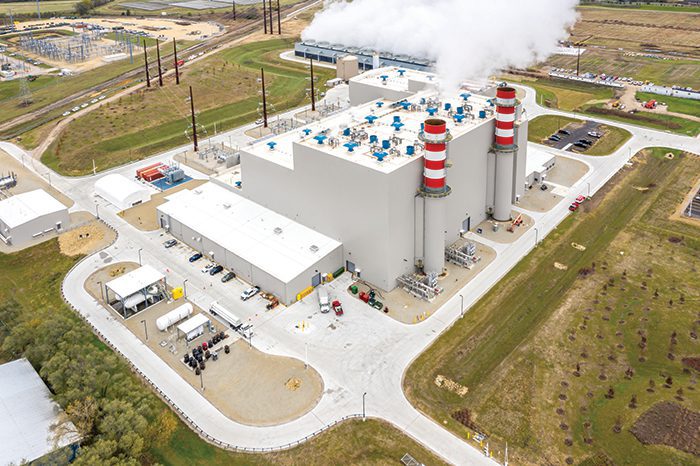
To serve that growth, Alliant is pursuing a substantial portfolio of natural gas and energy storage projects, although it has not identified which will receive federal financing. In Iowa, IPL has begun construction activities for the 720-MW Bobcat Energy Center, a simple-cycle gas plant near its existing Marshalltown Generating Station, and a 95-MW reciprocating internal combustion engine (RICE) project in Burlington.
During the July earnings call, Chief Financial Officer Robert Durian said IPL had filed generation certificates for two other simple-cycle gas projects: the 720-MW Morgan Valley Energy Center and the 1.2-GW Riverhawk project. The utility also filed for approximately 125 MW of battery storage. Other investments include the approved 94-MW Cedar River RICE project at Prairie Creek and a 17.5-MW RICE unit at Riverside in Wisconsin.
Alliant’s 2025 annual report identifies additional approved battery storage projects at the former Lansing Generating Station (150 MW), Golden Plains (75 MW), and Whispering Willow–North (75 MW). In Wisconsin, WPL has pursued a 2-Bcf LNG storage facility in Rock County to provide additional fuel supply flexibility. Existing generating assets are also undergoing upgrades. Durian said in July that generation enhancements at Neenah and Sheboygan Falls had entered service, adding approximately 260 MW of capacity.
The utilities are also retaining existing fossil generation while developing additional resources. WPL plans to keep its ownership interests in Columbia Energy Center (596 MW) and Edgewater Unit 5 (405 MW) operating at least through 2029 while evaluating potential conversion to natural gas. Alliant maintains a voluntary target to eliminate coal from its fleet by 2040.
The investments form part of Alliant’s approximately $13.4 billion construction and acquisition program for 2026 through 2029, outlined in its 2025 Form 10-K. The plan includes approximately $5.05 billion for renewable generation and storage and $4.08 billion for gas projects, alongside distribution infrastructure investments. It also encompasses new renewable capacity, including up to 1,000 MW of proposed Iowa wind generation.
The company’s financing strategy combines operating cash flow, tax credit monetization, debt, and equity. Durian said in July that Alliant had secured approximately $1.8 billion of its identified $2.4 billion equity requirement through 2029 using forward equity agreements.
Alliant maintains that large-load customers must cover their incremental service costs while creating opportunities to stabilize rates for existing customers. IPL operates under a retail electric base-rate moratorium through September 2029, and management has suggested additional load growth could extend the period before its next general rate review.
“Look, the math is self-explanatory. By growing, we’re able to keep rates flat in Iowa,” Barton said during the July earnings call.
Alliant is scheduled to report its third-quarter earnings after market close on Oct. 29, followed by an Oct. 30 conference call that could provide further details on its capital investments, data center demand, and use of the newly completed federal financing.