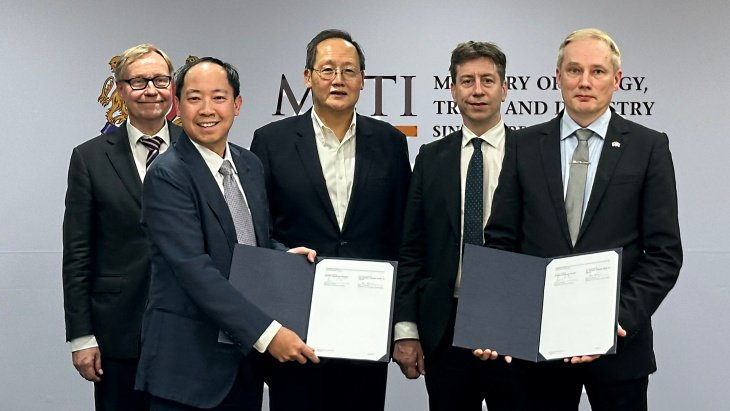
The signing of the MoU on 30 October was witnessed by Tan See Leng, Singapore’s Minister for Energy, Trade and Industry, and Sakari Puisto, Finland’s Minister of Economic Affairs.
Under the MoU, VTT and Singapore Nuclear Research and Safety Institute (SNRSI) at the National University of Singapore will cooperate in areas including nuclear reactor technology assessment and safety analysis, radioactive waste and spent fuel management, and capability development. The collaboration with VTT will complement SNRSI’s efforts to develop a community of nuclear experts and to build the research infrastructure and technical support capabilities needed for independent assessment and nuclear safety.
“The new collaboration brings together VTT’s decades of experience in nuclear safety and technology with SNRSI’s technical expertise to build up Singapore’s growing national capabilities in nuclear science,” VTT said. “It will support the development of expertise needed to understand and assess nuclear technologies and nuclear safety.”
Jani Halinen, Vice President, Nuclear energy at VTT, said: “VTT’s role is to help build independent knowledge and capabilities needed for assessing nuclear energy options and for safe and responsible deployment of the technology. We are pleased to strengthen our collaboration with SNRSI and share Finland’s world-leading experience in nuclear safety, nuclear waste management, and technology development, a decades-long success story which builds on VTT’s research and technical assessment capabilities. Through this cooperation, we aim to support Singapore’s efforts to develop the expertise needed for evidence-based decision-making.”
“While Finland and Singapore differ in geography and energy systems, both are relatively small nations that recognise the value of specialised expertise, strong institutions and international cooperation to address nuclear safety and technology challenges,” said SNRSI CEO Low Xin Wei. “Beyond the exchange of technical knowledge, international collaboration is ultimately about building relationships and mutual trust. SNRSI engages with international partners to strengthen cooperation in nuclear safety, and raise our technical bar so as to attract and develop the next generation of nuclear experts.”
Established in 2014 under the Nuclear Safety Research and Education Programme and elevated to a full-fledged institute in 2025, SNRSI houses and is building Singapore’s capabilities in nuclear science, engineering and safety.
Background
In March 2022, the Energy Market Authority (EMA) – a statutory board under the Singapore Ministry of Energy, Trade and Industry – released a report that concluded nuclear energy could supply about 10% of the island city-state’s energy needs, helping its power sector achieve net-zero carbon emissions by 2050.
In September last year, the EMA appointed UK-headquartered engineering firm Mott MacDonald to conduct a study on the safety and technical feasibility of advanced nuclear energy technologies. The study aims to evaluate the safety performance and technical feasibility of advanced nuclear energy technologies, such as small modular reactors, based on their safety features, technology maturity, and commercial readiness.
Delivering his Budget 2025 speech in February 2025, Prime Minister Lawrence Wong – who is also Finance Minister – said the government would study the potential deployment of nuclear power in Singapore and take further steps to systematically build up capabilities in this area. “We will need new capabilities to evaluate options, and to consider if there is a solution that Singapore can deploy in a safe and cost-effective way,” he said.
Last month the Ministry of Energy, Trade and Industry and the Energy Market Authority of Singapore launched a series of initiatives to develop “a strong pipeline of local expertise in nuclear energy”. The aim is to “help build the capabilities to assess the suitability of advanced nuclear energy technologies for power generation in Singapore” and prepare for an International Atomic Energy Agency Integrated Nuclear Infrastructure Review Mission next year.