The Paris Agreement, which was adopted in 2015 and signed by 195 countries, includes, under Article 6.4, the establishment of the Paris Agreement Crediting Mechanism, an international carbon market managed by the United Nations Framework Convention on Climate Change, whose signatories meet at the annual Conference of the Parties gatherings, best known as COP.
Ahead of this year’s COP – COP31 – in Turkey, Russia submitted its draft SMR-based climate methodology framework for recognising the low-carbon benefits of small modular reactors (SMRs), including the calculation of avoided greenhouse gas emissions. The draft methodology is not tied to any specific reactor design and could be applied to SMRs up to 300 MW capacity on land or on floating power units.
Carbon credits, with one credit equivalent to one tonne of greenhouse gas emissions avoided, can be traded and used by states and organisations in Paris Agreement signatory countries to hit their climate goals. The International Atomic Energy Agency suggested in its latest projections that there could be as many as 1,000 SMRs operating around the world by 2060.
So far five climate project methodologies under the Article 6.4 mechanism, including methodology on renewables, have been approved, with 20 more at various stages of review. The first carbon credits under its terms were issued in February for a clean cooking climate project in Myanmar, with more than a million credits issued for it so far.
Polina Lion, Chief Sustainability Officer at Rosatom, said: “The principle of technology neutrality is widely recognised in international climate policy, but it is not always followed in practice.
“We often see documents, climate action plans, green initiatives and declarations that focus exclusively on renewables – whether intentionally or simply because no one thought about nuclear energy. As a result, nuclear energy is automatically excluded from green plans. And this is a serious mistake.
“If a country uses nuclear power, its industrial companies should be able to demonstrate that they consume low-carbon electricity. Without access for nuclear to appropriate climate instruments, this becomes more difficult. This can affect the competitiveness of carbon-intensive products, such as steel and cement, in international markets.
“Unfortunately, not a single climate project based on a nuclear power plant has been registered in any national or international carbon market to date. There is not even an approved methodology for registering such projects.”
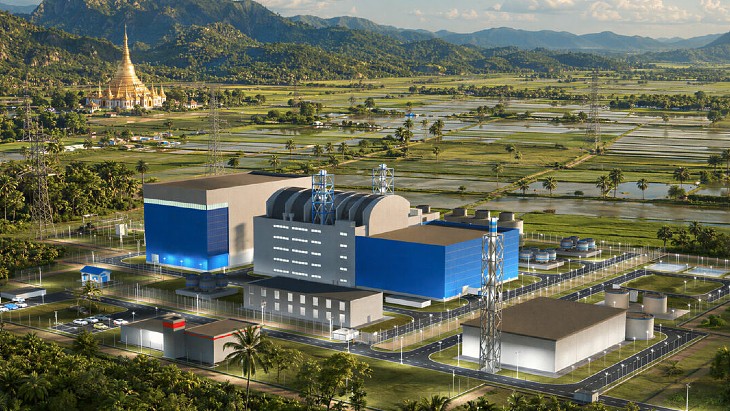
A rendering of how a proposed Rosatom SMR plant in Myanmar could look (Image: Strana Rosatom)
She noted the development of new climate mechanisms to offset emissions from international aviation and from shipping, as well as “strong demand for low-carbon energy and high-quality carbon credits from the digital sector, including data centres and AI technologies”.
The methodology being proposed would provide revenue from carbon credit sales for a hypothetical 100 MW capacity SMR of at least USD1 million per year of operation, Rosatom says, and would “narrow the gap between the treatment of renewables and nuclear power in international climate mechanisms” and “serve as a model for developing similar climate project methodologies on other international and national carbon markets”.
Although the carbon credit revenue might seem relatively small compared with the overall project costs, it could make a meaningful difference to financial models for debt financing of SMR schemes, she said, adding that the focus on SMRs is because “for various reasons, mainly related to methodological requirements, large nuclear power plant projects are not well suited to participate in carbon markets”.
Speaking ahead of two days of nuclear-focused events at the COP31 gathering, she said they were preparing for public consultation on the proposed methodology under the United Nations Framework Convention on Climate Change framework, adding: “We are convinced that nuclear energy – large or small, land-based or floating – is essential for the energy transition and energy security.”
Rosatom says that if its proposal successfully passes the various steps of the consultation and review processes, it would expect it to be approved in the first half of 2028.