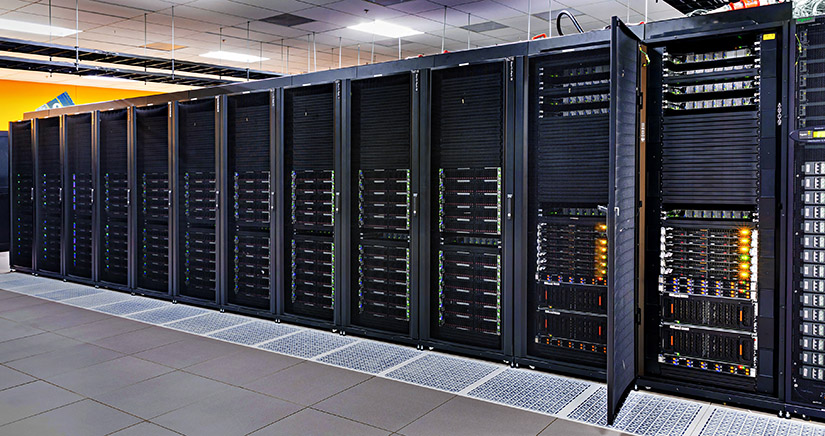
As demand for U.S. data centers rises with the growth of artificial intelligence, cloud services, and big data analytics, so does the energy consumption required to support these facilities.
Data center energy usage is expected to account for up to 9% of the U.S. annual electricity generation by 2030. Of that, around 40% is attributed to cooling systems, which also consume significant amounts of water. During peak demand hours, especially in the hottest months, the energy required by data centers places a substantial strain on the U.S. electric grid.
A new project led by the National Renewable Energy Laboratory (NREL) and funded by the U.S. Department of Energy’s (DOE) Geothermal Technologies Office seeks to address these cooling challenges by exploring the use of geothermal underground thermal energy storage (UTES) for data centers.
Typically, data centers cool their equipment by blowing cold air over components using water-cooled fan coils or by directly cooling the equipment with water. Geothermal electricity generation is one potential solution to meet these continuous cooling and computing power needs. Emerging geothermal technologies, such as the Cold Underground Thermal Energy Storage (Cold UTES) project, present an innovative opportunity to reduce cooling demands while enhancing infrastructure resilience. This technology offers a stable, long-term cooling source, decreasing the need to build additional power plants for data center cooling.
Cold UTES works by using off-peak power to create a cold energy reserve underground, which can then be used during peak grid demand hours. This charge/discharge cycle functions similarly to a conventional battery, optimizing energy use based on time-of-use pricing and other grid factors, ultimately lowering overall grid operating costs. Unlike traditional batteries, Cold UTES can also provide long-duration energy storage, making it an ideal solution for both daily and seasonal energy storage needs. NREL is spearheading the system analysis and grid impact work for the project. Zhu is collaborating with partners from Lawrence Berkeley National Laboratory, Princeton University, and the University of Chicago to demonstrate the commercial appeal and technical feasibility of Cold UTES for managing large data center cooling loads.
“The approach we’re taking is to look into the technical and economic viability of the proposed Cold UTES technologies by projecting what data center loads will look like over the next 30 years,” said Guangdong Zhu, a senior researcher in NREL’s Center for Energy Conversion and Storage Systems and principal investigator for the Cold UTES project. “We’ll then do some projections and grid-scale analysis to show what this technology could look like if it’s commercially deployed at a large number of data centers. We’re aiming to improve grid resilience and reduce the cost of required grid expansion.”
“Our expectation is that a Cold UTES system can provide a long-duration energy storage and industrial-scale cooling solution that is commercially attractive and technically viable for data centers,” said Jeff Winick, technology manager at DOE’s Geothermal Technologies Office. “This project will confirm the potential of these systems to provide significant savings and value to data center operators, utilities, and grid system operators.”