Tuesday, 11 March 2025
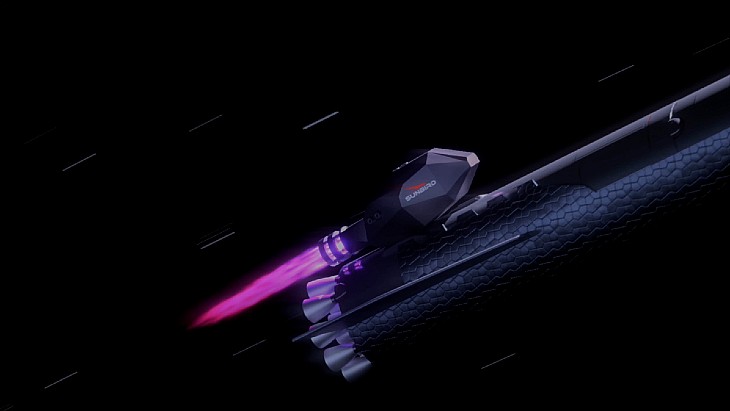
The company says its in-house team has been working on the project for a decade and it is “rapidly advancing toward in-orbit testing, with components of the system’s power supply set for demonstration later this year” and then demonstrated in orbit in 2027. They hope for a production-ready Sunbird in the early 2030s.
The Sunbird concept is for the fusion-powered ‘tugs’ to be permanently based in space, able to dock on to spacecraft and propel them at high speed over vast distances. Pulsar Fusion says it foresees a compact nuclear fusion engine providing both thrust and electrical power for spacecraft, including as much as 2 MW of power on arrival at a destination.
The company says that unlike the large amounts of fuel required for a chemical rocket, the relative tiny amounts of the deuterium and helium-3 fuel mix required means “a spacecraft would launch with a fixed supply, sufficient for missions like Pluto in four years, with no mid-flight refuelling needed”.
Pulsar describes itself as a “space propulsion systems and services company delivering intelligent propulsion now and delivering the future through fusion propulsion”. It uses Hall Effect Thrusters, which generate thrust by ejecting neutral plasma. In 2023 Pulsar Fusion formed a partnership with US-based Princeton Satellite Systems to use artificial intelligence to design a hyper-fast space rocket, with the aim being to create a deep space rocket engine with a 500,000 mph (800,000 km/h) potential.
CEO Richard Dinan said: “Pulsar has built a reputation in this industry for delivering real technology – not just talking about it. We’ve recently commissioned not one, but two of the largest space propulsion testing chambers in the UK, if not all of Europe. Pulsar is now an international space propulsion testing powerhouse, and we have ambitious plans to grow rapidly from here.”
Dinan, introducing the Sunbird concept at the Space-Comm Expo taking place in London, said “the reason we, as Pulsar, are remaining so focused on fusion is because, at some point as our satellites and payloads get bigger and we start going into deep space missions, we have a problem, and that is the fact that solar intensity starts to fade away” so new power sources will be required.
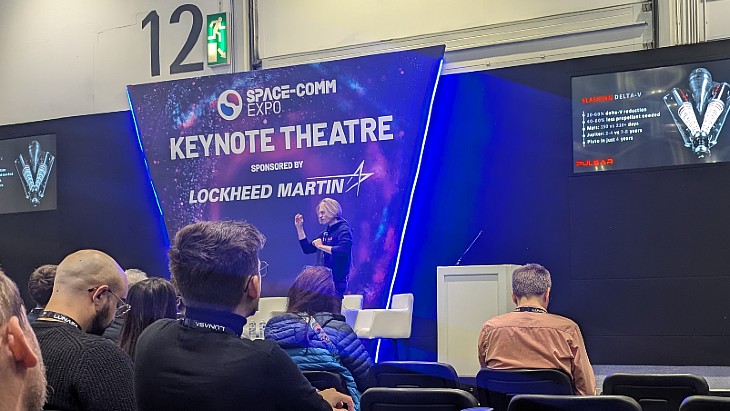
Dinan outlined the concept at Space-Comm Expo in London, which also featured speakers from the European Space Agency, UK Space Agency, NASA as well as Virgin Galactic’s Sir Richard Branson
“We are very interested in nuclear fission – it’s technology which is proven – and it’s going to be a really big thing in the medium term, nuclear fission electric propulsion. But if we are going to be the species that can one day go to Mars and we want to go there with more equipment, then exhaust speeds are pretty much the most important and fusion gives you a pretty exciting prospect.”
He said: “People say ‘doing fusion on earth is proving really hard – doing it space must be a crazy proposition’, but actually there’s a lower bar in space. Part of the problem is doing fusion in the atmosphere”, citing the huge size of the vacuum at the ITER project and the challenges of getting toroidal-type fusion reactors to work as a power source on earth.
“But in space, things start to go in your favour. So if you are going to do fusion, then doing it in space is actually easier than doing it in the atmosphere,” he said.
He added that “if you look at this problem as simply an exhaust speed potential … then in terms of what can be produced in exhaust speeds, then fusion is the king of propulsion”.
The concept of the fusion-powered Sunbirds having a docking station in orbit and operating like a tug came about because, Dinan said, he knew that it was important to keep launch weights as low as possible. He said that there is an “enormous amount of hard science and work that needs to go on”.
“We plan to start releasing some of our linear fusion-based models this year, and then in 2027 we are going to do our first in-orbit demonstration of some of the key components of this Sunbird project.”
The potential application of nuclear fission and nuclear fusion in powering and propelling spacecraft in the next wave of exploration has seen research being carried out in various countries around the world, such as the USA’s , in the and in Russia, whose Rosatom last month unveiled a laboratory prototype of based on a magnetic plasma accelerator which it said could slash travel time to Mars to one or two months.