By
- Oil majors cut spending, boost shareholder returns amid uncertainty
- Exxon Mobil bucks trend with increased spending, production plans
- Peak demand narrative persists despite geopolitical energy shocks
LONDON, March 26 – Top oil and gas companies are losing confidence in the outlook for their core businesses.
Recent strategy updates by leading European and U.S. energy firms saw them lower capital expenditures while increasing shareholder payouts. This looks a lot like the beginning of a long-term managed decline.
While there is no question that oil, and especially gas, will continue to fuel global economies for decades, there is tremendous uncertainty about the price outlook due to the acceleration of alternative clean technologies such as wind, solar and biofuels.
Oil and gas is a capital-intensive industry requiring heavy investment simply to maintain production, and project lead times are very long, so cutting spending now sends a clear signal about a company’s long-term trajectory.
Indeed, the boards of top European oil companies have recently slowed down, or even abandoned, investments into renewables. While that allowed them to shift more capex towards oil and gas, overall spending has been moderated. Oil and gas output is expected to be flat or grow in the low single-digits by the end of the decade.
Shell (SHEL.L) on Tuesday lowered its annual spending outlook to $20-22 billion through 2028, down from previous guidance of $22-25 billion per year, while also noting that it will keep oil output flat at 1.4 million barrels per day. It will instead focus on growing liquefied natural gas sales by 4%-5% per year.
At the same time, Shell raised guidance for shareholder returns – dividends and share repurchases – to 40-50% of cash flow from operations, up from 30-40%.
BP (BP.L), which is facing the fallout from a disastrous attempt to swiftly pivot towards renewables, announced last month that it was slashing spending to $13-15 billion per year, compared with $16.2 billion in 2024, while also seeking to boost shareholder returns.
France’s TotalEnergies TTEF.PA is taking a similar approach.
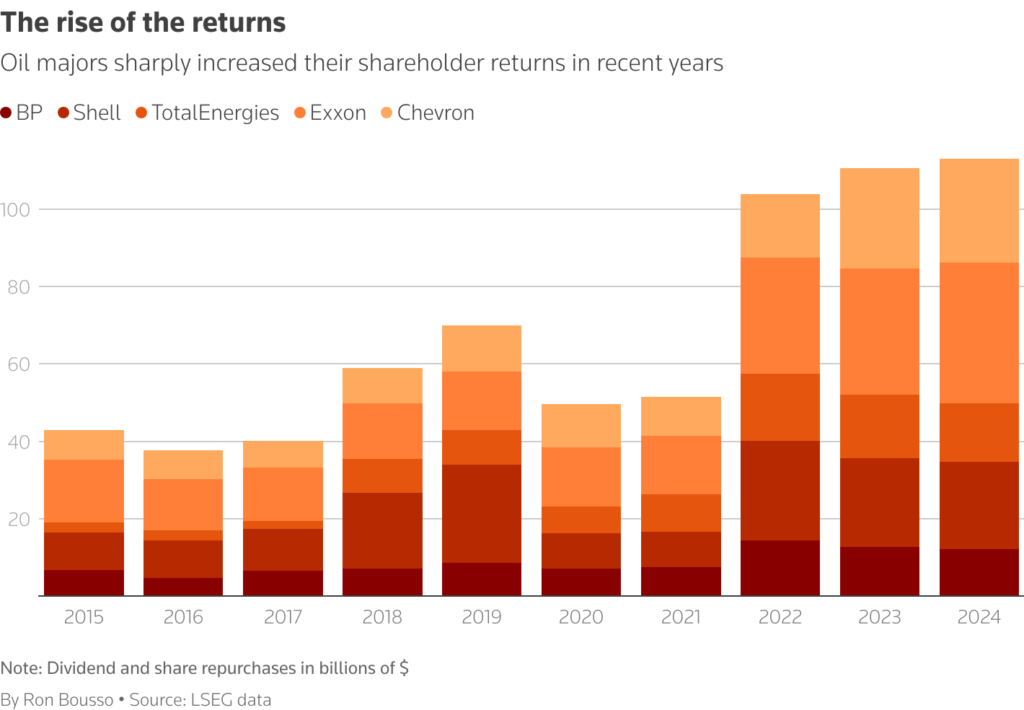
Oil majors sharply increased their shareholder returns in recent years
EXXON EXCEPTION
Over in the U.S., Chevron (CVX.N) plans to cut spending while growing production by 5%-6% between 2024 and 2026, after which growth is set to decelerate. That could change if its $53 billion acquisition of Hess goes through, but this consolidation points towards more spending cuts ahead.
The big exception here is Exxon Mobil (XOM.N), the largest U.S. oil and gas producer, which has a history of being countercyclical. It plans to increase spending to $28-$33 billion per year between 2026 and 2030 from $27.5 billion in 2024 while also increasing production to 5.4 million bpd from 4.3 million bpd last year.
This divergent strategy reflects the company’s dominant presence in two of the world’s fastest-growing and lowest-cost oil and gas basins, the Permian shale basin in the United States and Guyana’s offshore areas. Other Western majors simply cannot compete with that.
So if one takes a short-term view, the change in strategy by most top oil and gas companies makes sense and is positive for investors. Rising uncertainty about the industry’s outlook is leading to improved discipline aimed at avoiding the value destruction that blighted many companies’ performance over the past decade.
But this industry has always taken a long-term approach due to the longevity of its investments, and the current strategies largely ignore future risks.
PEAK DEMAND
Less than 20 years ago, the industry was focused on peak oil supply, the idea that existing fossil fuel reserves would not meet surging global demand. Rising energy prices and bullish investors encouraged energy firms to explore and develop new resources such as deep water reservoirs and, crucially, the U.S. shale basins. This, in turn, revolutionized the industry and led to a surge in oil and gas production from non-OPEC members.
In the middle of the last decade, the prevailing concern started shifting to peak oil demand as discussion of the energy transition increased. And there are now already indications that gasoline consumption is on the cusp of plateauing in China and the United States.
Importantly, the peak demand narrative has survived despite the temporary concern about oil and gas supply that followed Russia’s invasion of Ukraine in 2022. The brief energy price shock led governments around the world to rethink energy transition strategies and encourage higher domestic production.
And companies also do not appear to be altering their strategies following the re-election of President Donald Trump, whose support of the fossil fuel industry and animosity towards renewables are well documented.
So, for now, it appears likely that Western oil companies will remain on their current trajectory, focusing on oil and gas while reducing spending and sending more cash back to shareholders.
That should make investors happy in the short term. But whether the boards of energy majors will find a way to maintain their companies’ scale and importance over the long term, as the global energy system evolves, remains to be seen.
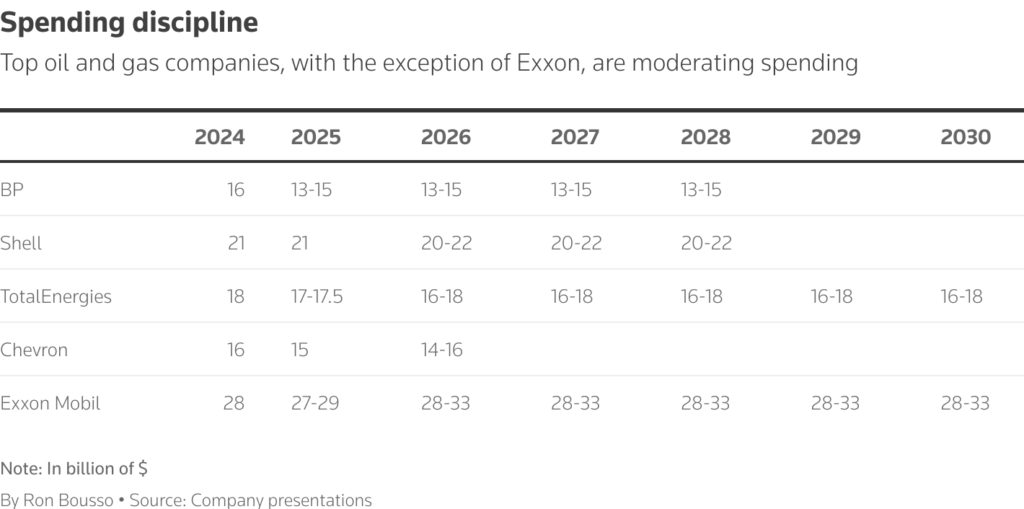
Top oil and gas companies, with the exception of Exxon, are moderating spending
The opinions expressed here are those of the author, a columnist for Reuters.
Want to receive my column in your inbox every Thursday, along with additional energy insights and trending stories? Sign up for my Power Up newsletter .
Reporting by Ron Bousso. Editing by Mark Potter
Share This:
More News Articles