Thursday, 27 March 2025
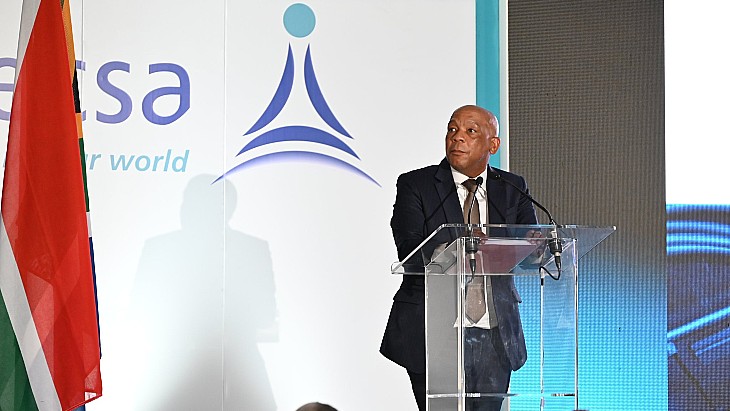
Addressing the celebrations held by the Nuclear Energy Corporation of South Africa (NECSA) on 25 March, Ramokgopa said the ZAR1.2 billion is included in the government’s 2025 budget, which is currently awaiting final parliamentary approval.
Safari-1 is a tank-in-pool research reactor which reached first criticality in 1965 with a capacity of 6.67 MWt. Over its 60 years of operation it has undergone various power uprates and been converted to use low-enriched uranium fuel and low-enriched uranium targets for isotope production. Today, it has a licensed operating power of 20 MWt and is one of the world’s major commercial producers of medical and industrial radioisotopes. It is also used for activation analyses, material modification (such as the neutron transmutation doping of silicon for the semi-conductor industry) and provides support services such as neutron radiography and neutron diffraction for both industry and research.
Safari-1 is currently licensed to operate until 2030, and could be a sustainable operational irradiation facility beyond that date, pending an engineering assessment supported by ageing management programme, according to Necsa.
The South African cabinet approved the construction of the Multipurpose Reactor to succeed the Safari-1 research reactor, in 2021. Necsa released a Request for Information for the new reactor the following year, to allow a good lead-time for procurement and construction so that the radioisotope production and the other functions currently fulfilled by Safari-1 can continue without interruption.
Ramokgopa acknowledged that the allocation in this year’s budget will not be sufficient, on its own, to fund the project, adding that Necsa must also find support from other quarters. ZAR1.2 billion “is not going to get us to where we want to be” but national financing is constrained, he said, “so we must find bespoke financing, we must find partners, who will not just bring money, but technological know-how, and when we bring it together with ours, the sum is greater than the whole of its parts”.
And a national contest will be held to choose a name for the new reactor. “We will not call it the MPR … we must give it a name,” he said. “Because South Africans must own Necsa. South Africans must know what nuclear is. South Africans must know what these possibilities are. So we will run this contest [to choose a name for the reactor] so that South Africans can embrace it, and know that it is their’s.”
Safari-1’s contribution over its 60 years of operations has been “profound”, saving up to 10 million lives in more than 60 countries, World Nuclear Association Director General Sama Bilbao y León said in an address to the Necsa celebration. The know-how and experience from the reactor’s exemplary operations have also been a driving force that will continue to support South Africa’s nuclear sector, she said. “Energy demand at a global level continues to increase, because it is an essential enabler for prosperity, growth and quality of life, and this is particularly important in Africa, where we still have 600 million people with zero access to energy. Nuclear energy can be a game-changer in Africa, providing abundant, affordable, 24/7 carbon-free energy that will be able to propel the entire industry forward,” she said.