Friday, 22 November 2024
According to the country’s Ministry of Energy’s Telegram account, Moroz said that a systemic analysis and a final decision was needed: “We are currently working quite intensively, studying the prospects, and seeing trends of rapid growth in electricity consumption.”
The official Belta news agency reported him as adding that “if we, together with scientists, come to the understanding that these trends are sustainable, then, of course, the feasibility study will show us how effective either the construction of a new nuclear power plant unit on the existing site or the creation of another station on a new site can be.” He added that, in line with a request to the ministry from the president, a feasibility study would be prepared in 2025 “and we expect that the final decision will be made during this period”.
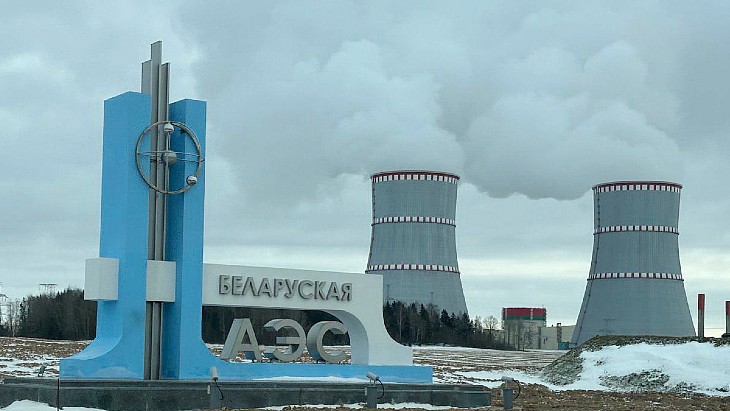
The existing Belarus nuclear power plant is located in Ostrovets in the Grodno region. A general contract for the construction was signed in 2011, with first concrete for unit 1 in November 2013. Rosatom began construction of unit 2 in May 2014. They are both VVER-1200 reactors. The first Ostrovets power unit was connected to the grid in November 2020 and, the energy ministry says, the plant will produce about 18.5 TWh of electricity per year, equivalent to 4.5 billion cubic metres of natural gas, with an annual effect on the country’s economy of about USD550 million. The second unit was put into commercial operation on 1 November 2023.
The country has been considering the option of a second nuclear power plant because of projections that electricity demand will rise in the coming years. Deputy Prime Minister Victor Karankevich, who was energy minister until earlier this year, said that if a second nuclear power plant was built, Belarus would become a world leader in terms of the share of its energy which comes from nuclear.
Cryptocurrency
Moroz was speaking during a tour of the nuclear power plant to mark a year since it was fully commissioned. He said the plant will generate more than 40% of the country’s electricity needs and reduce CO2 emissions by about 7 million tonnes per year.
According to Belta he said that the capacity offered by the new plant allowed incentive schemes to be introduced: “The power supply system works in such a way that it is impossible to determine where the electricity for cryptocurrency mining comes from – from a nuclear power plant or from gas generation. However, the emergence of BelNPP created conditions under which we formed incentive tariffs to attract mining to Belarus. If a company is engaged in cryptocurrency mining or processing a large array of data, it can receive electricity at incentive tariffs. Moreover, these tariffs are differentiated by the volume of electricity consumption. The more electricity such a company consumes, the cheaper the electricity is for it.”
There are also steps being taken to switch homes to electric heating and also transport electrification. “We see how much the lifestyle and comfort level of people who use electricity have changed. Therefore, of course, the construction of the Belarusian NPP has had a positive impact on the energy sector and related industries,” Moroz said.