Africa’s rapidly expanding data centre industry is expected to create substantial new demand for electricity over the coming decade, presenting opportunities for renewable energy developers, power infrastructure investors and independent power producers (IPPs). However, converting this demand into commercially viable energy projects will require careful assessment of electricity consumption, customer commitments and infrastructure requirements.
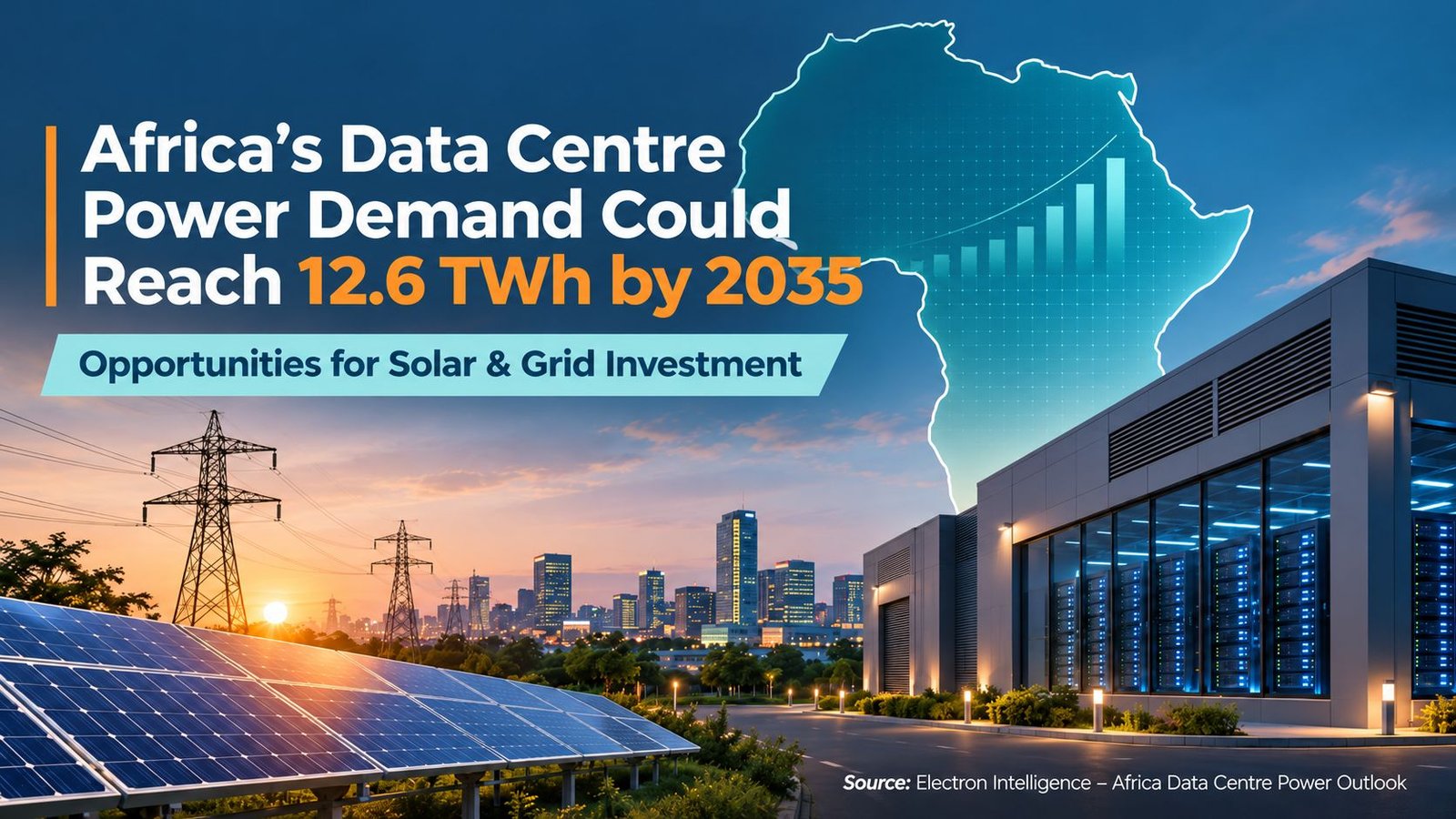
According to the Africa Data Centre Power Outlook, published by energy market intelligence provider Electron Intelligence in November 2026, electricity consumption by data centres across Africa is projected to increase from 2.55 terawatt-hours (TWh) in 2025 to 6.95 TWh in 2030, reaching 12.60 TWh by 2035 under the report’s base-case scenario.
The projected growth reflects increasing cloud adoption, enterprise digitalisation and demand for local data hosting. These developments are expected to increase the need for reliable power generation, renewable electricity procurement, grid infrastructure and backup energy systems.
South Africa is expected to account for approximately 77% of Africa’s additional data centre electricity consumption through 2035, representing 7.77 TWh of growth. Colocation operators are projected to contribute nearly 90% of the continent’s increase in demand.
However, the report highlights a significant difference between announced data centre capacity and actual electricity requirements. Of the 647 MW of announced additional IT capacity across Africa, only 337 MW, or approximately 52%, currently has a scheduled commissioning date by 2035.
The analysis estimates that another 583 MW of unannounced IT capacity would be required to meet projected demand, with approximately 513 MW of this requirement concentrated in South Africa. Kenya presents a contrasting situation, where the identified development pipeline already exceeds its forecast requirement for 2035.
David Oni, Head of Research at Electron Intelligence, emphasised that announced data centre capacity should not automatically be treated as near-term electricity sales. Power developers and lenders must consider confirmed tenant commitments, actual rack utilisation and existing supply arrangements when evaluating potential projects.
One of the important findings concerns the potential for renewable energy to reduce electricity procurement costs for data centres.
Using a modelled 12 MW IT facility consuming 97 gigawatt-hours annually, Electron Intelligence assessed different electricity supply arrangements in South Africa.
The analysis indicates that combining utility electricity and on-site backup systems with wheeled solar power could reduce modelled electricity costs by approximately 11.5%, from US$126.78 per megawatt-hour (MWh) to US$112.19/MWh. This represents potential annual savings of approximately US$1.42 million for the modelled facility.
These findings highlight opportunities for solar developers and IPPs to supply data centres through renewable power purchase agreements (PPAs) and electricity wheeling arrangements.
However, the report notes that the financial viability of these arrangements depends on factors including grid connection availability, municipal wheeling regulations, transmission-use charges and industrial electricity tariffs.
Reliable, continuous electricity supply remains essential for data centre operations, meaning that renewable power procurement must be evaluated alongside backup capacity and overall delivered electricity costs.
The report also examines alternative generation arrangements in Nigeria, where diesel-based electricity supply can significantly increase operating costs.
Electron Intelligence’s modelling indicates that natural gas generation supported by diesel backup could reduce delivered electricity costs by 54% to 60% compared with continuous diesel generation.
Nevertheless, the feasibility of these arrangements depends on gas delivery infrastructure, facility utilisation and electricity licensing regulations.
Across South Africa, Kenya, Egypt and Morocco, variations in grid access, wheeling frameworks and tariff structures influence the commercial attractiveness of different power procurement models.
These differences demonstrate the importance of developing market-specific electricity supply strategies rather than applying a uniform approach across the continent.
While projected electricity demand indicates substantial growth potential, the report cautions against committing infrastructure investment before customer demand is sufficiently secured.
Under Electron Intelligence’s delayed-growth scenario, Africa’s data centre electricity consumption reaches only 6.44 TWh in 2035, approximately 49% below the base-case forecast of 12.60 TWh.
The cumulative difference between the base-case and delayed-growth scenarios over 2026–2035 is estimated at 26.6 TWh.
Such uncertainty could create financial exposure for developers investing in substations, transmission connections, generation facilities and supporting infrastructure before sufficient electricity revenues are contracted.
The research therefore highlights the importance of minimum electricity purchase commitments, contractual protections and flexible power supply arrangements to manage project risks.
Africa’s growing digital infrastructure sector is emerging as a potentially important source of long-term electricity demand. For renewable energy developers, this creates opportunities to explore solar generation, grid-connected electricity supply and structured corporate power purchase agreements.
However, successful project development will depend on more than projected capacity additions. Electricity suppliers and infrastructure investors will need to evaluate actual consumption, regulatory conditions, commercial agreements and the reliability of power delivery.
The findings suggest that the next phase of Africa’s data centre expansion could support new investments in renewable energy and electricity infrastructure, provided that projects are aligned with verified demand and commercially sustainable power procurement arrangements.
Subscribe to get the latest posts sent to your email.