Friday, 6 June 2025
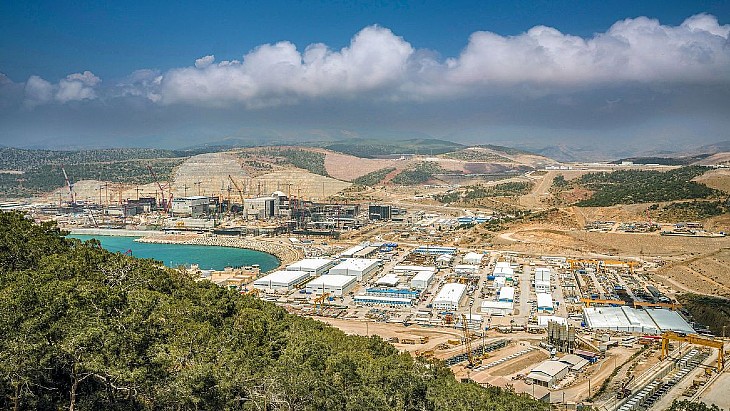
The four-unit Akkuyu plant will be cooled by water from the Mediterranean Sea. There will be one pumping station for each power unit, a drainage channel, siphon wells, a distribution chamber, a water intake and spillway structure and desalination processes. Rosatom says the total capacity in the normal operation of the power unit will be 260,000 cubic metres per hour and that the design “will reliably protect the pumping station equipment from any external factors including floods and tsunamis”.
The start-up and testing phase of the on-shore pumping station for unit 1 began in February.
Work to integrate the water monitoring system into the existing design started about three years ago, Rosatom said, after Turkey’s amended regulation was adopted, and the decision to include it has been confirmed.
The monitoring system, which will operate for the entire life of the plant, will “remotely monitor the purity and flow rate of the discharged water, suspended solids, dissolved oxygen, acid-base properties, chemical oxygen demand, temperature, conductivity, and other key indicators”.
Sergei Butckikh,Akkuyu Nuclear JSC CEO, said: “The Akkuyu NPP project is being implemented in accordance with high environmental standards and principles of sustainable development. All environmental parameters are systematically monitored at the site and in the construction region of the nuclear power plant: conditions of the soil, air, flora, fauna and, of course, sea water. For us, this is not just a duty to comply with legal requirements but a part of the project’s philosophy. All employees of the NPP will live with their families in this region, and each of them is aware of their personal responsibility for the environment.”
Background
Akkuyu, in the southern Mersin province, is Turkey’s first nuclear power plant. Rosatom is building four VVER-1200 reactors, under a so-called BOO (build-own-operate) model. According to the terms of the 2010 Intergovernmental Agreement between the Russian Federation and the Republic of Turkey, the commissioning of the first power unit of the nuclear power plant must take place within seven years from receipt of all permits for the construction of the unit.
The licence for the construction of the first unit was issued in 2018, with construction work beginning that year. Nuclear fuel was delivered to the site in April 2023. Turkey’s Nuclear Regulatory Agency issued permission for the first unit to be commissioned in December, and in February it was announced that the reactor compartment had been prepared for controlled assembly of the reactor – and the generator stator had also been installed in its pre-design position.
The aim is for unit 1 to begin supplying Turkey’s energy system in 2025. When the 4800 MWe plant is completed, it is expected to meet about 10% of Turkey’s electricity needs, with the aim that all four units will be operational by the end of 2028.