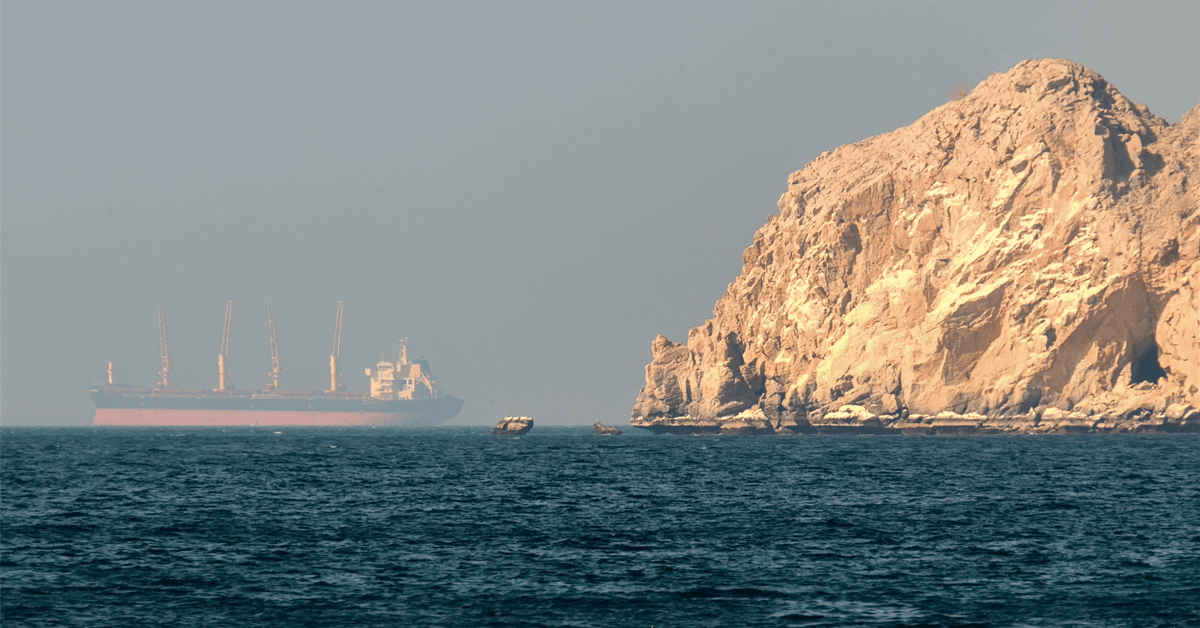
The war between the United States and Israel against Iran has the potential to be the largest oil supply disruption in history if oil flows via the narrow Strait of Hormuz remain low or come to a halt.
That’s what was stated in an analysis piece sent to Rigzone by the S&P Global team late Monday. The analysis piece was penned by Jim Burkhard – who heads S&P Global Energy crude oil research – and the S&P Global Energy Crude Oil Markets team.
“Initially, energy infrastructure had not been targeted by Iran, but that has changed with attacks on facilities in Saudi Arabia and Qatar,” the analysis piece noted.
“This adds a critical further dimension to the shock wave hitting oil and gas markets,” it added.
S&P Global Energy Commodities at Sea data shows that, on March 1, five oil tankers transited the Strait, the analysis highlighted. This compares with around 60 tankers per day recently, according to the analysis.
In the first two months of this year 20.8 million barrels per day of crude oil and products was shipped via the Strait of Hormuz, with 82 percent going to Asian markets, the analysis noted, adding that about 18 percent of global LNG supply also transits the Strait as well.
“The loss of a good part of this energy supply could fuel financial and economic shocks,” the piece warned.
“If tankers halt transiting the Strait, as much as 15 million barrels per day of crude oil and products – most of which is crude oil – are at risk, with the precise amount dependent on the utilization of Saudi and Emirati pipelines that bypass the Strait of Hormuz,” the analysis added.
“A supply disruption even at the mid-range of volumes at risk – seven to eight million barrels per day of crude and products – would be higher than the volume that was initially at risk when Russia invaded Ukraine or the volume cut off from the market following Iraq’s 1990 invasion of Kuwait,” it continued.
The analysis highlighted that, before the outbreak of hostilities, the S&P Global Energy outlook expected global crude oil production to exceed demand by 1.4 million barrels per day in the first quarter of 2026 and by an average of one million barrels per day for the year overall.
The analysis noted, however, that “the reduction in tanker traffic and the targeting of energy infrastructure have the potential for a shift – and possibly a historic one – from a surplus to a large deficit, which would mean prices high enough to ration scarce supplies and lower demand”.
In the analysis, Burkhard pointed out that “the duration of the war is critical”.
“If the reduction in tanker traffic continues for a week or so it will be historic. Beyond that it would be epochal for the oil market with prices rising to ration scarce supply and impacts in financial markets,” he warned.
“While not certain, the risk is real. The potential impact on global oil supply and the world economy could be so significant that it is difficult to imagine a worst-case scenario – no tankers transiting the Strait of Hormuz – lasting more than a short while, but it could,” he continued.
Daniel Yergin, Vice Chairman, S&P Global, said in the analysis piece, “key questions are how much supply will be lost, for how long, and how do major powers react?”.
“That a scenario capable of causing the greatest oil supply upheaval in history is even under consideration is, by itself, alarming,” Yergin added.
In a BMI report sent to Rigzone by the Fitch Group on Tuesday morning, analysts at BMI, a Fitch Solutions company, highlighted that, on February 28, the U.S. and Israel launched a large-scale military operation against Iran.
“Initial developments point to a short-lived but expansive campaign, with the threat of further escalation in the coming weeks,” the analysts noted.
“For global oil and gas markets, the conflict introduces risk through two primary channels: damage to physical infrastructure and disruption to transit in the Strait of Hormuz,” they added.
In the report, the analysts noted that maritime traffic “has dropped sharply and at least three tankers have been attacked” in the Strait.
“Ultimately, the magnitude and persistence of any price moves will hinge on the scale and duration of disruptions in the strait and the extent of any damage to infrastructure,” the analysts said.
The BMI analysts stated in the report that, depending on how the conflict evolves, they see three pathways for crude, “broadly aligning with our Country Risk team’s three pathways for military escalation”.
“Currently we are largely in our low case scenario, with certain spillovers into the mid case,” they said.
In its low case scenario, BMI anticipates a “short-lived, large campaign, but with greater regional spillover, [and] partial/full Hormuz disruption”, the report showed. This scenario sees a settled oil price trading range of between $75 and $90 per barrel.
BMI’s mid case scenario also anticipates a “short-lived, large campaign, but with greater regional spillover, [and] partial/full Hormuz disruption”, but this scenario projects a settled oil price trading range of between $90 and $110 per barrel, the report outlined. In this scenario, “direct tanker strikes, vessel seizures, swarm tactics or limited mine-laying force temporary pauses while lanes are assessed” and infrastructure outages “become more consequential”.
Under BMI’s high case scenario, there is a “prolonged, large-scale campaign, greater regional spillover, [and] partial/full Hormuz disruption”. This case sees a settled trading range between $110 and $130 per barrel and warns of a risk of prices jumping over $130 per barrel. In this scenario, commercial transit of the Strait “becomes commercially non-viable even if not formally ‘closed’” and infrastructure sees “extensive and systemically significant outages”.
In a separate BMI report sent to Rigzone by the Fitch Group on Tuesday, BMI analysts said they are maintaining their 2026 Brent crude forecast at $67 per barrel, “despite a stronger than expected price performance in Q1 and the outbreak of military hostilities between the U.S., Israel, and Iran”.
“While the distribution of outcomes has widened materially and near-term upside risks have intensified, our analysts’ core view for a short-lived, albeit large, campaign is consistent with a brief spike in oil prices in March, followed by rapid retracement heading into Q2, as geopolitical risk premia fade and investor focus shifts back towards loose underlying fundamentals,” BMI analysts stated in that report.
“This will limit the impact on prices from an annual average perspective,” they added.
The analysts noted in that report that they are factoring in a trading range of around $75 to $90 per barrel in March, “bringing the Q1 average to around $71 per barrel”.
“In Q2, we forecast a far lower average, at $63 per barrel,” they said.
“This view makes several key assumptions, most notably a rapid normalization of transit through the Strait of Hormuz and no material lasting damage to Middle East Gulf export infrastructure,” they noted.
“Stripping away conflict-related disruptions, the global oil market looks oversupplied for H1 and the loss of the geopolitical risk premia surrounding Iran would likely be the trigger for a sharp sell-off in Brent,” they continued.
“Over H2, we expect a gradual recovery in prices, and a marked reduction in volatility, as oil demand continues to rise and economic momentum and market sentiment improve,” they stated.
“That said, whereas the risks to our $67 per barrel average forecast were previously skewed to the downside, they now skew to the upside, given the potential for wider escalation and larger and longer-lasting conflict-related disruptions,” the analysts went on to state.
Rigzone has contacted the White House, Israel’s Ministry of Foreign Affairs, and the Iranian Ministry of Foreign Affairs for comment on the S&P analysis piece and the BMI reports. At the time of writing, none of the above have responded to Rigzone.
To contact the author, email