Brazil’s INB gets approval to seek export of enriched uranium

Monday, 10 February 2025
Brazil's INB gets approval to seek export of enriched uranium
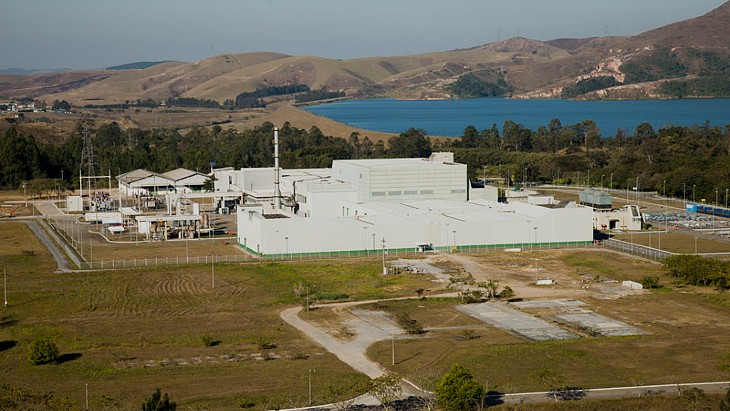
INB’s Resende facility (Image: INB)

The material was imported in 2016 and has been stored at the Resende Nuclear Fuel Factory. However, Indústrias Nucleares do Brasil (INB) says, “due to its operational unsuitability for fuel manufacturing and the economic unfeasibility of its internal use, the sale will free up space for raw material essential to supply Angra’s nuclear plants, in addition to generating revenue for new investments by the state-owned company”.

Following the decision of the commission (CNEN) the plan is to stage an open competition to achieve the highest price “positioning the state-owned company in new markets and expanding its business opportunities in the global nuclear sector”, according to the state-owned company’s announcement.

Once the potential buyer is confirmed, INB will need to obtain an export licence from the Ministry of Foreign Affairs.

Adauto Seixas, president of INB, said: “This initiative represents a strategic advance for INB, demonstrating our capacity for efficient asset management and taking advantage of commercial opportunities in the international nuclear sector.”

Background
 

Uranium-235 (U-235) is the main fissile isotope of uranium and occurs at a concentration of about 0.7% in natural uranium. Standard fuel used in today’s operating light water reactors uses low-enriched uranium (LEU), with enrichment levels up to about 4.8% U-235. But higher-enriched – or LEU+ – fuel containing up to 10% U-235 can potentially offer improved nuclear fuel cycle economics for currently operating reactors.

The announcement comes six months after INB announced it was to resume exploration for uranium in the country after a 40-year hiatus. According to World Nuclear Association, exploration in the 1970s and 1980s showed that Brazil has reasonably assured resources of 210,000 tonnes of uranium. However, there has been little investment in exploration since the mid-1980s.

The country’s three main deposits are: Pocos de Caldas in Minas Gerais state, where a uranium mine closed in 1997; Lagoa Real or Caetité in Bahia state, which has been operating since 1999; and Itataia, now called Santa Quitéria, in Ceará state, where the production of uranium as a co-product with phosphate is planned. Uranium has been mined in Brazil since 1982, but the only operating mine is INB’s Lagoa Real/Caetité mine, with a capacity of 340 tU per year. The mine has known resources of 10,000 tU at 0.3%U.

In 2022, Brazil produced 43 tU. All mined uranium is used domestically, after conversion and most enrichment abroad. The country’s uranium requirements are currently about 339 tU per year.

Brazil has two nuclear reactors, Angra 1 and 2, which generate about 3% of its electricity, and a third under construction.
   

  • Related Posts

    Kairos secures HALEU for Hermes’ first fuel load

    Kairos is building the Hermes Low-Power Demonstration Reactor – known as Hermes 1 – in Oak Ridge, Tennessee. It was one of the first round of companies conditionally selected by…

    Reactor internals delivered for Xudabao unit 1

    The main functions of the reactor internals are to provide support for fuel assemblies and other components in the reactor pressure vessel, and to guide the control rod drive mechanism.…

    Have You Seen?

    Power Ministry’s Chintan Shivir 2026 Concludes, Outlines Roadmap to 100 GW Hydro Pumped Storage by 2035–36 and Strengthens DISCOM Reforms

    • January 24, 2026
    Power Ministry’s Chintan Shivir 2026 Concludes, Outlines Roadmap to 100 GW Hydro Pumped Storage by 2035–36 and Strengthens DISCOM Reforms

    IEW 2026 in Goa to Drive Global Energy Partnerships as India Pushes Security, Decarbonisation and Investment-Led Growth

    • January 24, 2026
    IEW 2026 in Goa to Drive Global Energy Partnerships as India Pushes Security, Decarbonisation and Investment-Led Growth

    Bihar’s Power Distribution Reforms Gain National Recognition as NBPDCL and SBPDCL Achieve ‘A’ Grade in PFC Rating

    • January 24, 2026
    Bihar’s Power Distribution Reforms Gain National Recognition as NBPDCL and SBPDCL Achieve ‘A’ Grade in PFC Rating

    Scatec Secures 25-Year PPA with Tunisia’s STEG for 120 MW Tataouine Solar Project, Strengthening Country’s Renewable Energy Push

    • January 24, 2026
    Scatec Secures 25-Year PPA with Tunisia’s STEG for 120 MW Tataouine Solar Project, Strengthening Country’s Renewable Energy Push

    Republic Day 2026: Ministry of Power’s ‘Prakash Ganga’ Tableau Showcases India’s Journey from Universal Electrification to Global Clean Energy Leadership

    • January 24, 2026
    Republic Day 2026: Ministry of Power’s ‘Prakash Ganga’ Tableau Showcases India’s Journey from Universal Electrification to Global Clean Energy Leadership

    Oil Rises Nearly 3% as US Sends Armada to Iran, Slaps New Sanctions

    • January 24, 2026
    Oil Rises Nearly 3% as US Sends Armada to Iran, Slaps New Sanctions

    US Oilfield Service Firm SLB Says it Can Rapidly Boost Venezuela Operations

    • January 24, 2026
    US Oilfield Service Firm SLB Says it Can Rapidly Boost Venezuela Operations

    US Drillers Add Oil and Gas Rigs for First Time in Three Weeks, Baker Hughes Says

    • January 24, 2026
    US Drillers Add Oil and Gas Rigs for First Time in Three Weeks, Baker Hughes Says

    SLB North American Revenue Jumps after ChampionX Acquisition 

    • January 23, 2026
    SLB North American Revenue Jumps after ChampionX Acquisition 

    US Control of Venezuela Oil Risks Debt Restructuring Showdown with China

    • January 23, 2026
    US Control of Venezuela Oil Risks Debt Restructuring Showdown with China