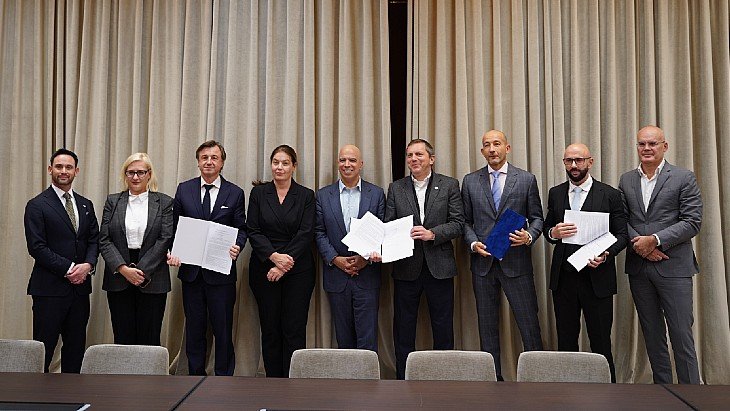
The agreement, signed in the presence of Bulgarian energy minister Iva Petrova, will see the parties “jointly assess potential sites, financing structures, project delivery models and the licensing and regulatory framework required to support future SMR deployment in Bulgaria”.
SGE – formerly Synthos Green Energy – is the exclusive regional lead for GE Vernova Hitachi Nuclear Energy’s BWRX-300 in much of Central and Eastern Europe and has multi-unit projects being developed, notably in Poland and the UK. The new MoU expands a letter of intent signed last year between SGE and Blue Bird Energy.
The main shareholders in Blue Bird Energy are two of the leading Bulgarian industrial corporations – Glavbolgarstroy (GBS) and Asarel-Medet JSC. GBS, founded in 1969, is the largest and most established construction and engineering group in Bulgaria and a major player on the South-Eastern European construction market. Asarel-Medet JSC is Bulgaria’s biggest copper mining and processing company, focused on open-pit mining and ore processing.
Georgi Dobrev, CEO of Natsionalna Elektricheska Kompania (NEK), said: “Through this cooperation, we aim to explore the technical, economic and commercial potential of small modular reactor technology in Bulgaria, while assessing its possible contribution to the country’s future energy mix. Our participation reflects a commitment to evaluating new opportunities responsibly, as we believe this partnership offers an opportunity to strengthen Bulgaria’s energy security, enhance the competitiveness of its industry, and reinforce the country’s position as a leading energy producer in Southeast Europe.”
Rafał Kasprów, CEO of SGE, said: “The involvement of a state-owned energy company alongside our existing partner Blue Bird Energy is an important step in advancing BWRX-300 technology in Bulgaria. By applying SGE’s fleet approach and drawing on experience from other European markets, we aim to create a competitive model for deploying reliable, clean nuclear energy at scale. This cooperation will strengthen Bulgaria’s energy security, support its industrial competitiveness, and contribute to the development of a broader BWRX-300 fleet across Europe.”
Background
Bulgaria currently has one nuclear power plant, Kozloduy. Units 1-4 at the plant were VVER-440 models which the European Commission classified as non-upgradeable and Bulgaria agreed to close them during negotiations to join the European Union in 2007. Units 5 and 6 feature VVER-1000 reactors that were connected to the grid in 1987 and 1991, respectively. Both units have been through refurbishment and life-extension programmes to enable extension of operation from 30 to 60 years. The country’s two operable reactors generate about one-third of its electricity.
Westinghouse’s AP1000 has been selected as the technology for two proposed new units. The aim is for the first new Westinghouse AP1000 unit – unit 7 at Kozloduy – to be operational in 2035 and the second one – unit 8 – to be operational in 2037. The 2,300 MWe capacity of the two new units would exceed the 1,760 MWe capacity of the closed first four units. The Bulgarian government has also said that further units will be needed to replace units 5 and 6 by 2050.
It has also been considering the deployment of small modular reactors in the country.
The BWRX-300 is a 300 MWe water-cooled, natural circulation SMR with passive safety systems that leverages the design and licensing basis of GE Vernova Hitachi Nuclear Energy’s US Nuclear Regulatory Commission-certified ESBWR boiling water reactor design and its existing, licensed GNF2 fuel design. The first BWRX-300 is under construction at Ontario Power Generation’s Darlington site in Canada, with completion expected around the end of the decade.