By and
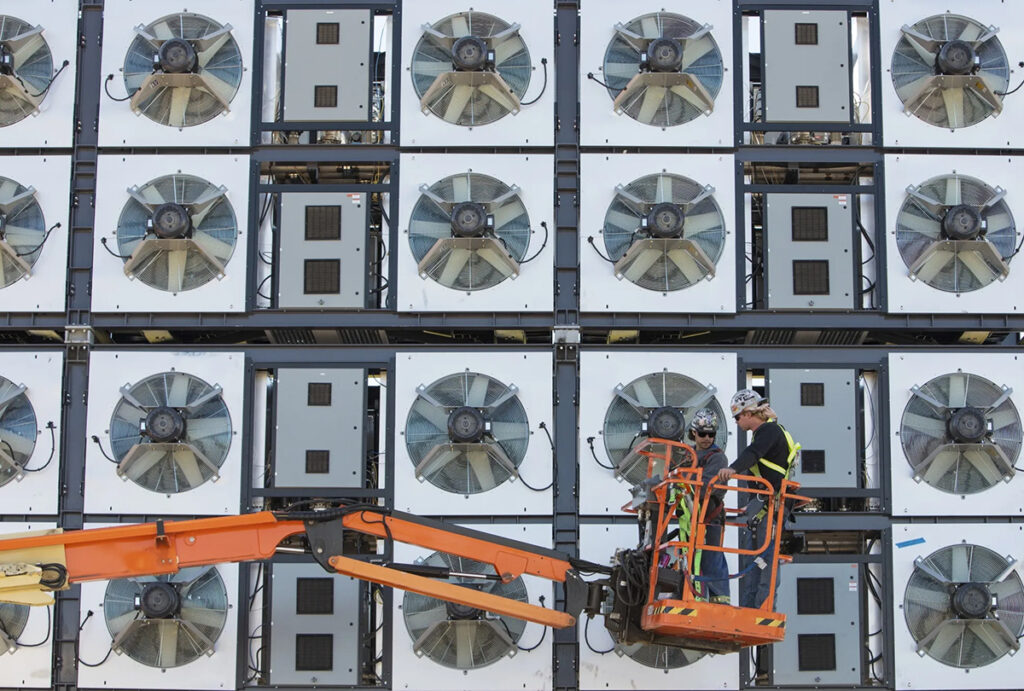
Crew work to finish construction on CarbonCapture Inc.’s direct air capture system. Photographer: Amber Bracken/Bloomberg
Get the Latest US Focused Energy News Delivered to You! It’s FREE:
A carbon capture startup has moved its first commercial pilot project from the US to Canada due to what it sees as more stable government incentives and support.
CarbonCapture Inc. subsidiary True North Carbon is constructing a direct air capture (DAC) system in Alberta, Canada, it expects to go online by the end of October. The project will have the ability to capture 2,000 tons of carbon dioxide per year at full capacity, making it the biggest system of its kind operating in the country.
In Canada, tax incentives and the regulatory landscape will make it easier for the carbon capture and storage industry to scale, CarbonCapture Chief Executive Officer Adrian Corless said. The company originally planned to build the project in Arizona and had components for it ready in a factory in the state. But earlier this year, when Energy Secretary Chris Wright terminated billions in awards issued by the Office of Clean Energy Demonstrations, the company made a quick decision to pivot, shipping all the equipment to a rural patch of farmland in Alberta in a matter of months, Corless said.
The US has a program for so-called DAC hubs that started under former President Joe Biden to support the industry. But as the Trump administration shifts its climate and energy policy, Corless said he was concerned the program may end up being cut or scaled back. Those concerns also factored into CarbonCapture’s decision earlier this year.
On Wednesday, Bloomberg News reported that the Energy Department plans to terminate $7.6 billion of projects following the government shutdown, and CarbonCapture’s regional DAC hub project is on the list of canceled awards.
The Energy Department did not immediately respond to a request for comment.
Canada offers a 60% investment tax credit for DAC projects deployed in the country, with the Alberta government offering an additional 12% stacked on top for projects based in the province. Those “significantly improve the economics” of projects, Corless said. The technology has struggled to gain traction due to high costs around the world.
The Canadian incentives are key to scaling CarbonCapture’s DAC technology, Corless said, which currently costs the company about $1,000 per ton to operate at the pilot level. So, too, is the infrastructure that can support the project.
The company relocated its 2,000-ton system to Innisfail, Alberta, just north of Calgary, the country’s oil and gas hub. Alberta is home to the world’s third-largest oil reserves and has hosted facilities that capture carbon from smokestacks and store it in underground saline aquifers for years. It’s also host to a robust network of CO2 pipelines and has plans to build more, Corless said.
CarbonCapture has partnered with Canadian startup Deep Sky, which runs the facility where the system will be located. There, a three-story structure that resembles stacks of air conditioning units is being erected amid the green fields. Large fans will suck air through specially engineered cartridges that absorb CO2 from the air and then carry the greenhouse gas via pipeline to a tank where it will eventually be trucked to another location and buried deep underground.
Deep Sky’s site is home to DAC systems from five other companies, with more planned. It and CarbonCapture will split the new system’s operational costs as well as carbon credit sales.
CarbonCapture had previously attempted to build a DAC facility in Wyoming, where it planned to capture 5 million tons of CO2 annually by 2030. But it abandoned those plans last year, citing a lack of available carbon-free energy and transmission constraints. It would have taken multiple years for the company to get power, whereas Corless expects interconnection in Alberta to happen within “a matter of months, not years.”
(Updates from the third paragraph on with more details on project cancellations by the Trump administration.)
Share This:
More News Articles