By
LONDON, April 10 (Reuters) – As U.S. President Donald Trump turns up the tariff heat on China, Beijing is targeting ever more of the United States’ critical material supply chains.
Weird and wonderful metals such as antimony, gallium and germanium have already been sucked into the escalating trade war with China restricting exports and banning sales to the United States.
Beijing has just raised the mineral threat another level by adding seven rare earths to its dual-use list of restricted exports.
Rare earths are China’s ultimate metallic weapon. The country has a vice-like grip on every stage of the global supply chain from mining to processing to manufacturing the permanent magnets that power laptops, electric vehicles and fighter jets.
China supplies around 90% of the world’s rare earth magnets, according to the CRU research house. Which is a big problem, since the magnets themselves are also now on the export control list.
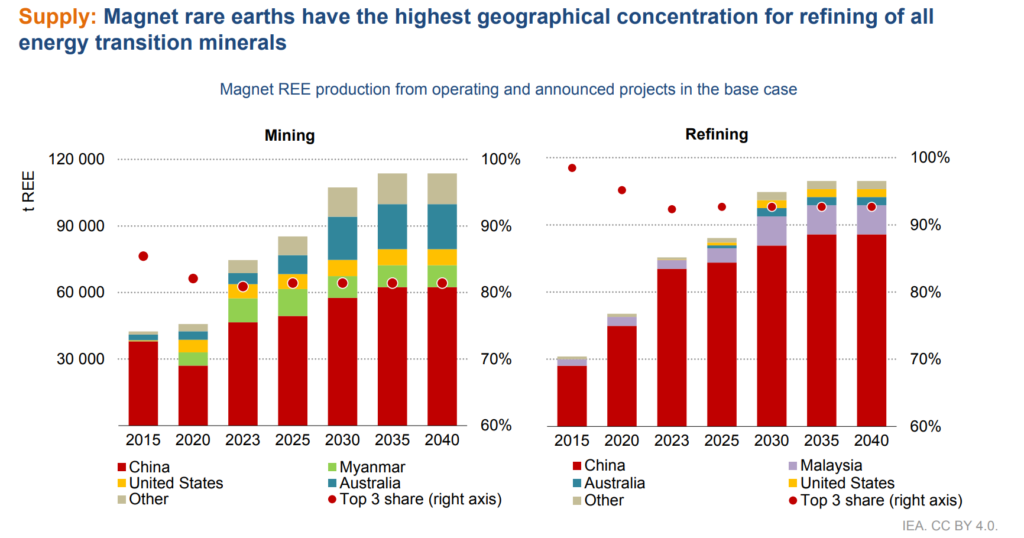
Major miners and processors of rare earths by the IEA
INVISIBLE METALS
Chances are you’ve never heard of the rare earths that are now going to be subject to export restrictions, but they have seeped into all aspects of modern technology.
Consider, for example, yttrium. Yttrium compounds are used in everything from jet engines to microwave radar to super-conductors and even dentistry.
Global production may be no more than 20,000 metric tons a year, according to the U.S. Geological Survey, but in tiny quantities it’s just about everywhere.
So too are the other six metals now joining the Ministry of Finance’s watch list.
But the common theme is their use in permanent magnets. Dysprosium and terbium are used as additives to enhance the performance of neodymium magnets while samarium is combined with cobalt for even higher-performance applications such as missiles and fighter aircraft.
Magnets make the modern world go round and their inclusion on China’s export control list is a major red flag for everyone else.
ON THE WATCH LIST
Being put on the dual-use watch list doesn’t automatically lead to outright bans on exports to specific countries but, as already seen with antimony, gallium and germanium, it can do.
It also allows Chinese authorities to scrutinise buyers and exclude those involved in military supply chains, particularly U.S. military supply chains.
It’s noticeable that Chinese exports of germanium and gallium to the United States stopped months before the full ban in December 2024, suggesting licenses to export to what was previously a major market were already being refused.
Moreover, depending on just how tightly the export controls are exercised, the market impact can be explosive.
The price of antimony has jumped from $14,000 to nearly $60,000 per ton since China cut off exports to the United States.
Bismuth has surged from $6 to $40 per kilogram since the metal was put on the dual-use export control list in February.
Rare earths have been here before of course. China’s ban on exports to Japan in 2010 caused a momentous price spike and ultimately ended up with China losing a trade case at the World Trade Organization.
STILL DOMINANT
The world largely ignored that warning. Fifteen years on and China’s grip on the rare earths market is as tight as ever.
The country accounts for around 60% of global mined production and is embedded in Myanmar, the world’s second-largest producer.
China’s control over the processing stage of rare earths production is almost total at around 90% of global output.
Even Mountain Pass, the only major operating rare earths mine in the United States, sends much of its output to China for the tricky business of separation and refining.
Moreover, Mountain Pass mainly produces light rare earths rather than the heavy rare earths China is now threatening.
The only significant producer of the heavy stuff outside of China, Myanmar and Laos is the Serra Verde mine in Brazil, according to consultancy Project Blue. No prizes for guessing where it sends its production for processing.
COUNTDOWN
Western countries have belatedly woken up to their problematic dependence on China for rare earth magnets.
Multiple projects to lift production capacity from both new mines and recycling are under way in both the United States and Europe.
But few are anywhere near commercial production and few can compete with China’s rare earth giants, meaning the West remains highly vulnerable to China’s export threats.
At the very least, the new export controls on these rare earths and the associated magnets will cause short-term supply disruption as exporters apply for new licences.
They may also presage a broader decline in Chinese supply as the authorities stop sales to Western buyers involved in military procurement chains.
The good news, as it were, is that China has a long list of critical metals it can weaponise and a rare earths export ban will likely be kept in reserve for now.
But as the trade war between China and the United States escalates, there’s a strong sense that the rare earth time bomb is now ticking.
The opinions expressed here are those of the author, a columnist for Reuters.
Editing by Hugh Lawson
Share This:
Next Article
More News Articles