By

LONDON, March 11 (Reuters) – The International Energy Agency’s plan to release 400 million barrels of oil reserves is unprecedented in scale and desperately needed to blunt the devastating supply shock triggered by the Iran war. But it will offer only limited relief as long as energy exports from the Middle East remain blocked.
Get the Latest US Focused Energy News Delivered to You! It’s FREE:
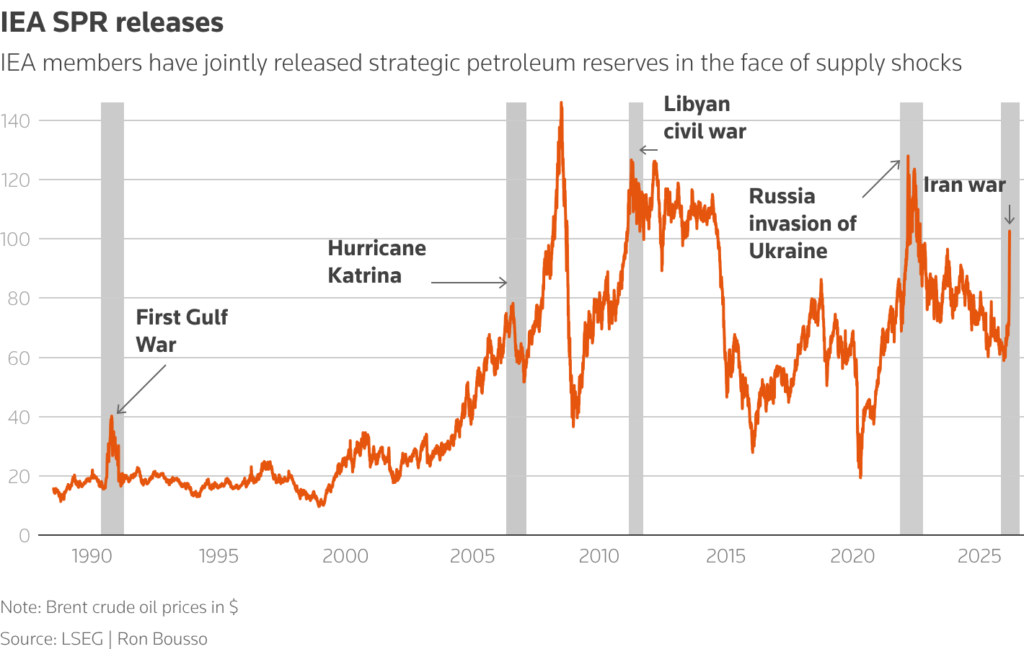
The IEA said on Wednesday that its 32 member countries unanimously agreed to move forward with the biggest collective drawdown ever from their strategic petroleum reserves (SPR).
The release is more than double the scale of the previous – and until now, largest-ever – coordinated drawdown in March 2022 following Russia’s invasion of Ukraine, when the U.S. released 180 million barrels.
Yet the enormity of the crisis confronting the global oil market today certainly warrants these record-breaking volumes – if not more. Nearly 20 million barrels per day (bpd) of supply – roughly a fifth of global output – have been trapped inside the Gulf since the effective closure of the
Strait of Hormuz shortly after the launch of the joint Israel‑U.S. war against Iran on February 28.
Measured against that disruption, the announced release looks a lot less impressive. After only 11 days of conflict, the current market deficit has already reached roughly 220 million barrels. Saudi Arabia and the United Arab Emirates are working to divert some exports to ports outside the Gulf, which should provide additional relief, but those flows remain limited and vulnerable.
The duration of the Iran conflict and the continued closure of the Strait of Hormuz are therefore critical in determining whether the release can meaningfully stabilise markets or merely slow the pace of damage.
IEA SPR releases
MISSING DETAILS
The IEA has coordinated emergency stock releases only four times since it was created by OECD members in the mid‑1970s in response to the 1973 OPEC oil embargo. That crisis caused severe fuel shortages and a quadrupling of oil prices.
The infrequency underscores the gravity of the current situation – but also potentially the limits of the tool being deployed.
Several key details of the release have yet to be announced, and they are crucial to assessing its likely impact.
First, the pace of the drawdown is unknown. The IEA said that members will determine the timing of their release and, more importantly, how quickly oil will actually reach the market.
JPMorgan estimates that a coordinated SPR release could flow at a maximum rate of about 1.2 million bpd, based on past precedents. The 2022 drawdown equated to roughly 1 million bpd. At those rates, the release would offset only a small fraction of the current supply disruption, leaving the market heavily undersupplied.
US strategic petroleum reserves
LOCATION, LOCATION, LOCATION
Where the oil is released matters almost as much as the quantity. The region most heavily hit by the supply shock so far is Asia, which relies on the Gulf for about 60% of its oil imports. Refiners there have already started cutting operating rates, while several countries have begun rationing fuel to conserve dwindling stocks.
Japan, which holds the second‑largest strategic reserves in the OECD, said it will release around 80 million barrels from both state and private inventories, equivalent to 45 days of supply, starting as early as March 16. That should provide Japanese refiners with rapid, tangible relief.
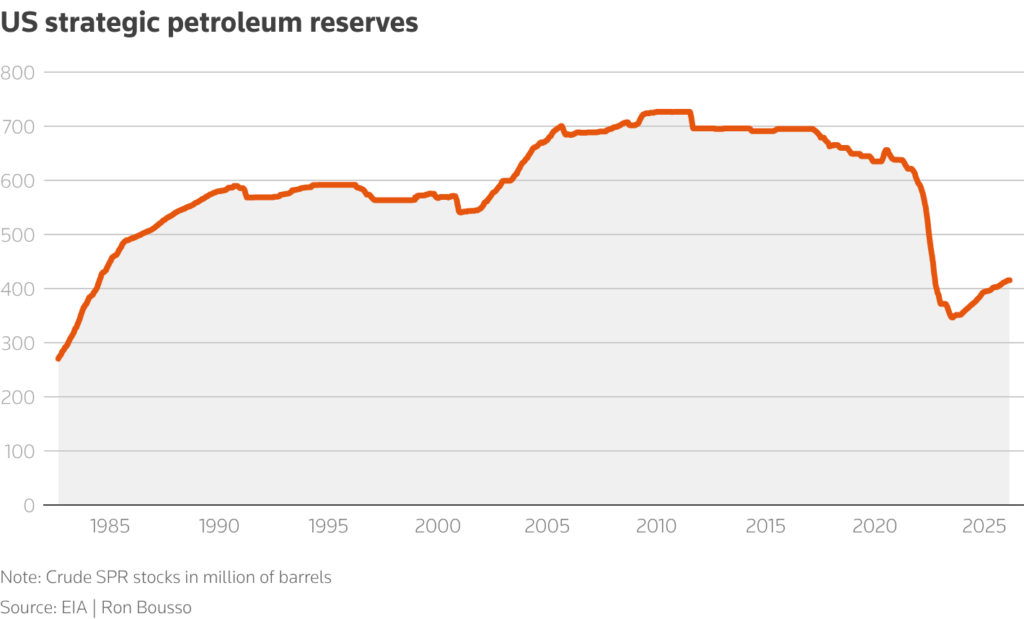
The U.S., which has yet to spell out its contribution, will almost certainly account for the largest share of the release. Its SPR stands at about 415 million barrels stored in dozens of salt caverns along the Gulf Coast. That’s less than 60% of total capacity of roughly 713 million barrels, according to Energy Information Administration data.
For refiners in Asia, however, the release of U.S. barrels might not be that helpful. A tanker journey from the U.S. Gulf Coast to Asia takes 40 to 60 days depending on the route, more than twice as long as shipments from the Middle East.
Those delays will be compounded by sharply higher freight costs. The recent surge in tanker rates due to the conflict adds an extra $10 to $12 per barrel for a voyage from the U.S. Gulf Coast to Singapore – around 15% of the cargo’s value – compared with just 2% to 3% before the war, according to Reuters calculations.
There is also a longer‑term cost. A release of this magnitude will drain a substantial share of the world’s emergency reserves, leaving consuming nations with a far thinner cushion should the conflict drag on or escalate further.
The SPR release will unquestionably offer the global oil market vital breathing room as governments grapple with the threat of surging inflation, economic slowdown and social strain.
But without a rapid resumption of energy flows from the Middle East, even this historic intervention could quickly become a drop in the ocean.
The opinions expressed here are those of Ron Bousso, a columnist for Reuters.
Ron Bousso Editing by Marguerita Choy
Share This:
More News Articles