By Alex Epstein
This is the fourth of the “Alex Notes” on my book —like Cliff’s Notes, but actually written by the author. (See , , and ).
Myth: Fossil fuels have made the planet less livable.
Get the Latest US Focused Energy News Delivered to You! It’s FREE:
Truth: Fossil fuels have made the planet incomparably more livable, by fueling an unprecedented increase in humanity’s productive ability.
(A summary of Fossil Future Ch 4, part 1 of 3)
- The Full Benefits of Continuing Fossil Fuel UseTo properly evaluate fossil fuels, we need to understand their full benefits and side-effects.
It’s crucial to start with their benefits, since these can often be used to neutralize and overwhelm their negative side-effects.
- Understanding the benefits of anything requires knowing 1) the state of human flourishing and 2) the role of that thing.E.g., understanding antibiotics’ benefits requires knowing 1) we’re safer than ever from infectious disease and 2) antibiotics have an essential role.
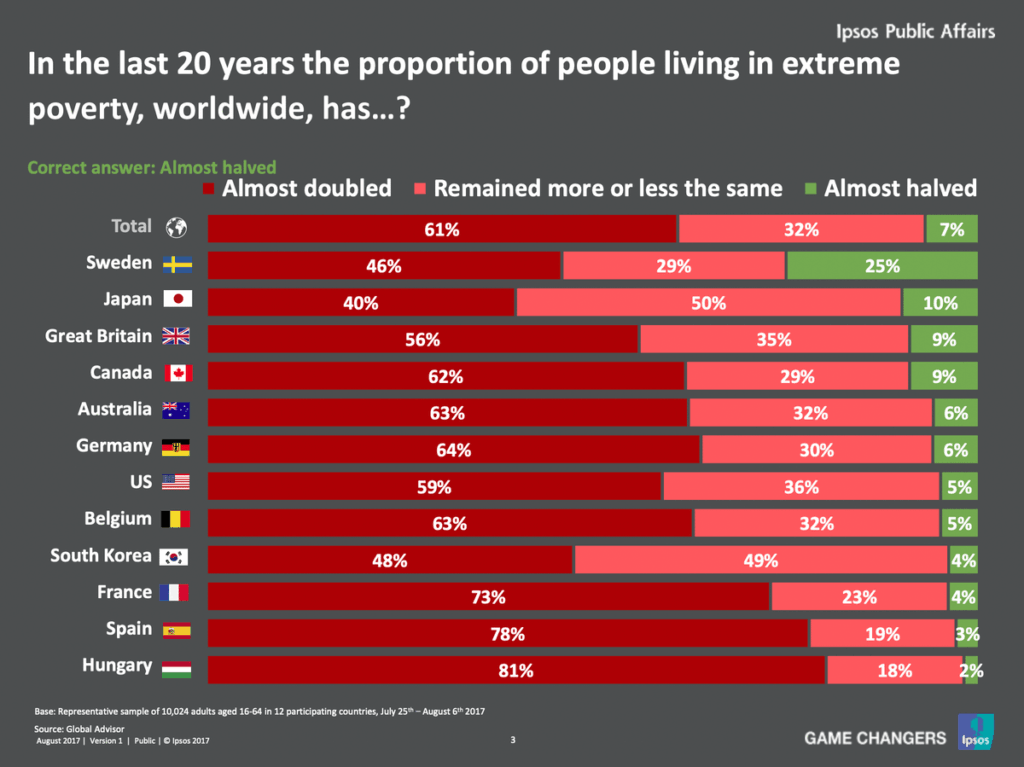
- Many people have the view that the world has rapidly become far less livable, to the point they think that extreme poverty has actually increased (when it’s actually plummeted).E.g., In a 2017 survey, 61% of respondents said extreme poverty has increased in the last 20 years!¹
- Oftentimes, people who think the state of human flourishing on Earth has gotten worse think fossil fuels have played a major role.In reality, fossil fuels have played a crucial role in making the state of human flourishing better.
- What Is a “Livable Planet”?People often talk about fossil fuels in terms of the “livability of the planet,” which is good and valid—if it’s by the standard of human flourishing, including being open to the ways in which fossil fuels benefit the livability of the planet.
- Looking at the Livability of the Planet from a Human Flourishing PerspectiveThere are three essentials of a livable world from a human flourishing perspective:
1) How nourishing it is
2) How safe it is
3) How opportunity-filled it is
- Being Open to Ways in Which Fossil Fuels Profoundly Benefit the “Livability of the Planet”If we are open to fossil fuels’ benefits on livability, we see that all 3 essentials of a livable world—how nourishing, safe, and opportunity-filled it is—have gone up due to fosil fuels.
- The Hydrocarbons and Human Flourishing Hockey SticksEmpirically, the world is more livable than ever. Average life expectancy, average income, and population have all gone up time in an unbelievable “hockey stick” that exactly correlates with global CO2 emissions.²
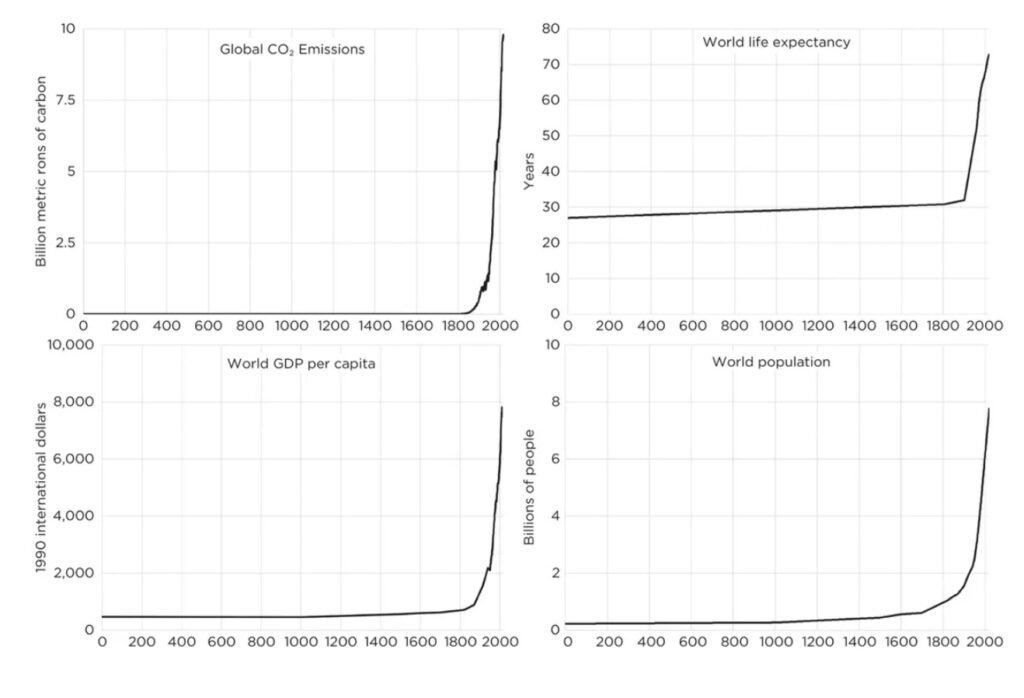
- The world is more livable than ever by every metric—but what caused this? And why are the metrics of livability so strongly correlated to global CO2 emissions from fossil fuel use?To understand this, we must first understand why livability was so low for so long.
- The Problem of Human Weakness on a Naturally Deficient and Dangerous PlanetThe livability of our naturally deficient and dangerous world is overwhelmingly determined by humanity’s productive ability, which for most of history has been limited by our lack of physical power.
- As deserted island stories accurately portray, left to our own devices (i.e., without machines), about the best humans can do is build a primitive shelter that wouldn’t survive a major storm and, if we’re lucky, find or grow enough food to keep us going.
- There’s no getting around that human beings relying on our own meager energy and power cannot produce enough value to flourish on this naturally deficient and dangerous planet.How did we solve this problem?
By replacing our own productive energy with machine energy.
- The Solution: Cost-Effective Machine Labor and Machine FoodHumans create a livable world by using machines—but the amount of machine labor we can use is limited by the cost-effectiveness of machine labor, including, crucially, the cost-effectiveness of energy (machine food).
- Humanity’s Unprecedented, Fossil-Fueled Productivity and ProgressUltra-cost-effective energy from fossil fuels drives humanity’s unprecedented, increasing productive ability through powering ultra-cost-effective machine labor, and the human mental labor that frees up.
- Thanks to freed-up time from ultra-cost-effective machine labor, humanity today has the ability to produce an unprecedented quantity of values (such as food, shelter, and clothing) and an unprecedented variety of values (from airplane trips to Google searches to MRI scans).
- Powering Ultra-Cost-Effective Machine LaborFossil fuels are uniquely cost-effective: low-cost, on-demand, versatile, and scalable. The ultra-cost-effectiveness of fossil fuels has made machine labor so cost-effective that it can be used everywhere in every aspect of life.
- Fossil fuels have made machine labor so cost-effective that a private jet is one of the few machines that is not cost-effective in the empowered world.The vast majority of machines—from washing machines to smartphones to refrigerators—are cost-effective for billions of people.
- Enormous Amounts of Human Mental Labor Freed Up by Ultra-Cost-Effective Machine LaborFossil-fueled machine labor allows humans to produce enough for our survival needs quickly, freeing up ample time for the uniquely human mental labor that most modern productive areas require.
- Super-SpecializationFossil fuels make possible today’s super-specialization by freeing up human mental labor, by empowering specialists with machine labor, and by producing ultra-cost-effective transportation that facilitates global trade.
- Some of the ways in which fossil fuels make possible today’s super-specialized global trade: giant cargo ships and planes that can’t be powered at scale by anything besides oil.
- Rapid InnovationFossil-fueled machine labor is the root of today’s massive innovation via a virtuous circle of empowerment: fossil-fueled machine labor frees up time that we can devote to productive innovation—productive innovation that utilizes fossil-fueled machines.
- Consider scientific and technological research—fields that are major drivers of prosperity and progress.It is only in an empowered world, where machine labor does enormous amounts of work for us, that we can confidently free up enormous amounts of human time for such pursuits.
- Fossil Fuel MaterialsFossil fuels, by fueling super-specialization and rapid innovation, led to research and development, not just in how to burn fossil fuels for energy but also in how to leverage their unique properties to make materials.
- Consider the thousands of materials that are made from fossil fuels.You are probably sitting in a room with at least fifty things derived from oil, from the insulation in your walls to the carpet under your feet to the laminate on your table to the screen on your computer.
- SummaryIt is no exaggeration to say that today’s productive ability is fossil-fueled: it depends on ultra-cost-effective fossil-fueled machine labor, fossil-fuel-freed-up time, and fossil fuel materials!
1
2
Share This:
More News Articles