Future fusion power plants will rely on two hydrogen isotopes – deuterium and tritium – to produce energy. Deuterium can be readily extracted from seawater. Tritium, however, is scarce in supply, necessitating the development of methods to produce it sustainably. To address this challenge, tritium must be produced (or ‘bred’) in a lithium-containing blanket that surrounds the fusion reaction. This ‘breeder blanket’ will perform several tasks: producing tritium; absorbing heat; and acting as a radiation shield. By ensuring a continuous supply of tritium for the fusion machine’s operations, the breeder blanket enables a self-sustaining fuel cycle.
In January 2025, the UK government announced a GBP410 million (USD543 million) investment to accelerate development of fusion energy. The funding – announced by the Department for Energy Security and Net Zero – will support the development of the UK fusion energy sector over 2025 to 2026 with investment in the skills needed for scientists, engineers, welders and programme managers to enter the industry. This new investment includes the Lithium Breeding Tritium Innovation (LIBRTI) programme – a GBP220 million initiative that focuses on pioneering fusion fuel advancements and stimulating general industry capacity through international collaboration.
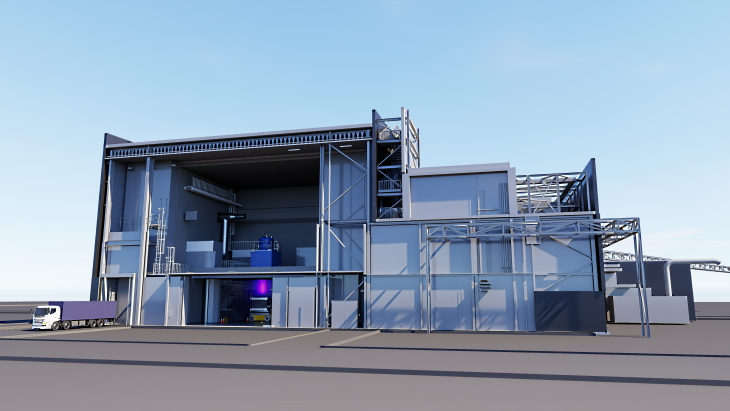
The programme is creating a first-of-a-kind technology facility at UKAEA’s Culham Campus in Oxfordshire, England, which will enable industry partners to develop and verify their blanket technologies in fusion environments representative of full-scale machines. As part of this effort, UKAEA has acquired a 14 mega electron volt (MeV) deuterium-tritium fusion system from SHINE Technologies of Janesville, Wisconsin, USA, to provide the LIBRTI high-flux neutron source.
UKAEA has now announced that Commonwealth Fusion Systems (CFS) is the first international company to join the Lithium Breeding Tritium Innovation programme. CFS – spun out of the Massachusetts Institute of Technology in 2018 – is currently building the SPARC prototype fusion machine at its headquarters in Devens, Massachusetts. It is described as a compact, high-field, net fusion energy device that would be the size of existing mid-sized fusion devices, but with a much stronger magnetic field. The donut-shaped device will use powerful electromagnets to produce the right conditions for fusion energy, including an interior temperature surpassing 100 million degrees Celsius. It is predicted to produce 50-100 MW of fusion power, achieving fusion gain greater than 10. CFS expects to generate electricity from its first fusion power plant in Virginia in the early 2030s.
CFS and UKAEA will work together, designing the experimental setup, developing testing protocols, and conducting experiments at the Lithium Breeding Tritium Innovation facility. CFS will build the test articles to be used in the first investigations.
Amanda Quadling, Executive Director of Materials, Blankets and Research at UKAEA and Senior Responsible Officer for the Lithium Breeding Tritium Innovation programme, said that “welcoming CFS is a defining moment … their participation adds momentum to our own efforts and accelerates the global pathway to demonstrated fusion power plant scale technology”.
Commonwealth Fusion Systems co-founder and Chief Science Officer Brandon Sorbom said the programme’s “specialised testing capabilities will allow us to demonstrate net tritium production and increase confidence in our ARC blanket system design. Through this collaboration, CFS will gain hands-on experience engineering and building blanket systems directly representative of our commercial fusion power plant. We’re thrilled to partner with UKAEA and the LIBRTI team as an early user”.
Heena Mutha, Commonwealth Fusion Systems Director of Fuel Cycle and Blanket Technology, added: “It’s an incredible moment for the fusion industry that we’re building the capability to investigate the performance of blankets in a fusion-relevant environment.”