Monday, 4 August 2025
A study led by researchers at Massachusetts Institute of Technology shows that simulations of underground radioactive waste interactions, generated by new, high-performance computing software, aligned well with experimental results from a research facility in Switzerland.
The study was co-authored by MIT PhD student Dauren Sarsenbayev and Assistant Professor Haruko Wainwright, along with Christophe Tournassat from Lawrence Berkeley National Laboratory (LBNL) and the University of Orléans in France, as well as Carl Steefel from LBNL.
Tournassat and Steefel have developed high-performance computing software – called CrunchODiTi – to improve modelling of interactions between the radioactive waste and both engineered and natural materials.
The CrunchODiTi software accounts for electrostatic effects associated with the negatively charged clay minerals used in the barriers within a waste repository, making it the only one that can simulate those interactions in three-dimensional space. The software was developed from established software known as CrunchFlow and was most recently updated this year. It is designed to be run on many high-performance computers at once in parallel.
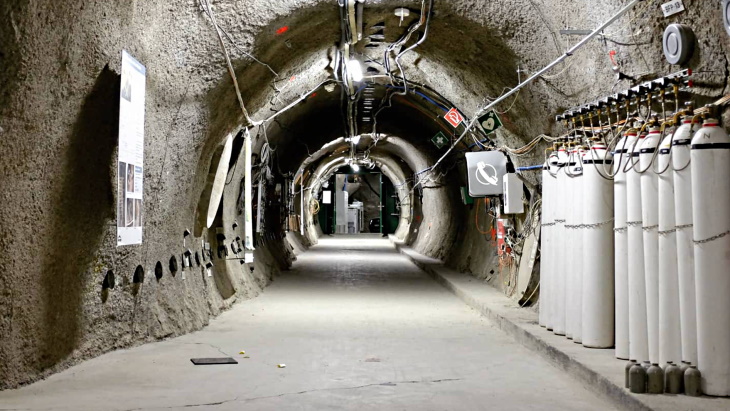
The research builds on the developing work of the Mont Terri Project near St-Ursanne in Switzerland, an international research project for the hydrogeological, geochemical and geotechnical characterisation of an Opalinus Clay formation. Founded in 1996, the rock laboratory is situated about 300 metres underground.
“It is widely regarded as one of the most valuable real-world experiment sites because it provides us with decades of datasets around the interactions of cement and clay, and those are the key materials proposed to be used by countries across the world for engineered barrier systems and geological repositories for nuclear waste,” Sarsenbayev said.
Within the last several years, a mix of both negatively and positively charged ions were added to the borehole located near the centre of the cement emplaced in the formation. The researchers focused on a 1-cm-thick zone between the radionuclides and cement-clay referred to as the ‘skin’. They compared their experimental results with the software simulation, finding the two datasets aligned.
The experimental results showed the model successfully accounted for electrostatic effects associated with the clay-rich formation and the interaction between materials in Mont Terri over time.
The new model could now replace older models that have been used to conduct safety and performance assessments of underground geological repositories.
“These powerful new computational tools, coupled with real-world experiments like those at the Mont Terri research site in Switzerland, help us understand how radionuclides will migrate in coupled underground systems,” Sarsenbayev said.
Wainwright added: “This research – coupling both computation and experiments – is important to improve our confidence in waste disposal safety assessments. With nuclear energy re-emerging as a key source for tackling climate change and ensuring energy security, it is critical to validate disposal pathways.”
The authors said they hope the research will “improve confidence among policymakers and the public in the long-term safety of underground nuclear waste disposal”.
A Geological Disposal Facility comprises a network of highly-engineered underground vaults and tunnels built to permanently dispose of higher activity radioactive waste so that no harmful levels of radiation ever reach the surface environment. Countries such as Finland, Sweden, France, Canada, the UK and the USA are pursuing this option.