Xuwei Phase I was among 11 reactors approved by China’s State Council in August 2024. China National Nuclear Corporation (CNNC) plans to build two 1,208 MWe (net) Hualong One (HPR1000) pressurised water reactors (units 1 and 2) and one 660 MWe high-temperature gas-cooled reactor (HTGR) (unit 3) at the site in Lianyungang, Jiangsu province. The project will be equipped with a steam heat exchange station, which will adopt the heat-to-electricity operation mode for the first time.
Construction has now started on unit 3 of the plant, which will feature a Chilong One HTGR, jointly developed by CNNC and Tsinghua University. The unit has a rated capacity of 660 MWe and is designed for an operational lifespan of 60 years.
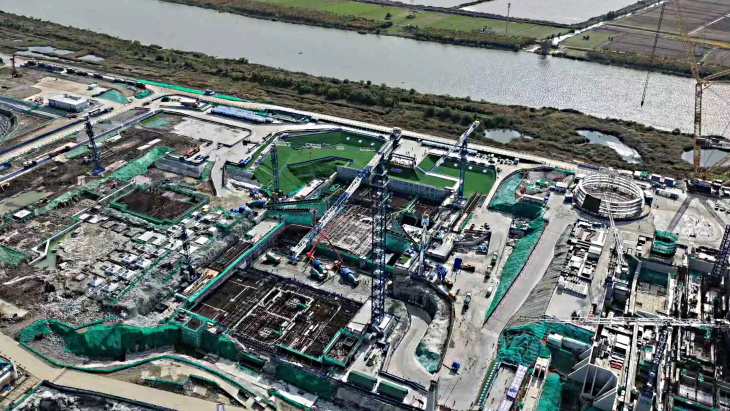
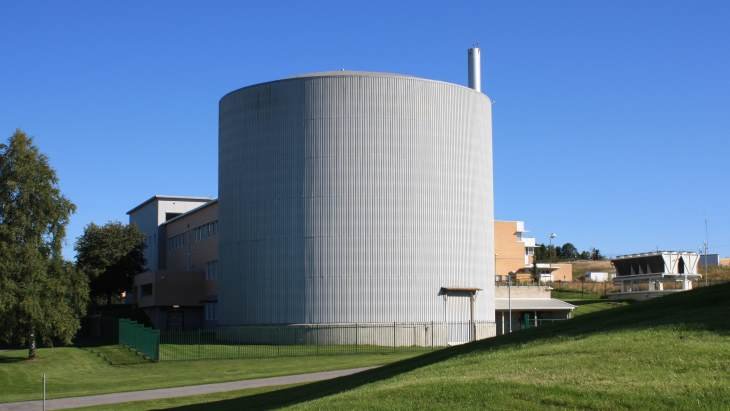
(Image: CNNC)
“With the commencement of concrete pouring for the high-temperature gas-cooled reactor nuclear island of Unit 3, the project construction is progressing smoothly according to plan,” CNNC said.
First concrete was poured in January this year for the nuclear island of the unit 1 Hualong One at the Xuwei project.
CNNC said the project is planned to be implemented through direct procurement, with specialised nuclear power engineering subsidiary CNNC Energy Technology Company Ltd entrusted with the high-temperature reactor design, equipment and material procurement and delivery, certification support, construction technical support, commissioning support, equipment training, and related project management. CNNC Energy Technology Company Ltd has previously undertaken EPC general contracting for the nuclear island and balance of plant for the Shandong Shidaowan High-Temperature Gas-Cooled Reactor Nuclear Power Demonstration Project, as well as nuclear island commissioning services. CNNC holds a 46% stake in the company.

(Image: CNNC)
A contract for the construction of the conventional islands of the three units was awarded in September last year to a consortium formed by China Energy Engineering Jiangsu Electric Power Construction No 3 Company and China National Nuclear Huachen Construction Engineering Company. Under the CNY4.2 billion contract, Jiangsu Electric Power Construction No 3 Company will build the three conventional island power plants, their ancillary facilities, and the construction and installation of some ‘balance of plant’ components.
At the plant – very close to CNNC’s existing Tianwan plant – demineralised water will be heated by the primary steam of the Hualong One units to produce saturated steam, and the primary steam of the HTGR will be used to heat the saturated steam for the second time “to generate three different types of high-quality industrial steam with different parameters”. CNNC said: “This will meet the industrial steam demand of the petrochemical park. Once completed, the plant will have both high-quality steam supply and power generation capabilities under its design conditions.”
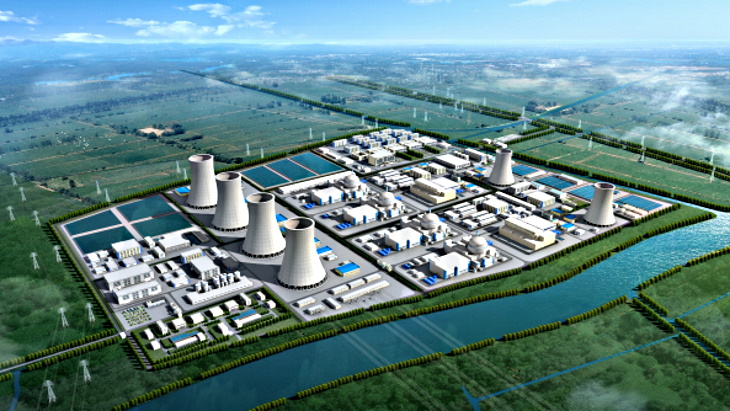
A rendering of the Xuwei plant (Image: CNNC)
Once the first phase of the project is completed and put into operation, it will supply 32.5 million tonnes of industrial steam annually, with a maximum power generation of more than 11.5 billion kilowatt-hours, which can reduce the use of standard coal by 7.26 million tonnes and reduce carbon dioxide emissions by 19.6 million tonnes each year.
“Jiangsu Xuwei Nuclear Power Plant is the world’s first large-scale coupling project of nuclear energy and petrochemicals, the world’s first coupling project of pressurised water reactor and high temperature gas-cooled reactor, the world’s first application project of ‘reactor-machine-heat’ coordinated control mode, and the world’s first commercial application project of high temperature gas-cooled reactor,” according to CNNC.
CNNC Suneng Nuclear Power Company is the CNNC subsidiary which is the owner of the Xuwei project and responsible for project investment, construction and operation management.
“From experimental reactors and demonstration projects to the commercial promotion of the Xuwei project, China’s fourth-generation nuclear energy technology is accelerating towards large-scale industrial application,” CNNC said. “The commercial application of high-temperature gas-cooled reactors not only provides a large-scale supply of high-quality heat sources for the petrochemical industry, but also promotes the transformation of China’s nuclear energy from primarily power generation to diversified supply, providing a replicable ‘Chinese solution’ for the green transformation of energy-intensive industries worldwide.”