Monday, 6 January 2025
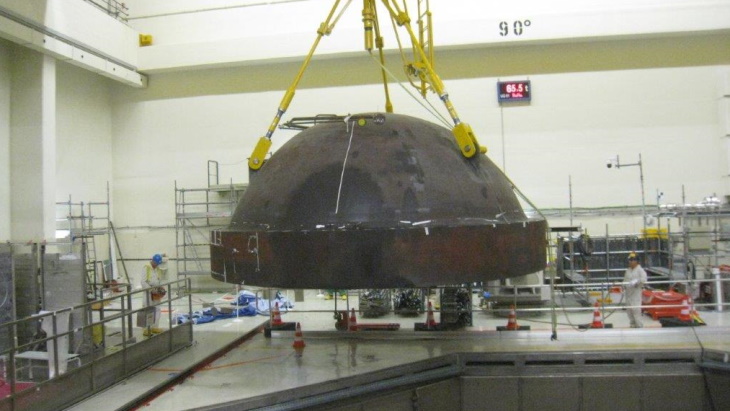
Weighing almost 70 tonnes and with a diameter of more than 6 metres, the lid of the reactor pressure vessel was heavier than any of its internal components, Vattenfall noted. Like the internal components, it has now been dismantled and packed.
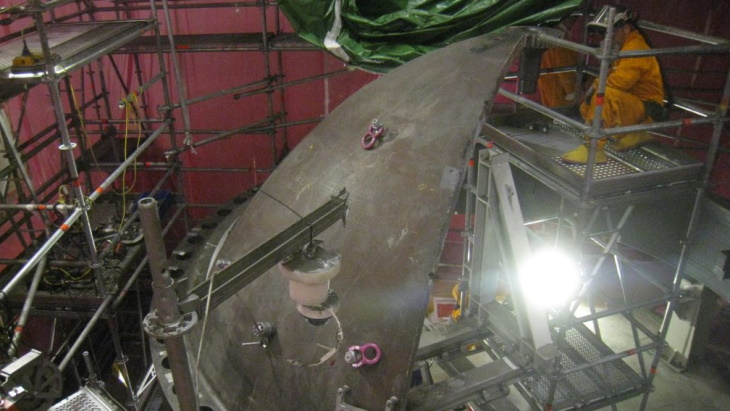
The cover dome was made of 8-centimetre-thick heat-resistant steel and was coated on the inside with a 6-millimetre-thick stainless steel plating to protect it from corrosion. The flange had a wall thickness of 42 centimetres. The cover dome was cut into eight segments, with each segment weighing 2.8 tonnes. Six pieces, each weighing 7.7 tonnes, were cut from the surrounding flange.
(Image: Vattenfall)
Some of the tools used in the segmentation process had to be specially made for this project, including the substructure to secure the individual dome segments during cutting and the wire saw used.
“When you break the lid dome down into individual parts, you need a support so that the cut-out parts can be handled safely,” said Michael Maassen, who was responsible for the work on site. “The lid was placed on the substructure and turned seven times. So we moved the lid, not the saw.”
The dismantled parts of the cover have been packed in a total of four 20-foot IP2 containers. The cut pieces will be melted down by a contract partner as part of the release process. The steel produced can then be used for other applications.
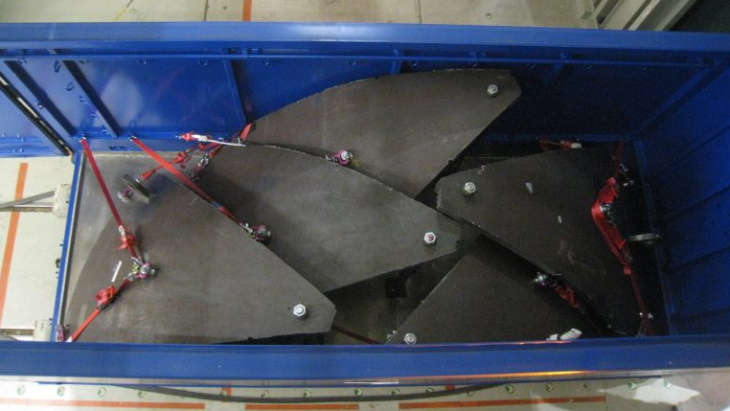
(Image: Vattenfall)
The single-unit Brunsbüttel plant was among the eight oldest German reactors taken out of service in March 2011. The 771 MWe boiling water reactor had been idle since 2007 following a grid-facilitated trip. Brunsbüttel was one of eight older power reactors that had their operating licences withdrawn by the federal government shortly after the Fukushima accident in Japan in March 2011. Vattenfall – which owns a 66.7% stake in the plant with PreussenElektra holding the remaining 33.3% – applied in late 2012 to decommission that plant.
With the removal of the last fuel element in June 2017 and the last fuel rods in February 2018, around 99% of the radioactive inventory has left the plant. Of the remaining 1% of the radioactive inventory, more than 90% is in the reactor pressure vessel and its internals. The internals are currently being removed, dismantled and packaged for final storage.