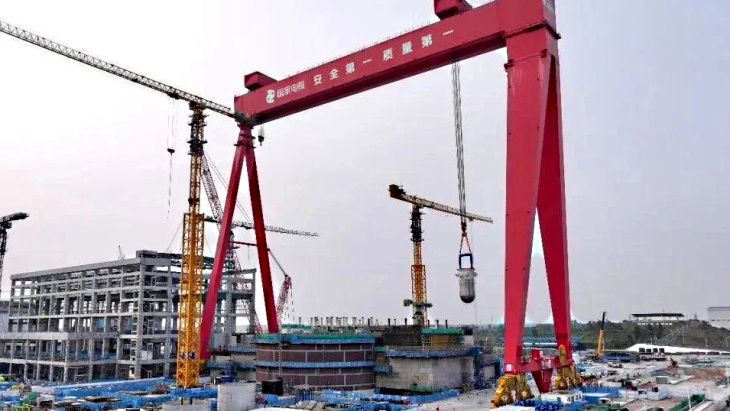
State Power Investment Corporation (SPIC) said the outer steel dome of the nuclear island of unit 4 of the Haiyang plant in Shandong province was hoisted into place on 9 February.
The steel dome module is an important component of the shielded building, situated on top of a steel-concrete composite structure, and supporting the passive containment cooling water storage tank. The steel dome is conical in shape, consisting of 32 radial main beams, three ring beams, 96 steel cladding panels, and three steel platforms connected at the bottom. It has a diameter of about 41 metres, a height of about 11 metres, and a total lifting weight of nearly 1,000 tonnes.
The installation of the outer dome marks “the basic completion of the main structure of the nuclear island plant and lays an important foundation for the project to fully enter the equipment installation and system commissioning phase”, it said.
_e928cc67.jpg)
(Image: SPIC)
The CAP1000 reactor design – the Chinese version of the Westinghouse AP1000 – uses modular construction techniques, enabling large structural modules to be built at factories and then installed at the site. This means that more construction activities can take place at the same time, reducing the time taken to build a plant as well as offering economic and quality control benefits.
The construction of two CAP1000 reactors at Haiyang – which is already home to two AP1000 units – was approved by China’s State Council in April 2022.
The first safety-related concrete was poured for the nuclear island of Haiyang unit 3 in July 2022. Construction of Haiyang 4 began in April last year. The planned construction period for Haiyang 3 and 4 was 56 months, with the two units scheduled to be fully operational in 2027.
Dome installed at Xudabao unit
Meanwhile, China National Nuclear Corporation (CNNC) announced that the inner dome – the top of the containment vessel – was hoisted into place on 10 February at unit 1 of the Xudabao plant in Liaoning Province, “marking the transition of the unit’s construction from civil engineering to the installation phase”.
_33928a28.jpg)
(Image: CNNC)
The steel containment vessel of the CAP1000 consists of six modules: a bottom head, a cylindrical shell (comprising rings one to four), and a top head. It serves as a crucial barrier to prevent the release of radioactive material and is a key component in implementing passive safety functions.
The containment top head is assembled and welded from 64 curved steel plates, forming a semi-ellipsoidal structure with an inner diameter of nearly 40 metres and a total height exceeding 11 metres, and weighing over 820 tonnes. Prior to hoisting, it completed the installation of multiple systems and equipment, including fire sprinklers, temporary ventilation, and airflow turbulence, significantly reducing subsequent construction work within the nuclear island, effectively improving construction efficiency and lowering installation risks.
_ce158606.jpg)
(Image: CNNC)
“This successful hoisting of the top head creates favourable conditions for subsequent installation, commissioning, and grid connection, providing strong support for building China’s northernmost nuclear power base and laying a solid foundation for Liaoning Province to develop an integrated wind, solar, thermal, nuclear, and energy storage base,” CNNC said.
The Ministry of Ecology and Environment announced in November 2023 that the National Nuclear Safety Administration had decided to issue a construction licence for Xudabao units 1 and 2, which will both feature 1250 MWe CAP1000 reactors. A ceremony was held later that month at the Xudabao site near Xingcheng City, Huludao, to mark the start of construction of unit 1.
_840161b9.jpg)
(Image: CNNC)
The Xudabao project (also known as Xudapu) was originally expected to comprise six CAP1000 reactors, with units 1 and 2 in the first phase. Site preparation began in November 2010. The National Development and Reform Commission gave its approval for the project in January 2011. However, with a change in plans, construction of two Russian-supplied VVER-1200 reactors as Xudabao units 3 and 4 began in July 2021 and May 2022, respectively.
The Xudabao plant is owned by Liaoning Nuclear Power Company Ltd, in which CNNC holds a 70% stake with Datang International Power Generation Company holding 20% and State Development and Investment Corporation owning 10%. The general contractor is China Nuclear Power Engineering Company Ltd, a subsidiary of CNNC.
Two further CAP1000 reactors are proposed for units 5 and 6 at the Xudabao plant.