In February 2022, French President Emmanuel Macron announced that the time was right for a nuclear renaissance in France, saying the operation of all existing reactors should be extended without compromising safety and unveiling a proposed programme for six new EPR2 reactors, with an option for a further eight EPR2 reactors to follow. The first three pairs of EPR2 reactors are proposed to be built, in order, at the Penly, Gravelines and Bugey sites. Construction is expected to start in 2027. The cost was originally estimated at EUR51.7 billion (USD53 billion), but this was revised to EUR67.4 billion in 2023. EDF is expected to make a final investment decision on the project next year.
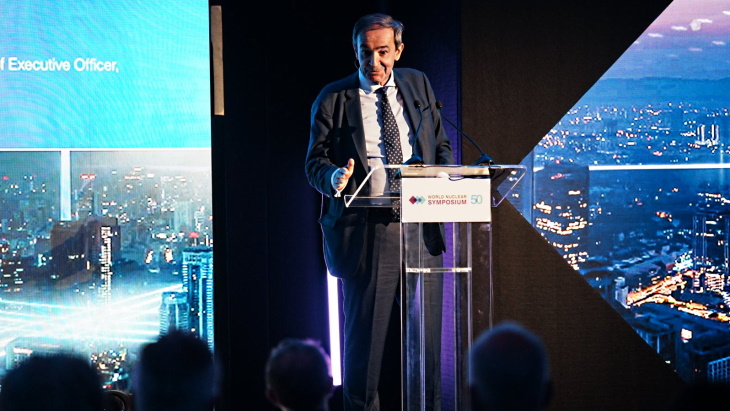
“We all know that delays directly inflate the cost, and in fact, the financial charge alone is not a very significant part of the cost of the nuclear programme,” he said. “This is why reducing lead time, the time from design to delivery, is one of my really top, top, top priorities.
“We want to minimise unnecessary delays, often caused by overly complex approvals or bureaucratic bottlenecks that we deploy ourselves in our processes everywhere. So streamlining approvals, ensuring consistency in overall, in oversight, and ensuring smoother project execution are key to success and to make nuclear more competitive. By reducing cycle time, we can deliver the energy transition at the pace and the scale our countries are required.”
Fontana said for EDF the challenge is to maximise standards of quality control while “preserving the agility we need to execute the major programmes”. To achieve this, EDF is reshaping both its relationship with suppliers and its internal organisation.
“With suppliers, we are moving towards industrial partnership models, sharing a common focus on safety, on quality, and on timing. Internally, we are strengthening project governance, standardisation, and investing in digital tools to enable production in series so that every project builds systematically on the experience of the last one.”
He said this approach allows EDF to deliver better coordination with its suppliers, stronger internal planning supported by advanced digital platforms, and “above all, an industrial mindset focused on standardisation, repeatability, quality, and delivering the projects. So safety, quality with efficient quality control and lead time are the three pillars of EDF’s operational transformation, enabling us to build faster, deliver at low cost and maintain the highest standards, ensuring that EDF remains a cornerstone of nuclear energy future”.
Fontana concluded: “Just as in the 1970s, when France built one of the world’s most successful nuclear fleets, EDF has the ambition and the responsibility to demonstrate once again, we can deliver a competitive fleet on time, on budget, and at scale. And reducing lead time, improving quality with better processes, and cost efficiency go hand in hand.”
Building confidence and trust
Speaking in a separate session on the supply chain, Vakis Ramany, EDF’s Senior Vice President International Nuclear Development, said the company was preparing to move from one-off projects to a new build programme.
“In France, currently, the process is reaching, hopefully, a decision point for six EPR technology-based reactors to be built. And that approach for six reactors, of course, three sites, is something which will effectively completely change the dynamic, provide the suppliers with a very different dynamic to deal with, and their ability to plan will be different. Of course, they will have also to deliver and demonstrate they can deliver.
“On our side, on the industry level, we have to organise things in such a way that effectively we can provide the suppliers, especially when we are integrators like EDF, all the elements that help them plan and define their approach from one project to another. This is what will improve lead time and efficiency.”
Ramany said early involvement builds trust.
“What we need to work on is really how to bring the culture of confidence and mutual performance, bringing to the delivery and lead time for the programmes in the collaboration, the cooperation, really aim for common milestones and shared risk. I think there is a time now where we move to fleet approach and where, effectively, the assessment and the approach to risk has to be much more shared and accepted also to the supply chain.”