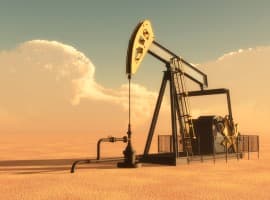
Egypt has announced discoveries at four exploration wells in the Western Desert as the North African country looks to boost oil and gas production and cut dependence on imports.
The four exploration wells are expected to have a combined daily production capacity of nearly 4,500 barrels of crude oil and 2.6 million cubic feet of natural gas, the Egyptian Ministry of Petroleum and Mineral Resources said.
Khalda Petroleum Company, a joint venture between Egyptian General Petroleum Corporation (EGPC) and Apache Corporation, as well as Tharwa Petroleum Company and Borg El Arab Petroleum Company, made the discoveries, Egypt said.
Khalda Petroleum made two discoveries with a daily production rate exceeding 1,500 barrels of crude oil and about 1.7 million cubic feet of gas, from the wells Sultan S-1X RC and Alex NW-1X.
Tharwa Petroleum made its discovery in the East Abu Sennan concession area, in the EAS Z-3 well, with an initial production rate of 1,500 barrels of oil per day. Testing is ongoing, and the size of the added reserves will be assessed upon completion of the tests, the company said this weekend.
Borg El Arab Petroleum found oil and gas at the AS Z-2X well in the Abu Sennan Development Area. The test results suggested production rates of about 1,305 barrels of oil per day, in addition to 900,000 cubic feet of associated gas per day.
At the end of last year, Egypt said it plans to drill 480 new exploratory oil wells over the next five years, in an ambitious $5.7 billion wager that the country can claw its way back from years of production decline.
A total of 101 wells are slated for drilling in 2026, spread across Egypt’s main producing regions.
After four years of declines, Egypt’s oil and gas production started to rise in September, providing much-needed relief to the import bill of the North African country.
By Tsvetana Paraskova for Oilprice.com
More Top Reads From Oilprice.com
- Venezuela’s Oil in Floating Storage Soars to 29 Million Barrels
- Trump’s War on Wind Power Is Raising Costs Around the World
- U.S. Pushes for Reducing Rare Earth Dependence on China