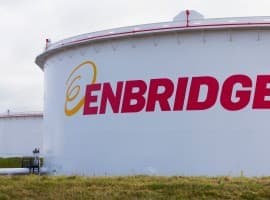
Enbridge has approved a $1.4 billion expansion across its Mainline and Flanagan South systems that will push more Canadian heavy crude into the U.S. Midwest and down to the Gulf Coast—right where coking refineries are built to run it. Phase 1 of the Mainline Optimization (MLO1) adds 150,000 bpd on the Mainline and 100,000 bpd on Flanagan South, with in-service targeted for 2027. The uplift comes through pump and terminal expansions on Flanagan South and upstream optimizations on the Mainline, backed by long-term take-or-pay commitments from Edmonton to Houston.
The timing lines up cleanly with Canada’s production trajectory. Oil sands output is on track for a record this year and is projected to approach 3.9 million bpd by 2030, driven by low-decline, high-efficiency expansions rather than new megaprojects. Extra pipeline capacity keeps barrels moving to the highest-value markets and reduces the risk of the painful differential blowouts Canada has seen whenever egress tightens.
Enbridge is already running close to the ceiling. Mainline throughput averaged a record 3.1 million bpd in Q3—evidence of how little spare capacity remains and why incremental debottlenecking is the only realistic near-term solution. The company has also been exploring the 200,000 bpd “Southern Illinois Connector” to move more crude from Illinois toward the Gulf Coast, a sign of continued pull from heavy-capable U.S. refiners.
The regulatory backdrop has softened slightly. The U.S. Army Corps of Engineers recently approved Enbridge’s 41-mile Line 5 reroute around the Bad River Reservation in Wisconsin. The project remains politically explosive, but the approval removes one regulatory unknown for shippers who depend on Enbridge’s network for multi-year planning.
Market-wise, more Canadian heavy into PADD 2 and the Gulf tends to narrow WCS-Houston versus Maya or Arab Medium and can tighten regional heavy-light spreads when barrels land consistently. For U.S. refiners, added reliability of heavy feedstock is a strategic advantage in a world where Venezuelan flows remain constrained and Mexico is increasingly reserving its crude for domestic refining. For Canadian producers, additional egress helps stabilize upstream planning and supports the capex-light growth model that has defined the post-2018 oil sands.
Enbridge’s most recent results also showed that liquids performance can ebb and flow depending on how individual lines are running and what shippers are nominating. Flanagan South and Spearhead brought in less than they did a year earlier, which isn’t unusual given how sensitive those systems are to refinery maintenance, crude quality swings, and downstream congestion. Even so, the company is plainly leaning into a long-term plan: get more capacity out of the rights-of-way it already controls, secure firm commitments, and give both producers and refiners a clearer view of how barrels will move after 2027. The barrels will be there—MLO1 is about making sure the path is too.
By Julianne Geiger for Oilprice.com
More Top Reads From Oilprice.com
- Canada and India to Partner in Critical Minerals Supply Chain
- Unusual Weather Drives China’s Biggest Power Spike in Two Years
- Ukraine Intensifies Campaign Targeting Russia’s Vital Oil Lifeline