Thursday, 6 March 2025
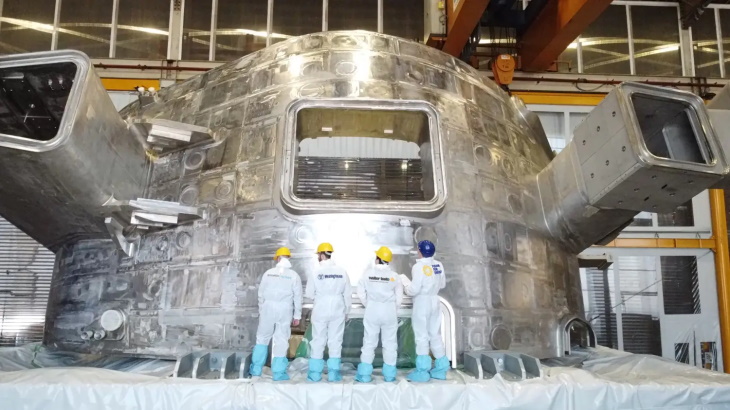
The International Thermonuclear Experimental Reactor’s (ITER’s) plasma chamber, or vacuum vessel, houses the fusion reactions and acts as a first safety containment barrier. With an interior volume of 1400 cubic metres, it will be formed from nine wedge-shaped steel sectors that measure more than 14 metres in height and weigh 440 tonnes. The ITER vacuum vessel, once assembled, will have an outer diameter of 19.4 metres, a height of 11.4 metres, and weigh approximately 5200 tonnes. With the subsequent installation of in-vessel components such as the blanket and the divertor, the vacuum vessel will weigh 8500 tonnes.
Each vacuum vessel sector is manufactured in four segments, requiring more than 1.6 kilometres of welding for assembly. Maintaining precise tolerances of less than a few millimetres ensures the seamless integration of internal components, which demands advanced forming and welding technologies.
The fabrication of the vacuum vessel sectors is shared between Europe (five sectors) and South Korea (four sectors). Initially, South Korea was tasked with producing two vacuum vessel sectors under its agreement with the ITER Organization. However, in 2016, an additional agreement was made to produce two more sectors originally assigned to the EU.
Starting with the delivery of the first sector in 2020 and the final one in November last year, South Korea completed four sectors, fulfilling its commitment to this significant international project.
The manufacture of the first of five vacuum vessel sectors under the responsibility of Fusion for Energy (F4E) – the ITER Organisation’s European domestic agency – was completed in Italy in September and subsequently delivered to the construction site.
Europe completes second sector
During a ceremony held on 5 March at Walter Tosto’s facility in Ortona a Mare, Abruzzo, senior representatives from industry, politicians, and members of the technical teams gathered to celebrate Europe’s completion of the second sector.
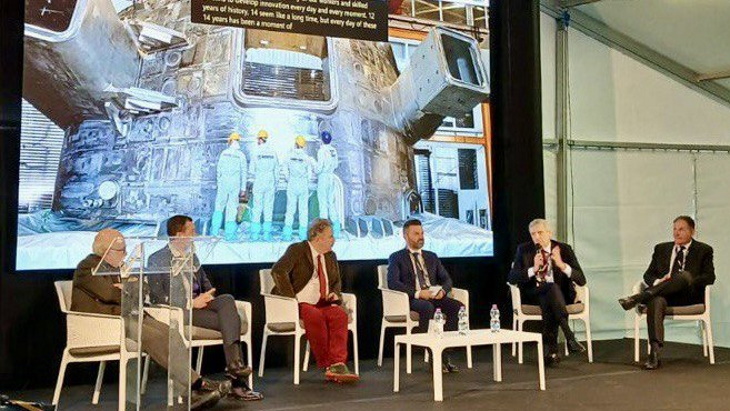
(Image: Ansaldo Nucleare)
“The completion of the second European sector of ITER’s vacuum vessel demonstrates yet again the exceptional manufacturing skills of our industry and its ability to apply quickly lessons learned from the first sector,” F4E Director Marc Lachaise said in his speech at the ceremony. “It also illustrates how the EU, through its participation in the biggest international fusion project, can successfully involve medium-sized companies, help them grow, and target overseas markets. We are proud of this achievement because it shows that Europe delivers and is competitive.”
Ansaldo Nucleare President Roberto Adinolfi added: “The completion of the second EU sector of the Vacuum Vessel by the AMW Consortium confirms the ability of the European supply chain to combine strengths and capabilities existing in our individual companies to deliver high quality complex components, at the forefront of nuclear technologies.”
The sector will depart from Italy later this month and travel by sea to Fos-sur- Mer, the industrial port of Marseille. Then, it will be loaded onto a trailer to be driven to ITER site. Europe’s remaining three sectors are in production and will be delivered in the next two years.
The ITER project
ITER is a major international project to build a tokamak fusion device designed to prove the feasibility of fusion as a large-scale and carbon-free source of energy. The goal of ITER is to operate at 500 MW (for at least 400 seconds continuously) with 50 MW of plasma heating power input. It appears that an additional 300 MWe of electricity input may be required in operation. No electricity will be generated at ITER.
Thirty-five nations are collaborating to build ITER – the European Union is contributing almost half of the cost of its construction, while the other six members (China, India, Japan, South Korea, Russia and the USA) are contributing equally to the rest. Construction began in 2010 and the original 2018 first plasma target date was put back to 2025 by the ITER council in 2016. However, in June last year, a revamped project plan was announced which aims for “a scientifically and technically robust initial phase of operations, including deuterium-deuterium fusion operation in 2035 followed by full magnetic energy and plasma current operation”.