By
40 min ago 2 min read
The European Bank for Reconstruction and Development (EBRD) is boosting Latvia’s biomethane production capacity and use of renewable fuels with a €26m loan to Next Biogas, a subsidiary of the Netherlands-based HoSt Group.
The investment will help the group acquire an existing biogas plant in Lēdurga, and convert it into a biomethane production facility.
Once operational, the facility will be one of the largest biomethane plants in the country, producing around 80,070 MWh of biomethane per year, which will be transported and injected into the gas grid for both domestic use and export to European markets.
The production process also captures biogenic CO₂, creating a secondary sustainable product while ensuring a highly carbon-neutral production cycle.
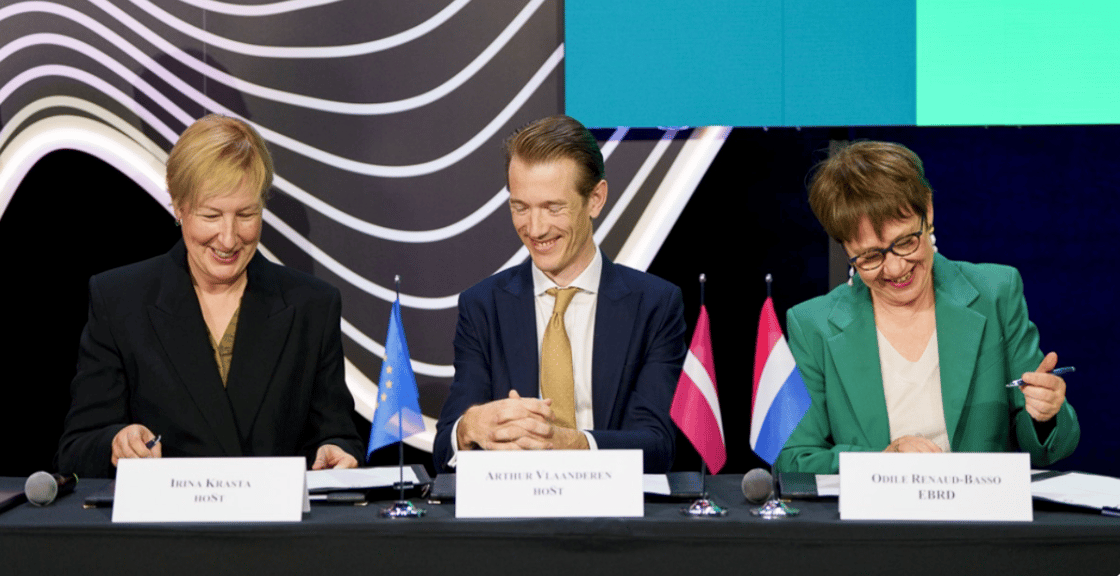
Signing the deal at the EBRD’s 2026 Annual Meeting in Riga, EBRD President Odile Renaud-Basso said, “This project boosts energy security while accelerating the low carbon transition, especially for hard to abate sectors.”
Arthur Vlaanderen, Group CFO of HoSt Group, added that the funding directly accelerates HoSt Group’s strategy to develop, own, and operate critical green energy infrastructure.
“This sustainable investment proves the strong commercial viability of advanced biomethane projects and underscores our shared drive to power the energy transition,” he said.
“By transforming the Lēdurga plant into one of Latvia’s largest biomethane facilities, we are anchoring circular energy production in the region and making a tangible contribution to Europe’s energy security.”
Valdis Dombrovskis, European Commissioner for Economy and Productivity, and Implementation and Simplification, said the strategically important project supports the development of a nascent biomethane market in Latvia and the Baltics.
“It will enhance energy security by substituting imported natural gas with locally produced low-carbon fuel, aligned with EU decarbonisation and autonomy objectives. The loan extension stands again as a testament to the EBRD as a key EU partner, active on shared priorities.”
The Latvian government recently approved proposals by the Ministry of Climate and Energy for the construction of at a cost of €4.7m ($5.5m).