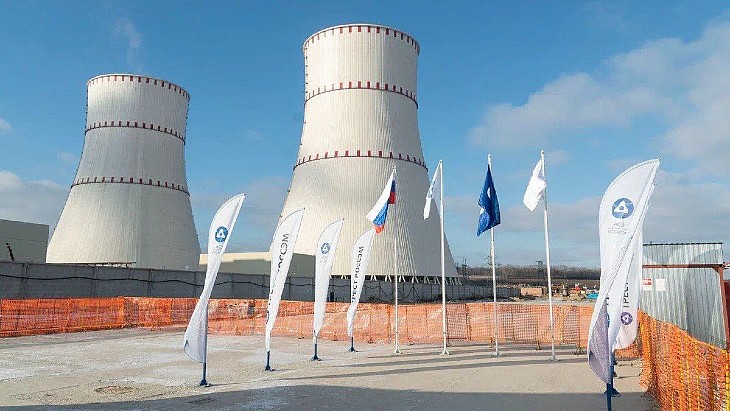
First new Kursk unit reaches full power

The 1,250 MWe unit was connected to the grid in December. During pilot operation there have been a series of checks and tests at each capacity level before it is allowed to increase in steps to 100% capacity.

Alexander Uvakin,Kursk Nuclear Power Plant Director, said: “At each stage, our specialists conducted a series of tests to verify the parameters and performance characteristics of the systems and equipment met their design values ​​and ensure their reliable and safe operation. At 100% power, we will once again examine the neutronic characteristics of the core, study the reactor’s performance under various scenarios, test the in-core monitoring systems, conduct a complete power-down of the unit, and check the effectiveness of the biological shielding and radiation situation at the NPP.”

Oleg Shperle, Vice President and Director of the Kursk NPP Construction Project at JSC ASE, said: “We can now confidently say that the unit has confirmed the validity of the design and engineering solutions adopted in the VVER-TOI design, the high quality of the manufactured equipment, and the construction and installation work performed.”

The new unit is scheduled to begin commercial operation later this year, once nuclear regulator Rostechnadzor and the Rosenergoatom acceptance committee approve it.

Background

Kursk II is a new nuclear power plant in western Russia, about 60 kilometres (37.5 miles) from the Ukraine border, that will feature four of the new VVER-TOI reactors, the latest version of Russia’s large light-water designs. They have upgraded pressure vessels and a power rating of 1,250 MW. Construction of the first unit began in 2018, its polar crane was installed in October 2021 and the reactor vessel was put in place in June 2022. Concreting of the outer dome of the first unit was completed in August 2023. The second unit is also under construction and the target is for all four units to be in operation by 2034.

Rosatom says the service life of the main equipment has doubled, and that the VVER-TOI units feature a mix of passive and active safety systems and include a core meltdown localiser. The new units at Kursk II will replace the four units at the existing, nearby Kursk nuclear power plant, which are scheduled to shut by 2031. The first unit was shut down after 45 years of operation in December 2021 and the second unit followed in January 2024. The original design life for the four RBMK-1000 reactors at the plant was for 30 years but had been extended by 15 years following life extension programmes.
   

  • Related Posts

    Construction starts at Saskatchewan uranium mine

    The groundbreaking ceremony comes after the company received the final regulatory approval for the project – described by NexGen as the largest development-stage uranium project in Canada – in March.…

    Nuclea Energy to acquire Moltex Energy technology portfolio

    Ontario-headquartered Nuclea is designing the Morpheus microreactor, a compact, transportable and factory-fabricated lead-cooled, graphite-moderated microreactor which is currently in the conceptual design stage. The Moltex asset acquisition would extend Nuclea’s…

    Have You Seen?

    Diversifying helium: Can dedicated projects reshape global supply?

    • August 17, 2026
    Diversifying helium: Can dedicated projects reshape global supply?

    How Phoenix is capitalizing on the Southwest’s opportunity

    • August 17, 2026
    How Phoenix is capitalizing on the Southwest’s opportunity

    India Daily: SECI Seeks Inputs for RE PMU, UPERC Rejects UPRVUNL Solar Petition, Adani Acquires Vizag Transmission SPV, KERC Drafts 2026 Supply Rules, Telangana Eyes 2,545 MW Solar and More…

    • August 17, 2026
    India Daily: SECI Seeks Inputs for RE PMU, UPERC Rejects UPRVUNL Solar Petition, Adani Acquires Vizag Transmission SPV, KERC Drafts 2026 Supply Rules, Telangana Eyes 2,545 MW Solar and More…

    How ReNew Is Advancing Its Net-Zero and Sustainability Roadmap: Key Takeaways From Its FY2025–26 Integrated Report

    • August 17, 2026
    How ReNew Is Advancing Its Net-Zero and Sustainability Roadmap: Key Takeaways From Its FY2025–26 Integrated Report

    CATL Achieves Carbon Neutrality Across Core Operations, Targets Full Value Chain by 2035

    • August 17, 2026
    CATL Achieves Carbon Neutrality Across Core Operations, Targets Full Value Chain by 2035

    Why Has Oil Not Rallied to $150 or Higher?

    • August 17, 2026
    Why Has Oil Not Rallied to $150 or Higher?

    Türkiye And Saudi Arabia Expand Renewable Energy Partnership To 5,000 MW

    • August 17, 2026
    Türkiye And Saudi Arabia Expand Renewable Energy Partnership To 5,000 MW

    Podcast | Gas distribution done right: design, reliability, and performance from source to point-of-use

    • August 17, 2026
    Podcast | Gas distribution done right: design, reliability, and performance from source to point-of-use

    Bangladesh tragedy shines spotlight on LNG shipbreaking safety

    • August 17, 2026
    Bangladesh tragedy shines spotlight on LNG shipbreaking safety

    Shell Energy Philippines Advances 30 MW/60 MWh Hermosa Battery Storage Project

    • August 17, 2026
    Shell Energy Philippines Advances 30 MW/60 MWh Hermosa Battery Storage Project