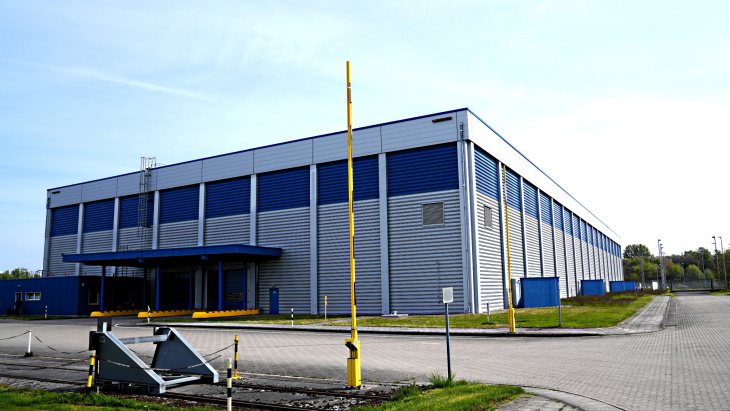
The storage facility forms part of the Gronau plant’s expansion licence which was granted in 2005 by the nuclear licensing authority of the state of North Rhine-Westphalia. The licence allows an annual capacity of up to 4.5 million separative work units (SWU) per year at the plant. SWU is the unit used to measure the energy required to separate uranium-235 from uranium-238. The state government required Urenco to build an additional storage hall for up to 59,000 tonnes of uranium oxide on the Gronau site.
The storage facility is a key element of the strategy for managing depleted uranium, the by-product known as tails, which is generated during the uranium enrichment process. Over the coming years, material from Gronau will be transported for further processing both to Orano’s Pierrelatte in France and to Urenco’s Tails Management Facility in Capenhurst in the UK. At these sites, the depleted uranium, which is in uranium hexafluoride (UF6) form, will be chemically converted into uranium oxide (U3O8).
U3O8 is considered a particularly suitable form for long-term storage. The material is insoluble in water, non-combustible, chemically highly stable and non-volatile even at elevated temperatures. Following the commissioning of the storage facility, depleted uranium originating from Gronau and converted into U3O8 at dedicated facilities at Pierrelatte and Capenhurst can be returned to Gronau for long-term storage.
The storage building itself was completed in 2014 under the existing licence. With its formal commissioning now complete, all legal and operational requirements for the safe storage of U3O8 on the site have been fulfilled.
Under current legislation, depleted uranium is classified as a potentially reusable material resource. The safety report prepared for the final expansion stage of the Gronau enrichment plant in 2002 noted that depleted uranium still contains a significant proportion of the uranium-235 originally present, meaning that potential future uses remain possible. While no specific reuse pathway is currently envisaged, Urenco said a range of potential utilisation options continues to exist in principle.
“With the commissioning of the U3O8 storage facility, we are implementing a component of our site strategy that has been planned for many years,” said Jörg Harren, managing director of Urenco Deutschland GmbH. “Storage is carried out in a form that is regarded as particularly safe and stable according to the current state of science and technology. At the same time, we are preserving depleted uranium responsibly for the future. Although no specific future use is currently planned, potential utilisation options remain available in principle. Our goal is to combine safety, sustainability and long-term thinking.”
Background
Urenco’s board approved the construction of the Tails Management Facility (TMF) at Capenhurst, comprising a tails deconversion facility and a number of associated storage, maintenance and residue processing facilities, in 2009. In 2010, Urenco received regulatory and planning approval to build the facility. A ceremony was held in June 2019 to mark the official opening of the TMF. It is operated by Urenco subsidiary Urenco ChemPlants.
Urenco – established in 1970, and one-third owned by the UK government, one-third by the Netherlands and one-third by the two German utilities RWE and Eon – operates plants in Germany, the Netherlands, the UK and the USA using its own centrifuge technology to enrich uranium for the use as a nuclear fuel for civil power generation.
Unenriched, or natural, uranium contains about 0.7% of the fissile uranium-235 (U-235) isotope. (“Fissile” means it’s capable of undergoing the fission process by which energy is produced in a nuclear reactor). The rest is the non-fissile uranium-238 isotope. Most nuclear reactors need fuel containing between 3.5% and 5% U-235. This is also known as low-enriched uranium, or LEU. Advanced reactor designs that are now being developed – and many small modular reactors – will require higher enrichments still. Material containing between 5-10% U-235 is known as LEU+ and high-assay low-enriched uranium, or HALEU, covers enrichment up to 20%.
Enrichment increases the concentration of the fissile isotope by passing the gaseous uranium hexafluoride through gas centrifuges, in which a fast-spinning rotor inside a vacuum casing makes use of the very slight difference in mass between the fissile and non-fissile isotopes to separate them. As the rotor spins, the concentration of molecules containing heavier, non-fissile, isotopes near the outer wall of the cylinder increases, with a corresponding increase in the concentration of molecules containing the lighter U-235 isotope towards the centre.