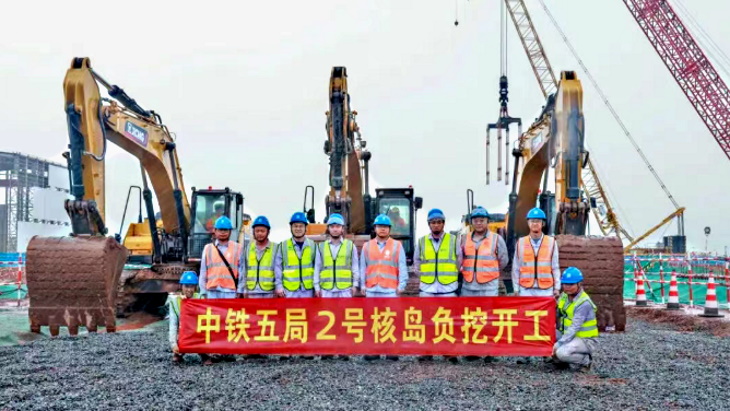
The excavation of the foundation pit for Bailong 2 began on 28 September, State Power Investment Corporation (SPIC) subsidiary Guangxi Nuclear Power Company Ltd announced.
The construction of Phase I (units 1 and 2) of the Bailong plant was among approvals for 11 new reactors granted by China’s State Council in August last year. An investment of about CNY40 billion (USD5.6 billion) is planned for the two CAP1000 units – the Chinese version of the Westinghouse AP1000 – which are expected to take 56 months to construct.
Excavation of about 66,000 cubic metres of earth to form the foundation pit of unit 1 – which will eventually be 12.2 metres deep and cover an area of about 3,000 square metres – began on 30 December. The excavation of the two nuclear island foundation pits utilises a “vertical slope construction technique with support first and excavation later”, Guangxi Nuclear Power noted.
“Thanks to the dedicated efforts of all builders, unit 1 is steadily progressing toward achieving its high-quality FCD [first concrete pouring] goals,” the company said. “During the initial phase of the excavation for unit 2, the company, in collaboration with all participating units, fully incorporated feedback from the unit excavation, systematically reviewed prerequisites, optimised construction techniques, and completed the construction of the foundation pit retaining structure cast-in-place piles and crown beams on schedule, laying a solid foundation for the smooth progress of the unit 2 nuclear island excavation.”
Once Bailong units 1 and 2 are put into operation, the annual power generation of the plant will be about 20 billion kilowatt-hours, Guangxi Nuclear Power said. It noted that this can reduce the consumption of standard coal by about 6 million tonnes and reduce carbon dioxide emissions by about 16 million tonnes annually.
Four CAP1400 reactors are also planned to be built at the site – located about 24 kilometres from the border with Vietnam and about 30 kilometres southwest of China General Nuclear’s Fangchenggang nuclear power plant – in later phases.