Tuesday, 21 January 2025
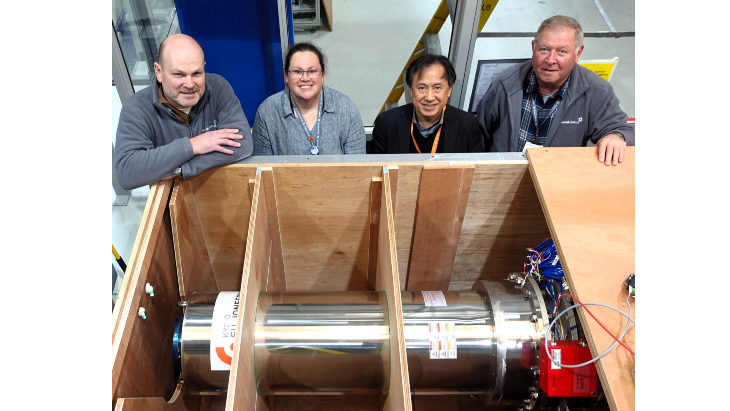
The new gyrotron will produce 1 MW of radio frequency power for Tokamak Energy over 18 months. It generates high-power electromagnetic waves for controlling and heating a hydrogen plasma to temperatures many time hotter than the sun.
Ross Morgan, director of strategic partnerships at Oxfordshire-based Tokamak Energy, said: “We’re excited to work with our partners Kyoto Fusioneering to add this important upgrade to our record-breaking fusion machine, and continue to operate ST40 to test and push new boundaries. The results from future experiments using the high-power gyrotron heating system will provide critical data to inform the design of future spherical tokamak pilot plants, on our mission to commercialise clean and limitless fusion energy in the 2030s.”
Kyoto Fusioneering’s CEO, Chief Fusioneer, and Co-Founder, Satoshi Konishi, said: “We are honoured to contribute to Tokamak Energy’s ST40, which stands as a benchmark for public-private partnerships and international collaboration. This partnership, bolstered by strong UK-Japan collaboration, represents a significant step forward in the pursuit of fusion energy. Committed to delivering world-class gyrotrons and exceptional engineering support, we look forward to working together to achieve the shared goal of clean, sustainable fusion power.”
Tokamak Energy explained that a gyrotron works by a beam of electrons travelling through a strong magnetic field, which accelerates them to the point where they emit microwave radiation which is directed through a waveguide to the plasma of fusion fuels – isotopes of hydrogen.
“The frequency of the microwaves is tuned to match the cyclotron resonance frequency of the electrons in the plasma (104GHz or 137GHz in the case of ST40). When the microwaves interact with the plasma, they transfer energy to the electrons, which heats and drives the plasma. A gyrotron, which uses Electron Cyclotron Resonance Heating, solves one of the key challenges for a spherical tokamak – limited space for a central solenoid, which would otherwise be required to induce the plasma current. A gyrotron means the central solenoid can be reduced in size.”
Tokamak Energy plans to use both its current neutral beam heating and gyrotron heating simultaneously, saying “this will build greater understanding of how a gyrotron works, the control systems needed and the best balance between the two forms of heating”.
Background
Tokamak Energy was spun out of the UK’s Atomic Energy Authority in 2009. It announced in February 2023 it was to build a prototype spherical tokamak, the ST80-HTS, at the UKAEA’s Culham Campus, near Oxford, England, by 2026 “to demonstrate the full potential of high temperature superconducting magnets” and to inform the design of its fusion pilot plant, to demonstrate the capability to deliver electricity into the grid in the 2030s, with the aim of globally deployable 500-megawatt commercial plants.
And in October it gave first details of a high-field spherical tokamak plant “capable of generating 800 MW of fusion power and 85 MW of net electricity” as part of the USA’s Bold Decadal Vision for Commercial Fusion Energy programme. It said “initial designs are for the tokamak to have an aspect ratio of 2.0, plasma major radius of 4.25 metres and a magnetic field of 4.25 Tesla, as well as a liquid lithium tritium breeding blanket”. It will include a new generation set of high temperature superconducting magnets “to confine and control the deuterium and tritium hydrogen fuel in a plasma many times hotter than the centre of the sun”.
In December it was announced that the US and UK energy departments were going to partner with Tokamak Energy for a USD52 million upgrade of the ST40 fusion facility which will coat its inner wall with lithium. The ST40, which uses applied magnetic fields to confine plasma, is privately owned and valued at more than USD100 million, the US Department of Energy said at the time of the announcement.
Tokamak Energy, in a previous partnership with the Princeton Plasma Physics Laboratory and Oak Ridge National Laboratory achieved temperatures in ST40 which were six times hotter than the sun, becoming the first private firm to reach a plasma temperature of 100 million degrees Celsius. Both laboratories will be assisting in the ST40 upgrade with their expertise, Princeton on lithium coatings and Oak Ridge on deploying pellet fuelling capabilities.