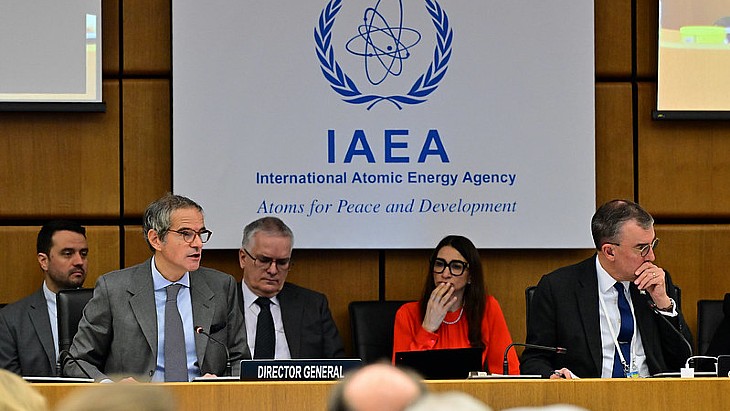
Director General Rafael Mariano Grossi, pictured above delivering his statement to the board of governors of the International Atomic Energy Agency (IAEA) on Monday, said the agency was collecting information and assessing the situation in the region, which hosts a number of nuclear sites.
He said that no elevation had been recorded in radiation levels in countries bordering Iran and “regarding the status of the nuclear installations in Iran, up to now, we have no indication that any of the nuclear installations, including the Bushehr Nuclear Power Plant, the Tehran Research Reactor or other nuclear fuel cycle facilities have been damaged or hit”.
But he added: “Efforts to contact the Iranian nuclear regulatory authorities through the IAEA’s Incident and Emergency Centre continue, with no response so far. We hope this indispensable channel of communication can be reestablished as soon as possible.”
Countries which have faced military attacks include the United Arab Emirates, which has four operating nuclear power reactors, and Jordan and Syria with operational research reactors, he said, adding: “Bahrain, Iraq, Kuwait, Oman, Qatar and Saudi Arabia have also been attacked. These countries all use nuclear applications of some sort or the other. We therefore urge utmost restraint in all military operations.”
The USA and Israel launched military strikes on Iran on Saturday. Iran has retaliated, hitting targets in various countries in the region.
Grossi said that “to achieve the long-term assurance that Iran will not acquire nuclear weapons and for maintaining the continued effectiveness of the global non-proliferation regime, we must return to diplomacy and negotiations”.
He added: “When it comes to nuclear matters, a crystal clear understanding of the scope and verifiability of an agreement is of the essence. Diplomacy is hard, but it is never impossible. Nuclear diplomacy is even harder, but it is never impossible. It is not a matter of if, but of when, we will again gather at that diplomatic table – we simply must do so as quickly as possible.
“I remain convinced that the lasting solution to this long-existing discord lies on the diplomatic table. The IAEA will be there, ready to play its indispensable part whenever it is called.”
The IAEA, he said, has been in close contact with member states in the region and has “extensive knowledge of the nature and location of nuclear and radiological material in the region, and we have clear guidance for actions necessary in case an attack or an accident causes a radiological release, as well as the ability for hands-on help if it is required”.
On Saturday, Alexei Likhachev, Director General of Russia’s state nuclear corporation Rosatom – which is building two new units at the Bushehr plant in Iran – said that they were monitoring the situation closely and 94 people – including children of employees – had been evacuated from the country.
A statement from Rosatom said: “Our employees are currently located at the Bushehr Nuclear Power Plant construction site or in the residential community. All necessary safety measures are being taken. A small group of our employees working in Tehran is concentrated on the grounds of the Russian Embassy.”