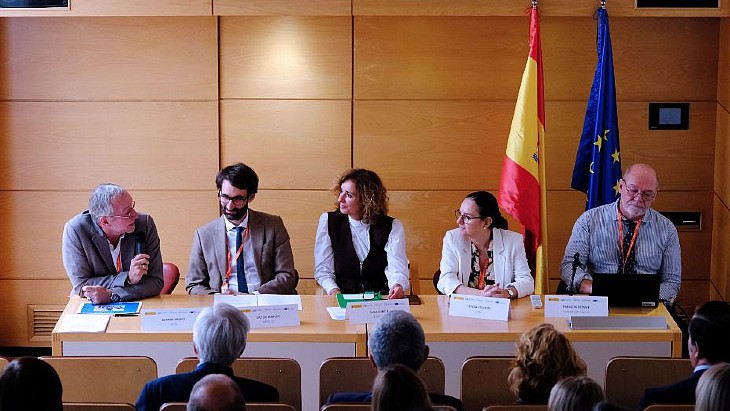
The five-day Integrated Review Service for Radioactive Waste and Spent Fuel Management, Decommissioning and Remediation (ARTEMIS) mission took place from 28 September. It consisted of international experts from Australia, France, the Netherlands, Slovenia and the UK as well as four International Atomic Energy Agency (IAEA) staff members.
Its scope was to address areas “where findings had been identified in 2018, including national policy and strategy for spent fuel and radioactive waste management, as well as financing and human resource capacities”.
It found that progress had been made by Spain in: establishing its 7th General Radioactive Waste plan; addressing the capacity of disposal of low and intermediate-level radioactive waste at the El Cabril Disposal Facility; developing a new strategy for the storage of used fuel, special waste and high-level radioactive waste; preparing a roadmap for the development of a deep geological repository; ensuring the routine review of the funding mechanisms for radioactive waste management; putting in place a strategy and mechanisms to avoid the loss of knowledge and know-how on radioactive waste and used fuel management; re-evaluating the adequacy of research and development funding needed to support the step-by-step development of the Deep Geological Disposal programme.
Victor Marcos, General Director of Energy Planning and Coordination at the Ministry for the Ecological Transition and the Demographic Challenge, which hosted the mission, said: “The outcome of the follow-up mission has been very positive: all five recommendations and the two suggestions have been closed, and, in addition, the review team has provided us with some observations that will be a good basis for future developments.”
Mission team leader François Besnus said: “The review team acknowledges the major progresses that have been made to successfully respond to the 2018 ARTEMIS mission findings and, in particular, commends Spain for the issuing of the 7th national plan for radioactive waste and spent fuel management as well as for the elaboration of a new roadmap for the development of a deep geological disposal facility.”
Background
Spain currently operates seven nuclear power reactors which produce about 20% of its electricity. Three other nuclear power plants have been closed down and are being decommissioned. Spain maintains a disposal facility for very low, low and intermediate-level radioactive waste and most nuclear power plants have interim used fuel storage facilities.
ARTEMIS missions are described by the IAEA as “an integrated expert review service for radioactive waste and spent fuel management, decommissioning and remediation programmes. This service is intended for facility operators and organisations responsible for radioactive waste management, as well as for regulators, national policy makers and other decision makers”. The follow-up mission took place at the request of Spain. The final report will be presented within three months.