Thursday, 6 February 2025
Khmelnitsky’s first reactor was connected to the grid in 1987, but work on three other reactors was halted in 1990, at a time when unit 3 was about 80% complete and unit 4 about 25%. Work on the second reactor restarted and it was connected to the grid in 2004, but units 3 and 4 remain uncompleted.
The Belene project in northern Bulgaria was for the construction of two 1000 MWe units, using Russian VVER-1000 designs. Preliminary site works began in 2008, and contracts for components including large forgings and I&C systems were signed with suppliers, but the project was stymied by financing problems and the then government formally ended plans for the project in 2023.
Since then there have been talks about Ukraine purchasing the unused Belene equipment to complete the Khmelnitsky units. International Atomic Energy Agency Director General Rafael Mariano Grossi said the agency would provide technical support and nuclear safety advice on the planned use of the Belene equipment to “help Ukraine ensure that this on-going project continues in accordance with safety standards”. Last month, the energy committee in Ukraine’s Parliament approved an amendment to allow the purchase from Bulgaria of the two unused Russian nuclear reactors destined for the Belene project.
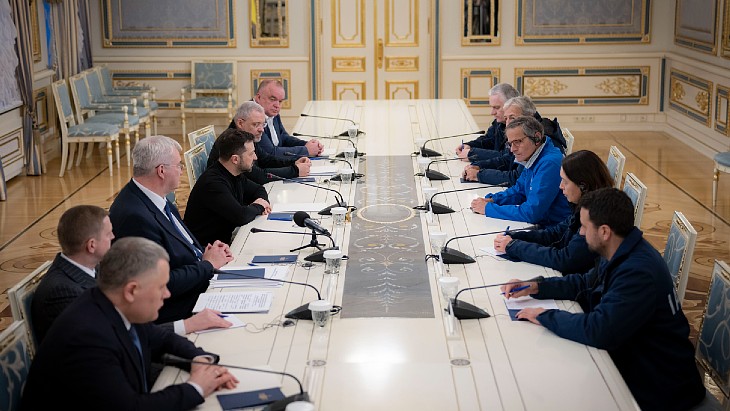
Speaking during a visit to Ukraine this week Grossi noted that a large investment had already been made with the partial construction of the two Khmelnitsky units, and described the current plan as an “interesting project” with its “efficient” suggestion of one interrupted construction project integrating technology from a discontinued project. He said the agency was ready to ensure that “if this is done there will not be a problem in terms of safety”.
He said that analytical work had already started on the specific areas where the IAEA “could provide a safety assessment” and the terms of reference.
After talks with the IAEA director general, Ukraine’s President Volodymyr Zelensky thanked Grossi for supporting the strategy for Khmelnitsky 3 and 4, saying: “The completion project is key to Ukraine’s energy independence and regional energy stability. It is crucial that Ukrainian MPs support this project.”
Westinghouse ready to supply fuel
Getting non-Russian fuel would not be an issue for the completed reactors, Energoatom said, with Westinghouse Electric Sweden Managing Director Aziz Dag confirming in a letter that it would be able to supply the necessary fuel.
“Westinghouse confirms the ability to provide a compatible fuel assembly design for the first and subsequent cycles of KhNPP-3, KhNPP-4 on the basis of the V-466V reactor in a timely manner. Given the timelines for implementing the nuclear fuel project, we recommend starting discussions on technical details and determining the scope of work on the expertise and implementation of the fuel project in the near future,” it quotes the letter as saying.
The country has been diversifying its fuel supplies in recent years and since the war with Russia began it has ended all use of Russian nuclear fuel, with Westinghouse already supplying fuel for its reactors.
Ukraine has 15 reactors generating half its electricity at four existing nuclear power plants, including the six-unit Zaporizhzhia plant which has been under Russian military control since early March 2022. The country has plans for at least nine Westinghouse AP1000 units, including two new ones at Khmelnitsky and others at the Rivne and South Ukraine plants.