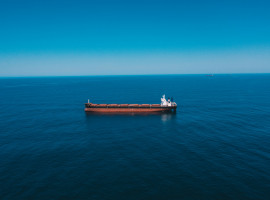
The journey took 16 days, with it passing through the River Volga, Lake Beloye, Lake Onega, and Lake Ladoga, the River Neva, and the Gulf of Finland.
_e6fca13d.jpg)
(Image: Rosatom)
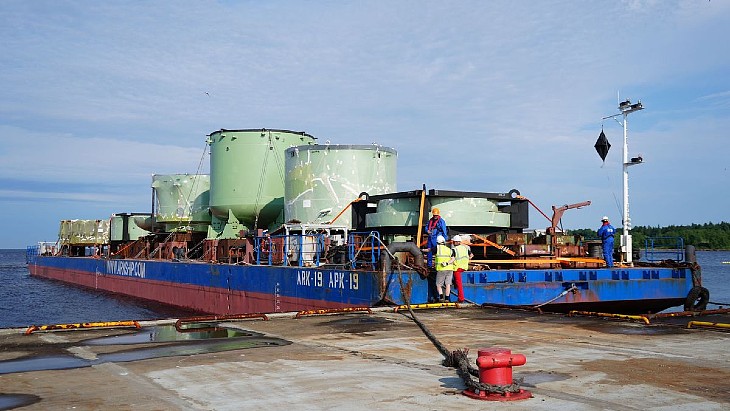
After its arrival at the pier it is being prepared to make the short journey to the Leningrad II Nuclear Power Plant construction site before its installation in the reactor shaft, scheduled for later this month.
(Image: Rosatom)
Vladimir Pereguda, Director of the Leningrad NPP, said: “We’ve set ourselves the goal of installing the core catcher vessel in the reactor shaft two months ahead of schedule. This will allow us to intensify work on this site and thoroughly prepare for the most important event for any nuclear power plant under construction – the installation of the reactor vessel. According to the schedule, this should take place in 2029.”
The core catcher, also known as a melt trap, is a key bit of safety equipment. It is a container in the form of a cone made of thermally resistant steel which in the event of an emergency is designed to securely hold the melt of the core and not allow radioactive substances to leave the containment of the reactor.
Background
The Leningrad nuclear power plant is one of the largest in Russia, with an installed capacity of 4,400 MWe, and provides more than 55% of the electricity demand of St Petersburg and the Leningrad region, or 30% of all the electricity in northwest Russia.
Leningrad 1 shut down in 2018 after 45 years of operation. Leningrad 2, also a 1,000 MWe RBMK unit, started up in 1975 and was permanently shut down in November 2020. As the first two of the plant’s four RBMK-1000 units shut down, new VVER-1200 units started up at the neighbouring Leningrad II plant. The 60-year service life of these fifth and sixth units (also known as Leningrad II-1 and Leningrad II-2) secures power supply until the 2080s, with the possibility of a further 20-year extension beyond that. Units 7 and 8 (also known as Leningrad II-3 and Leningrad II-4) will replace units 3 and 4 as they are shut in the coming years.
The pouring of the first concrete for unit 7 in March 2024 marked the start of the main phase of construction of the new power unit. The core catcher was installed last month. First concrete was poured for the eighth unit in March 2025.