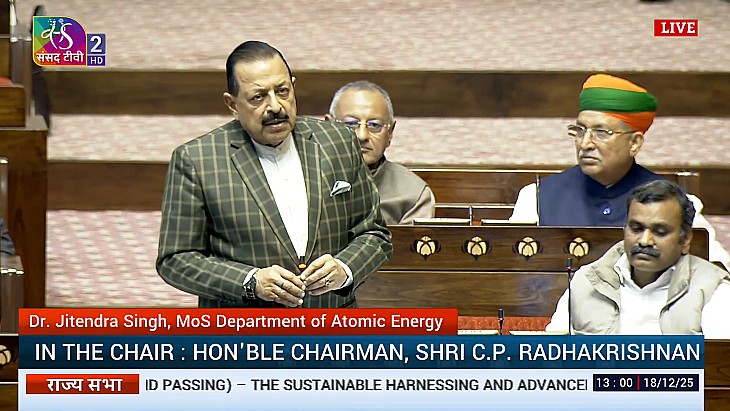
The Sustainable Harnessing and Advancement of Nuclear Energy for Transforming India Bill, 2025 – or SHANTI, for short – was tabled before the Lok Sabha on 15 December and approved by the lower house on 17 December. The bill’s approval by voice vote was not without controversy, with a walkout by opposition MPs – who had wanted the bill to be sent to either a Joint Parliamentary Committee or a Standing Committee – widely reported in the Indian press. According to the Times of India, the bill’s removal of a clause related to liability of suppliers of nuclear equipment was the main concern for opposition members.
The bill has now been presented to the upper house, the Rajya Sabha, by Minister of State Jitendra Singh, who described it as “landmark legislation” for India.
The Indian government is targeting 100 GW of nuclear power by 2047 under its Viksit Bharat development strategy with a two-pronged approach featuring the deployment of large-capacity reactors as well as small modular reactors. Participation of private-sector players is seen as a key part of this, but current legislation – the Atomic Energy Act of 1962 – prohibits private control of nuclear power generation: only government-owned enterprises Nuclear Power Corporation of India Ltd (NPCIL) and BHAVINI are legally allowed to own and operate nuclear power plants in India, and private sector companies and foreign investors are not allowed to invest directly in nuclear power.
The Civil Liability for Nuclear Damage Act of 2010 has been a second barrier, because it gives nuclear operators extensive legal recourse to equipment suppliers in the event of a nuclear incident – a feature which does not align with international nuclear liability practice.
The SHANTI bill seeks to repeal the Atomic Energy Act, 1962 and the Civil Liability for Nuclear Damage Act, 2010, and to replace them with a single, comprehensive law aligned with India’s present and future energy requirements, according to the Department of Atomic Energy.
Before becoming law, a bill must be passed in an identical form by both houses of the Indian parliament, after which it will be presented to the President of India for assent. Once presidential assent is given, the bill becomes an Act.