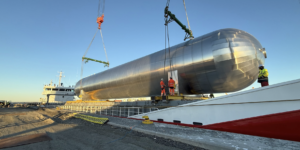
©Greensand / Carbon Destroyer 1 can hold around 5,000 tonnes of liquefied CO2 per voyage
You’ve read 1 of 1 of your free articles this month.
His Majesty King Frederik X of Denmark will officially open Greensand today – the first full-scale carbon dioxide storage site in Europe.
Greensand, funded by the EU Innovation Fund, expects to store up to 400,000 tonnes of CO2 annually in the first commercial phase at Esbjerg, scaling towards four to eight million tonnes annually at capacity.
Ineos Chairman Sir Jim Ratcliffe said Europe will not achieve net zero “by closing factories and exporting jobs”. Ineos Energy leads and operates the project (40%) as part of a joint consortium which includes Harbour Energy (40%) and Danish state-owned subsurface resource firm Nordsøfonden (20%).
“We need solutions that allow industry to remain competitive while reducing emissions,” said Ratcliffe. “Greensand proves it can be done … it is a fully operational carbon storage business. The technology works. The storage is ready. The challenge now is creating the right conditions for carbon capture to grow quickly at scale across Europe.”
Greensand received final investment decision in and construction began on the CO2 terminal in .

©Greensand
The terminal features six large holding tanks, each capable of storing approximately 1,000 tonnes of liquefied CO2 which will be shipped for permanent storage in the Greensand reservoir. Carbon Destroyer 1 can hold around 5,000 tonnes of liquefied CO2 per voyage.
Europe will need to meet carbon capture, utilisation and storage goals, according to a report from energy consultancy Xodus Group.
The number of new carbon capture and storage project announcements in Europe has , according to research from the renewables-leaning Institute for Energy Economics and Financial Analysis.
The continent is focusing heavily on carbon storage rather than carbon utilisation because permanent underground storage delivers net zero or net-negative emissions, whereas most utilisation methods release carbon back into the atmosphere.
Earlier this month Yara International officially inaugurated what it claims is Europe’s largest industrial capture and liquefaction facility at its Sluiskil plant in the Netherlands.