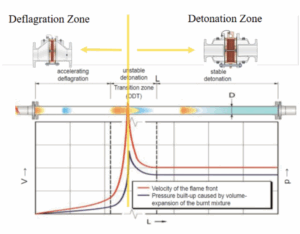
Explosive mixtures can burn in various ways. The following, among other things, can influence the combustion process: the chemical composition of the mixture, possible pressure waves, pre-compression, the geometric shape of the combustion chamber, and the flame propagation speed.
The relevant combustion processes for are defined by international standards:
Explosion is the generic term for an abrupt oxidation or decomposition reaction producing an increase in temperature, pressure, or both simultaneously [also see EN 1127-1]. Deflagration is an explosion that propagates at subsonic velocity [EN 1127-1]. Depending on the geometric shape of the combustion area, a distinction is made between atmospheric deflagration, pre-volume deflagration, and in-line deflagration.
… to continue reading this article and more, please login, register for free, or consider subscribing to gasworld