Friday, 31 January 2025
_18684.jpg)
Kairos is following an iterative approach for the development of its Fluoride Salt-Cooled High-Temperature Reactor (KP-FHR) technology. The non-power Engineering Test Unit 2 (ETU 2.0) follows ETU 1.0, a full-scale, electrically heated prototype of the Hermes reactor which carried out more than 2000 hours of pumped salt operations demonstrating the design and integration of key systems, as well as exercising the supply chain and establish new capabilities, including the production of the high-purity fluoride-lithium-beryllium (FLiBe) salt coolant.
ETU 1.0 completed operations in mid-2024. ETU 2.0 will demonstrate modular construction methods: as part of the project the company is ramping up output of ASME U-stamped pressure vessels, producing specialised reactor components, and gaining proficiency in modular construction methods.
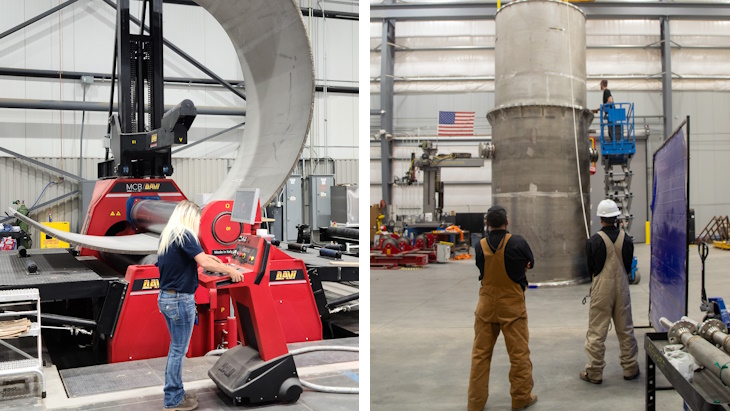
The dedicated shop for KP-FHR vessel production at Albuquerque includes large-scale plate-rolling, cutting, automated welding and machining capabilities. (Image: Kairos Power)
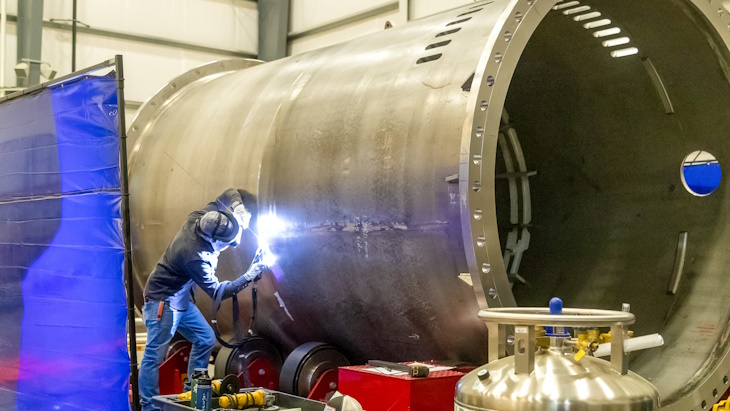
Kairos Power has established a dedicated shop in its Albuquerque facility for KP-FHR vessel production. Its in-house engineering, procurement, and manufacturing teams collaborated closely in the project to deliver the ETU 2.0 reactor vessel, enabling key learnings that will carry forward to future iterations, the company said. The company is minimising outsourced production of specialised components under its vertical integration strategy, aiming for 80% of ETU 2.0 costs to derive from raw materials or commercial off-the-shelf parts which it says gives better control over product cost, quality, and schedule.
Kairos Power co-founder and CEO Mike Laufer described the completion of the ETU 2.0 vessel as a “monumental achievement” for the company, illustrating the synergy between its rapid iterative development approach and vertical integration strategy. “We are systematically building the capabilities and know-how to self-produce major reactor components over multiple iterations – an investment that will ultimately lower costs for the commercial fleet,” he said.
(Image: Kairos Power)
The KP-FHR is one of five technologies selected in 2020 to receive federal funding for risk reduction projects under the US Department of Energy’s Advanced Reactor Demonstration Program, with the department investing up to USD303 million in the Hermes reactor project. The DOE ETU 2.0 reactor vessel is a contract milestone under that investment agreement.
ETU 2.0 will be followed by a third non-nuclear iteration, ETU 3.0, which will be built adjacent to the site in Oak Ridge, Tennessee, where the Hermes Low-Power Demonstration Reactor will be built. Both ETU 3.0 and Hermes will use reactor modules fabricated at the Albuquerque facility.
Hermes is the first non-light-water reactor to be permitted in the USA in over 50 years. It will not produce electricity, but Hermes 2 – a two 35 MWt-unit plant for which the US Nuclear Regulatory Commission issued a construction permit in November – will include a power generation system.
A deal signed in October by Kairos and Google will support the first commercial deployment of Kairos Power’s reactor by 2030, with multiple reactors supplying clean electricity to Google data centres through power purchase agreements.