By
33 min ago 3 min read
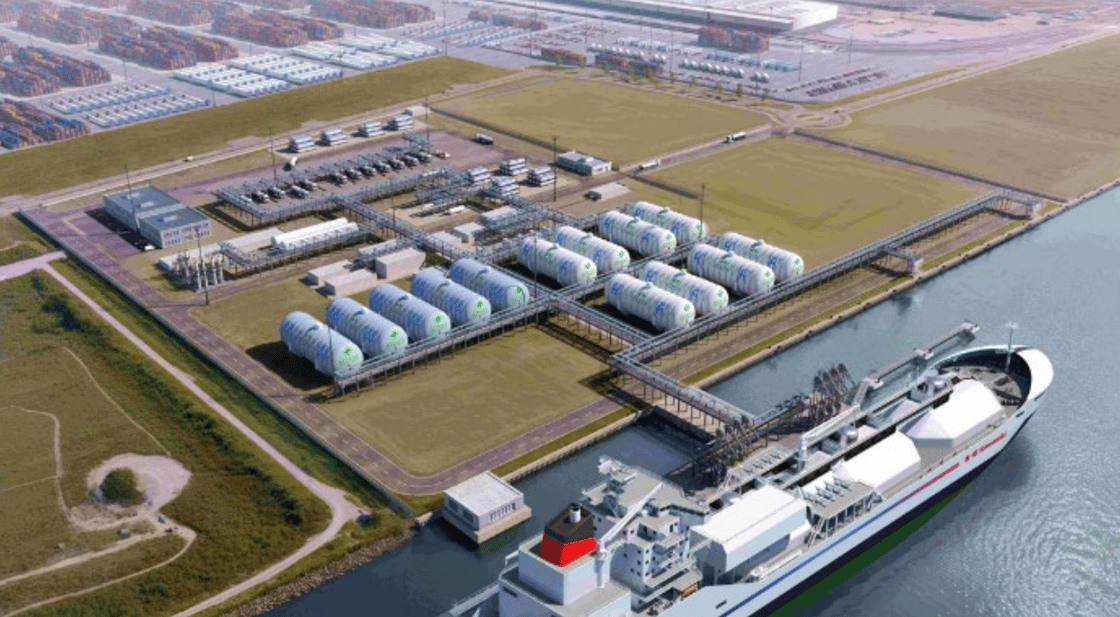
Kawasaki Heavy Industries and carbon shipping company EcoLog have partnered on midstream liquid hydrogen (LH2) transport activities to bring supplies of the molecule to the Port of Amsterdam.
The partnership targets operations spanning liquefaction, storage, and transport to connect hydrogen producers in the Middle East, Europe, and South America with demand centres across Europe.
KHI will provide carrier technology, transfer systems, and terminal infrastructure, while EcoLog is expected to own and operate the equipment and commercialise the hydrogen.
It comes after EcoLog awarded engineering company KBR front-end engineering design contract for its planned LH2 and liquid carbon dioxide (CO2) terminal in the Port of Amsterdam.
It could handle up to 200,000 tonnes of LH2 and 1.8 million tonnes of liquid CO2 per year, with the potential for scaling up to 600,000 and 4.25 million tonnes, respectively.
EcoLog is also part of a looking to import LH2 to the port from Oman’s Port of Duqm, where state-backed green hydrogen projects are being developed.
While imports are a key part of the EU’s clean hydrogen strategy, long-distance trade of the molecule remains complicated.
In March, the Port of Rotterdam said market consultation with companies looking to set up hydrogen import infrastructure suggested most would not begin operations by 2030 due to demand uncertainty, permitting, and grid constraints.
While proponents argue that LH2 offers efficiency advantages over carriers like ammonia, transporting it over long distances is technically and economically challenging due to the extremely low temperatures (–253ºC) it must be kept at to avoid potential boil-off.
However, speaking at the World Hydrogen Summit this week, Oman’s energy minister, Salim Al Aufi, said he believed LH2 would eventually become the primary method of shipping hydrogen over long distances.
“In my opinion, liquid hydrogen is probably going to be the future,” he said.
“Ammonia is good, ammonia is needed to transition, but if we are to move energy…it’s probably going to be liquid hydrogen.”
He argued that while expensive today, it could be the “only viable scale option.”
Gain access to the insights, data, and analysis trusted by hydrogen professionals worldwide.
With a H2 View subscription, you get:
- Unlimited access to 15,000+ articles
- Monthly digital magazine + H2 Review
- Exclusive interviews, webinars and reports
- Expert analysis shaping the hydrogen conversation