In an update outlining its first year of operation, the agency highlighted its development of a strategy for the nuclear industry to 2050 and the selection of Russia’s Rosatom as the leader of an international consortium to build the country’s planned new plant, to be named Balkash and located in the Zhambyl district of the Almaty region.
It said “the main stage of field research has been completed: geophysical work has been carried out, 60 wells have been drilled, about 1,000 soil and water samples have been taken for laboratory analysis, and hydrogeological studies have been conducted”.
Work was also taking place towards a second and third nuclear power plant in the country, with the Zhambyl district designated as the location for the second plant and “issues of possible partnership with Chinese companies” being worked out.
It stressed its close collaboration with the International Atomic Energy Agency in developing the nuclear power programme, saying: “The plan provides for the development of new regulatory documents, as well as updating the existing framework regulating the entire life cycle of nuclear power plants – from design to decommissioning.”
There had also been a new mechanism approved to use 1% of the costs of uranium production to finance scientific research.
“In 2026, it is planned to move to the next stage of the implementation of the nuclear programme. Among the priorities are the signing of intergovernmental agreements with the Russian Federation on the construction project of the Balkhash NPP, the signing of an EPC (engineering, procurement and construction) contract, approval of the industry development strategy until 2050, adoption of a law on working with radioactive waste, as well as further development of international cooperation, isolation of production and personnel training,” the update concluded.
Uranium outlook
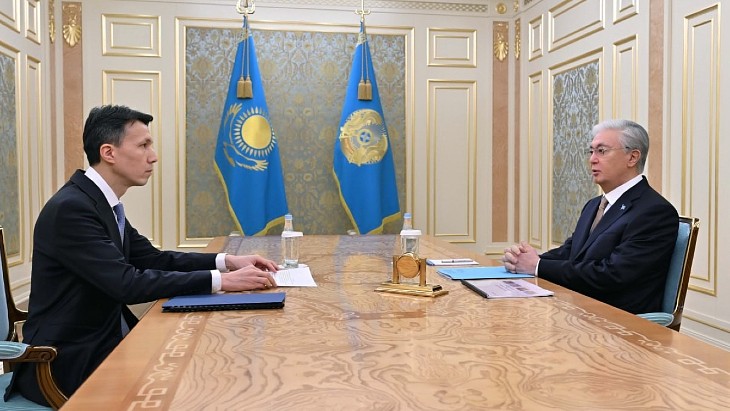
This week also saw Meirzhan Yussupov, CEO of Kazatomprom, update Kazakhstan President Kassym-Jomart Tokayev on the company’s performance, saying that uranium production in 2025 had been 25.8 thousand tonnes and, according to the company’s report, that “despite geopolitical turbulence, the company continues to deliver on its contractual obligations in full and ensures uninterrupted global uranium supplies”.
It added that Yussupov “emphasised that in accordance with the directives of the Head of State, the company is continuing its efforts on geological exploration and strategic expansion of the nation’s mineral resource base. Kazatomprom has established a portfolio of six new prospective uranium areas … spanning an aggregate area of more than 1,000 square kilometres, with total exploration investments projected at KZT75-85 billion (USD156-175 million) through 2030”.
By the end of 2025, consolidated sales volume across the Group had increased by 11%, reaching 18,500 tonnes and, it said, in accordance with the company’s 2025-2034 strategy, Kazatomprom was actively expanding its footprint across new markets and had secured uranium supply agreements with European utilities Axpo Power AG, of Switzerland, and ČEZ Group, Czech Republic, and Kansai Electric Power, from Japan. “Efforts are currently under way to finalise a long-term agreement for the supply of natural uranium concentrates to India,” the report added.
Background
Kazakhstan is the world’s leading producer of uranium. Although it does not currently use nuclear energy, it is not without nuclear experience: it has three operating research reactors, and a Russian-designed BN-350 sodium-cooled fast reactor operated near Aktau for 26 years, until 1999.
Kazakhstan has been preparing for a possible nuclear power programme to reduce its reliance on fossil fuels, diversify its energy mix and reduce CO2 emissions for some time. Kazakhstan Nuclear Power Plant (KNPP), a subsidiary of Kazakhstan’s Samruk-Kazyna National Welfare Fund JSC, was set up in 2014. In a referendum in 2024 more than 70% of the 7.8 million people who voted answered ‘yes’ to the question: “Do you agree with the construction of a nuclear power plant in Kazakhstan?”
As well as the proposed large-scale nuclear power plants there are also options for using small modular reactors to replace retiring coal plants in the years to come – the government has had a target for nuclear to produce a 5% share of the national generation mix by 2035.