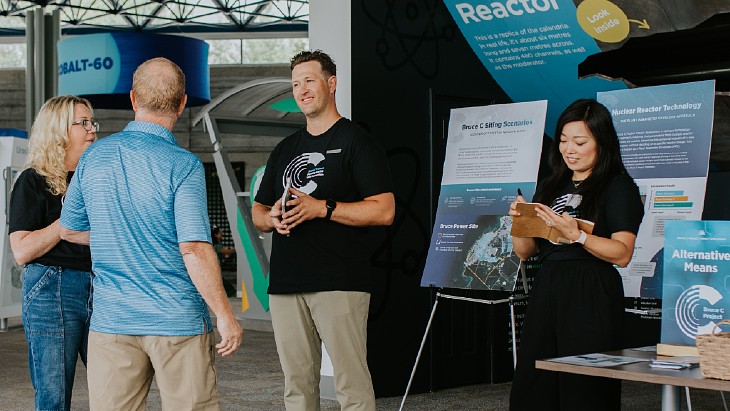
There are five stages to the Impact Assessment process. The planning phase “defines the scope of the project and provides opportunities for Indigenous people and the public to identify area of interests for the project and contribute to planning the assessment”.
It also involved establishing a baseline of existing socio-economic, health and environmental data.
The next stage was started on 19 August when the Impact Assessment Agency of Canada, in collaboration with the Canadian Nuclear Safety Commission, issued the formal Notice of Commencement of Impact Assessment under the country’s Impact Assessment Act.
In the Impact Statement phase, Bruce Power said it will: document existing conditions; include Indigenous knowledge and community knowledge where provided; assess potential positive and negative effects of the project; identify ways to mitigate possible negative effects and enhance the beneficial effects of the proposed project; understand cumulative impacts through Cumulative Effects Assessment; and continue to engage with Indigenous Nations and Communities, municipalities and the public.
It added that it would “leverage the requirements identified in the Tailored Impact Statement Guidelines and conduct the assessment to evaluate the potential environmental, health, social, and economic effects of the Bruce C Project, as well as impact to Indigenous rights”.
The federal government announced CAD50 million (USD36 million) of funding in February last year to support pre-development work to study the feasibility of building 4800 MWe of new generating capacity at the Bruce site in Ontario.
The multi-year federal impact assessment process including Indigenous and public engagement, environmental and socioeconomic studies, and permitting activities provides a planning tool to evaluate the potential for the Bruce C project. Although no decision has yet been made to advance a new build, it is seen as an important step to support future electricity planning and allow faster execution should a decision to proceed be made.
Weina Chong, Bruce Power Director of Regulatory Affairs, Bruce C, said: “The Bruce C Project represents a generational opportunity to support Ontario’s clean energy future. By leveraging the existing Bruce Power site, we aim to provide a high-value option for expanding nuclear capacity in a way that is safe, sustainable, and aligned with Ontario’s Integrated Energy plan, Energy for Generations.”
Bruce Power previously applied for a licence to prepare for construction of up to four new reactors – totalling up to 4000 MWe – in 2007, but withdrew its application in 2009 as the company focused on the refurbishment of the existing eight Bruce A and B units. Those refurbishment projects are generating 22,000 direct and indirect jobs, and CAD3-4 billion in GDP in Ontario and CAD8-11 billion in Canada.
With nuclear currently responsible for 50% of Ontario’s total generation and hydro contributing 24%, Ontario already has one of the cleanest grids in the world and the Energy for Generations plan published in June sees nuclear power – including required new capacity – “continuing to serve as the backbone of the province’s electricity system providing the 24/7 baseload power the province’s economy requires” as demand continues to rise.